


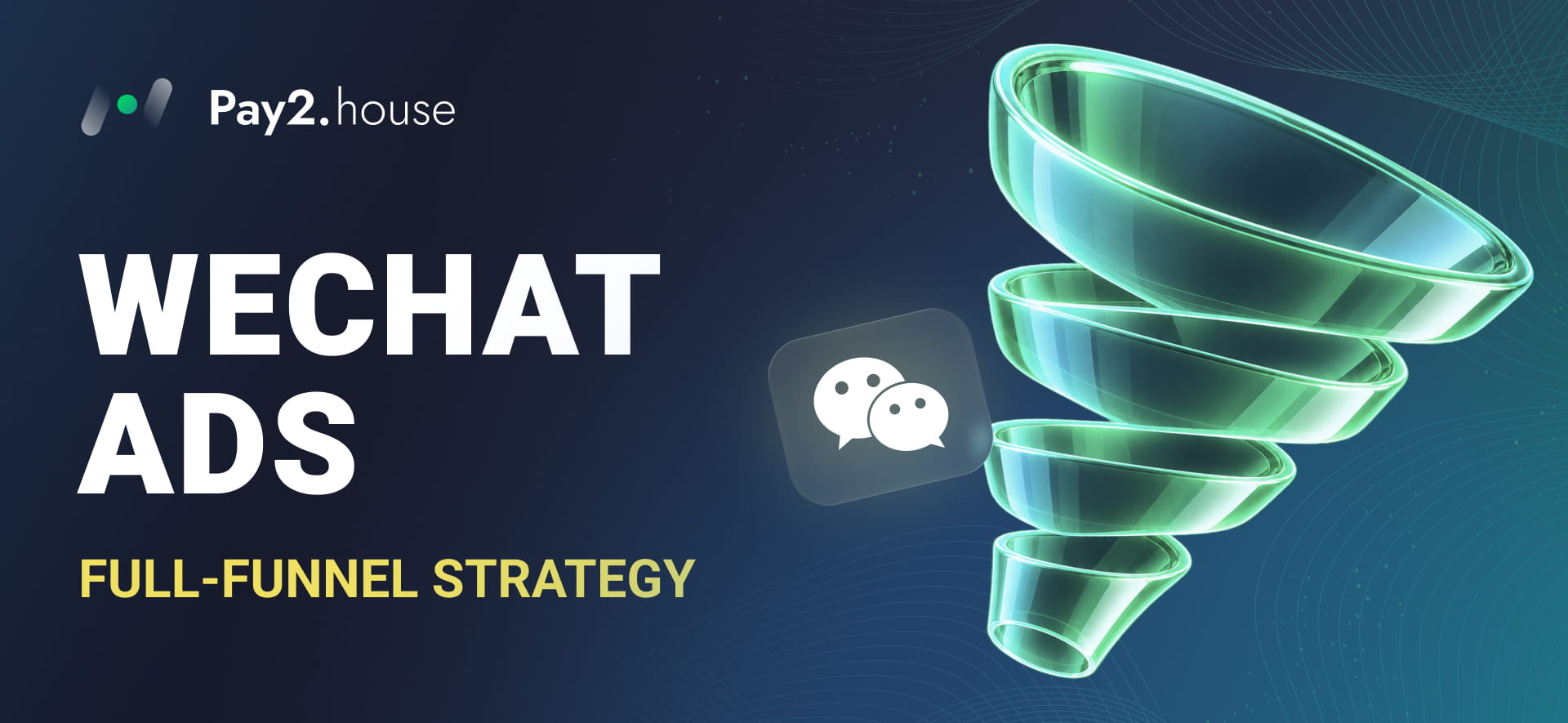
In many Western markets, an ad journey spans several disconnected tools: a social ad, an external landing page, a CRM, email and a third-party checkout. Each handoff can add friction and make measurement harder.
For campaigns aimed at mainland China and Chinese-speaking audiences, WeChat offers a different model: discovery, content, conversation, Mini Programs and payments can be connected inside one ecosystem. That does not make every journey automatic or friction-free, but it can reduce unnecessary handoffs when the account, content and commerce setup are eligible and well designed.
According to Tencent's results for the quarter ended June 30, 2026, combined monthly active users of Weixin and WeChat reached 1.439 billion. This figure describes the combined global user base; campaign reach, available placements and commercial eligibility still depend on market, account type and Tencent policy.
A full-funnel strategy therefore means coordinating paid reach, owned content, sales conversations, conversion and post-purchase service—and measuring where users actually progress or drop out.
1. WeChat full-funnel architecture
WeChat can keep several stages of the customer journey within the same ecosystem, but performance is not guaranteed. Results depend on audience fit, creative quality, account eligibility, Mini Program experience, measurement and compliance.
| Funnel Stage | Key Tools & Placements | Primary Goal & User Action |
|---|---|---|
| Top of Funnel (TOFU) Brand Awareness | Moments Ads (Feed) Channels Ads (Video/Streams) Official Account Ads (Banners) | First contact with the audience, building awareness, ad click |
| Middle of Funnel (MOFU) Nurturing & Lead Gen | Official Account (Brand Blog) WeCom (Personal Chat) Private Community Groups | Converting into "Private Traffic", 1-on-1 consultation, building trust |
| Bottom of Funnel (BOFU) Conversion & Purchase | Mini Programs (In-app Store/App) WeChat Pay (Instant Checkout) | Order placement, registration, or balance top-up in one tap |
| Retention & LTV Retention & Repeat Sales | Service Push Notifications VIP Support Chats Referral Programs | Repeat purchases, reducing churn, organic recommendations |
Top of Funnel (TOFU): Building Awareness & Reach
The Tencent Ads engine allows advertisers to engage audiences across key placements:
- Moments Ads: Native ads directly in the user’s personal social feed (video, interactive cards, galleries).
- Channels Ads: Video feed and live stream ads (similar to TikTok / Reels). One of the fastest-growing formats for e-commerce and B2B services.
- Official Account Ads: Banner ads and embedded text blocks inside articles by popular publishers and influencers.
Middle of Funnel (MOFU): Converting Traffic into "Private Traffic"
The main objective after the initial click is to move users from paid channels into a brand-owned environment where ongoing communication is free:
- Official Accounts: Brand hubs used to publish articles, announcements, and service updates.
- WeCom: A tool for B2B sales, SaaS, and fintech products that routes prospects directly to a dedicated manager for 1-on-1 consultations.
Bottom of Funnel (BOFU): Instant Conversion
- Mini Programs: Full-featured web applications that launch inside WeChat in fractions of a second without installation.
- WeChat Pay: One-tap payments using Face ID or PIN code, removing the need to manually enter card details.
2. Pay2.House in the team's payment operations
Pay2.House should be treated as payment infrastructure for the advertising team—not as a native component of WeChat Ads and not as a guaranteed way to fund Tencent Ads directly.
Practical uses for a media-buying team
- Separate operating budgets: issue dedicated virtual cards for eligible agency invoices, hosting, CDN and security services such as Cloudflare, proxies, analytics or content tools so costs can be tracked by project.
- Control spending: apply card-level or project-level limits and monitor transactions from one workspace.
- Manage team access: grant only the permissions each team member needs; the exact access options shown in the account are the source of truth.
- Use supported funding methods: rely on the top-up methods currently available in the Pay2.House account rather than assuming a specific network or currency is supported.
Important: merchant acceptance, issuer rules, geography and contract terms may differ. Confirm in advance whether a card can be used for a particular agency or service. Pay2.House does not guarantee acceptance by Tencent or an agency, approval of ads, or bypass of platform moderation.
3. Retention and LTV measurement
Relevant, permission-based follow-up can reduce reliance on repeated paid acquisition, but retention gains are not automatic. Treat the outcomes in the table below as objectives to test, then measure repeat-purchase rate, unsubscribe rate, support resolution and incremental revenue.
| Stage | In-Ecosystem Action | Result |
|---|---|---|
| Post-Purchase | Automated service notification via Official Account | Transaction confirmation, increased trust |
| Repeat Purchase | Push notification with a discount inside Mini Program | Incentivizing recurring sales |
| VIP Support | Direct messaging via WeCom | Personalized issue resolution, lower churn |
| Organic Growth | Referral links and shareable coupons in Mini Programs | Low-cost acquisition via social sharing |
4. Practical full-funnel example
Consider a skincare brand selling to consumers in mainland China:
- Reach: launch localized, policy-compliant video and feed creatives in Channels and Moments for a clearly defined Chinese audience.
- Engagement: send interested users to an Official Account article or a fast Mini Program landing page. Tag each placement so the team can compare qualified visits, not only clicks.
- Consideration: retarget eligible engaged audiences and offer an opt-in route to product guidance through an Official Account or WeCom conversation.
- Conversion: let eligible users complete the purchase in the Mini Program with WeChat Pay, after testing load time, product information, checkout and event tracking.
- Retention: send service notifications and optional follow-up offers only where the user has given the required consent; compare repeat purchases by source and cohort.
- Team finance: use separate Pay2.House cards and limits for eligible agency invoices and supporting tools. Keep these expenses distinct from Tencent billing and verify card acceptance before use.
The team should review reach, qualified-visit rate, Mini Program completion, cost per acquired customer, repeat purchase and support outcomes. A weak step is a testing signal, not proof that the whole ecosystem works or fails.
5. WeChat Ads campaign readiness checklist
- Eligibility: verify advertiser, entity and industry requirements with current Tencent documentation or an authorized partner; requirements vary.
- Audience and localization: define the China or Chinese-speaking segment precisely and adapt Simplified Chinese copy, visuals, offers and service flows.
- Funnel assets: test the relevant Official Account, WeCom, Mini Program and WeChat Pay journey on real devices.
- Measurement: configure permitted in-platform events, campaign tags and cohort reporting before scaling.
- Payment operations: separate team budgets and use Pay2.House only for eligible expenses after checking merchant acceptance and account terms.
- Governance: document owners, approval steps, access permissions and spending limits without relying on unverified role names.
6. Compliance and legal considerations
WeChat advertising requirements vary by advertiser location, industry, placement and offer. Restricted categories may require additional documentation or licences. Misleading claims, cloaking or prohibited targeting can lead to rejection, limits or suspension, but the exact outcome is determined by Tencent's current rules and review process.
When a Mini Program or sales flow collects personal information, assess the applicable requirements, including China's Personal Information Protection Law (PIPL), consent, data minimization, retention and privacy notices. Obtain local legal advice when needed; this article is not legal advice.
Summary
WeChat Ads can support a connected funnel for mainland China and Chinese-speaking audiences when paid reach, content, WeCom conversations, Mini Programs, WeChat Pay and measurement are deliberately coordinated. Pay2.House belongs in the team's external payment and expense-management layer. It is not part of WeChat Ads and cannot guarantee direct ad-account funding, acceptance or campaign approval.

 Telegram
 Email

Be the first to share your opinion!
We value your feedback — share your thoughts.