


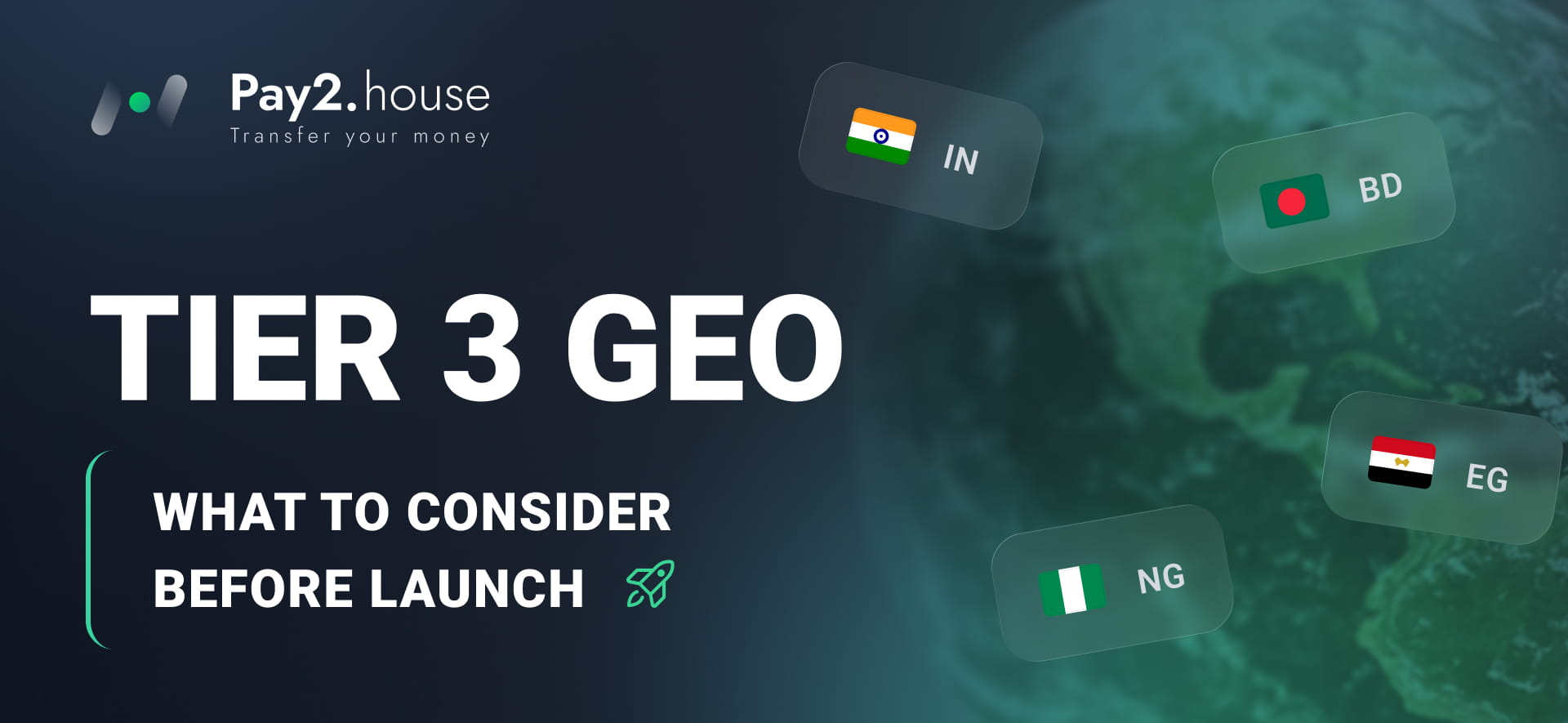
Tier 3 often attracts advertisers with the opportunity to acquire traffic at a lower cost. In such markets, a test budget can potentially buy more clicks or impressions and gather initial data much faster.
However, the low cost of incoming traffic alone says nothing about the campaign's final outcome.
A cheap click may be accompanied by a lower conversion rate, lower revenue per user, or a weak offer-to-audience fit. As a result, a GEO with the lowest CPC will not necessarily deliver the lowest CPA or the best overall campaign economics.
As with Tier 1 and Tier 2, Tier 3 is not an official classification of countries. The composition of this group varies depending on the source, vertical, and the team's methodology. Therefore, a Tier should be used as an initial reference point when selecting markets, rather than as a forecast of campaign performance.
Let's look into which countries are typically categorized as Tier 3, what makes accessible traffic appealing, and what is especially important to evaluate after the click.
Which Countries Belong to Tier 3?
In digital marketing, Tier 3 often includes markets that are considered in advertising practice to be less competitive and more affordable in terms of traffic costs compared to parts of Tier 1 and Tier 2 GEOs.
Depending on the classification, this group often includes, for example:
- India;
- Pakistan;
- Bangladesh;
- Indonesia;
- Vietnam;
- Philippines;
- Nigeria;
- Kenya;
- Egypt;
- other countries across Asia, Africa, and Latin America.
However, there is no universal list for Tier 3.
Furthermore, the markets within this category differ significantly from one another. India, Nigeria, Vietnam, and Egypt all have distinct linguistic, payment, cultural, and user contexts.
Even within a single country, advertising costs can vary widely depending on the audience, vertical, placement, seasonality, and advertising platform.
Therefore, viewing Tier 3 simply as a synonym for "cheap traffic" is inaccurate. Real costs and audience quality must always be tested at the level of a specific campaign.
If you are still choosing between different market categories, check out our comparison in the article "How to Choose a GEO for Traffic Arbitrage: Where to Start and What to Pick".
A Cheap Click Does Not Mean a Cheap Conversion
The primary appeal of Tier 3 is straightforward: if impression or click costs are lower, a team can potentially generate a much larger volume of incoming traffic within the same budget.
However, this is precisely where it is easy to draw the wrong conclusion and assume that cheaper traffic automatically means cheaper results.
Let's look at an illustrative example.
A team tests two GEOs with an identical budget of $500.
| Metric | GEO A | GEO B |
|---|---|---|
| CPC | $0.20 | $0.80 |
| Spend | $500 | $500 |
| Number of Clicks | 2,500 | 625 |
| CR | 1% | 5% |
| Estimated Conversions | 25 | 31.25 |
| Estimated CPA | $20 | $16 |
All values in the example are hypothetical and used solely to demonstrate the logic.
At first glance, GEO A appears far more attractive: a single click costs $0.20 compared to $0.80, and for the same budget, the team receives four times more visits.
However, the higher conversion rate of GEO B completely changes the picture.
Despite more expensive incoming traffic, the estimated CPA here is $16 versus $20 in GEO A.
In this example, a click that is four times more expensive results in a lower cost per target action.
And that is even before factoring in the revenue generated from each conversion.
Therefore, when evaluating Tier 3, you need to look at the entire chain:
CPM/CPC → CTR → CR → CPA → Revenue or Payout → Final Unit Economics
The cost of incoming traffic is merely the first step.
What This Means in Practice
| Characteristic | What It Means for the Team |
|---|---|
| Traffic in certain GEOs can be cheaper | You can gain more impressions and clicks within the same budget |
| High volume of incoming traffic | Quality must be evaluated separately after the click |
| Conversion rates vary drastically across markets | Decisions should not be based solely on CPC or CPM |
| User income and behavior differ | The offer must match the specific audience |
| Strong linguistic and cultural differences | Thorough localization is required |
| High volume of concurrent tests | Budgets, accounts, and payments must be structured in advance |
The primary advantage of Tier 3 is not guaranteed "cheap customers," but the opportunity in specific GEOs to acquire a large volume of incoming traffic for a relatively small budget.
The team's challenge is to determine whether this traffic is high quality and capable of progressing through the entire funnel to the desired business outcome.
1. Leverage Traffic Volume to Test Hypotheses
If the chosen Tier 3 GEO truly provides cheaper traffic, the team can gather more data within a limited budget.
This provides an opportunity to test:
- multiple creative approaches;
- different ad formats;
- isolated target audiences;
- landing page variations;
- different advertising angles and copy.
However, a large volume of cheap clicks should never become the goal in itself.
For instance, a campaign funnel might demonstrate:
High Impressions → High CTR → Many Cheap Clicks → Low CR → High CPA
In this scenario, the top of the funnel looks healthy, but users drop off immediately after the click.
Simply increasing the budget will not resolve the issue—it will merely buy more cheap clicks.
Therefore, when testing Tier 3, it is far more valuable to use the extra traffic volume for funnel diagnostics: identifying at which stage users drop off and which hypothesis genuinely needs adjustment.
2. Look Beyond the First Conversion
When working with low-cost traffic, it is crucial not to limit analysis to the metric closest to the click.
For example, a campaign might generate affordable:
- registrations;
- inquiries/form submissions;
- app installs;
- leads.
However, this is insufficient if the actual business outcome occurs further down the line.
Depending on the vertical, the funnel might look like this:
Click → Registration → Qualified Lead → Purchase / Deposit / Target Action → Revenue
Suppose two GEOs show an identical CPA for user registration. In one GEO, a high percentage of users subsequently complete the target action, while in the other, the vast majority drops off after the first step.
At the registration stage, both markets look identical. At the final outcome stage, they do not.
Before launching, determine in advance which metric genuinely reflects traffic quality.
This could be the cost of a qualified lead, purchase, first-time deposit, or another target action depending on your campaign model.
This prevents the team from optimizing ads solely for a large volume of cheap top-of-funnel events.
3. Ensure Offer-to-Audience Fit
The cost of advertising is only one component of the unit economics.
Equally critical is how well the product or offer aligns with the selected market.
Between different countries, there can be substantial variations in:
- user income levels;
- purchasing habits;
- availability of preferred payment methods;
- average order value (AOV);
- attitude toward recurring subscriptions;
- popularity of specific products and services;
- price sensitivity.
An offer that performs well in Tier 1 or Tier 2 will not necessarily maintain the same performance when ported to Tier 3.
For instance, lower advertising costs will not compensate for a product price point that is out of reach for a major portion of the target audience.
In another case, users might want the product, but their everyday payment method is missing on the landing page.
Before launch, evaluate the mechanics of the offer itself alongside potential traffic costs:
Offer → Price → Payment Method → Value Proposition → Probability of Target Action
The better the offer fits the local market, the higher the likelihood that the advantage of cheaper traffic carries through the rest of the funnel.
4. Localization Is Paramount
Tier 3 encompasses a massive number of markets with diverse languages, payment habits, and cultural backgrounds.
Consequently, a single universal creative can rarely serve as an effective strategy across the entire tier.
Localization may include:
- ad copy language;
- local idioms and phrasing;
- currency;
- pricing formats;
- visual assets and imagery;
- calls to action (CTAs);
- landing pages;
- familiar payment gateways;
- cultural nuances in communication.
Machine translation only addresses part of the equation.
An ad can be grammatically correct but rely on unnatural phrasing, display the wrong currency, or feature imagery that performs poorly with local audiences.
Whenever possible, have localized assets reviewed by a native speaker or a media buyer familiar with that specific GEO.
Do not automatically transfer findings across borders. A successful test in India provides no guarantee of how the same funnel will perform in Vietnam or Nigeria.
5. Monitor Traffic Quality During Scaling
Suppose a test yields positive results.
A common mistake is to sharply increase the budget simply because traffic remains relatively inexpensive.
During scaling, the ad platform begins targeting a broader audience. Simultaneously, multiple factors fluctuate:
- ad frequency;
- audience composition;
- distribution across placements;
- creative fatigue;
- CPC or CPM;
- CR;
- CPA.
Therefore, the assumption that:
Cheap Traffic + Larger Budget = Proportionately Greater Results
rarely holds true in practice.
When scaling volume, verify not only that CPC remains low, but that downstream user quality does not deteriorate.
After any significant budget increase, re-evaluate:
- CPC/CPM;
- CTR;
- CR;
- CPA;
- total target actions;
- quality of completed actions;
- revenue;
- overall campaign economics.
If clicks increase while the proportion of quality conversions drops, scaling quickly becomes economically unjustified—even if initial traffic remains cheap.
6. Prepare Payment Infrastructure
In Tier 3, payment pressure does not necessarily arise from high costs per click or expensive individual campaigns.
Instead, accessible traffic often encourages teams to launch more concurrent tests, GEOs, ad accounts, and unique hypotheses.
The complexity shifts from the cost of a single campaign to managing numerous parallel operations and tracking multi-account budgets.
For example, a team might simultaneously:
- test multiple countries;
- run separate ad accounts for distinct GEOs;
- distribute budget across numerous hypotheses;
- work with multiple currencies;
- involve several media buyers in campaign launches.
In this environment, it is best to establish beforehand:
- which cards fund specific accounts;
- the exact budget allocated per GEO;
- which currencies the team needs;
- who oversees spend limits;
- how funds are assigned among team members;
- fallback procedures if an individual card payment declines.
Pay2.House enables teams to issue virtual cards for advertising and online services, manage multi-currency accounts, and monitor transactions from a single interface. The platform also features built-in team management and customizable access permissions.
This keeps billing operations streamlined as ad accounts and test volumes multiply.
A payment provider does not enhance cheap traffic, boost conversions, or alter ad auction dynamics on its own. Its purpose is different: to eliminate billing bottlenecks while the team tests or scales active campaigns.
When Is Tier 3 Not the Best Choice?
Tier 3 does not have to be the default launchpad. If your budget is minimal, the offer's unit economics are untested, or the team is exploring an unfamiliar vertical, the expense of testing multiple angles can still present significant risk.
In such cases, compare several GEOs and evaluate:
- testing costs;
- potential payout;
- competition levels;
- audience characteristics;
- available test budget;
- potential for subsequent scaling.
Use Tiers as an initial guideline. Base your launch decision on actual numbers from your specific campaign: traffic cost, potential payout, expected conversion rate, and available working capital.
Tier 2 vs. Tier 3: Which to Choose?
Tier 2 and Tier 3 should not be viewed simply as "expensive vs. cheap."
These groups offer distinct dynamics suited for different goals.
| Factor | Tier 2 | Tier 3 |
|---|---|---|
| Traffic Cost | Moderate in certain GEOs | Significantly lower in some GEOs |
| Primary Risk | Picking a market based on broad tiers without verifying unit economics | Mistaking high volumes of cheap traffic for high-quality users |
| Key Focus | CPA, revenue, and scaling potential across GEOs | Post-click quality and downstream funnel stages |
| Localization | Essential for each specific market | Crucial due to pronounced linguistic and cultural diversity |
| Scaling | Heavily dependent on market size and economics of the specific GEO | Requires strict quality control as volume rises |
| Core Testing Objective | Identify an optimal balance of cost, conversion rate, and volume | Verify whether cheap incoming traffic converts into tangible business results |
For more details on Tier 2 characteristics, read our article "Tier 2 GEO: Which Countries Are Included, Why They Are Attractive for Ads, and What to Check Before Launch".
Base your choice between Tier 2 and Tier 3 on hard testing data:
Traffic Cost → Conversion Rate → Target Action Quality → CPA → Revenue → Scaling Potential
Conclusion
The primary advantage of Tier 3 is not guaranteed low-cost customers or massive profits, but the ability to purchase high traffic volumes at a relatively low initial price.
This is exceptionally useful for rapid hypothesis testing and data collection.
However, low CPC or CPM is only the entrance to the funnel.
What matters is what happens downstream: does the user convert, complete the target action, and provide acceptable campaign ROI?
Before launching in Tier 3, review the offer, target GEO, localization, test budget, and core success metrics. After launch, track not only click volume and CPC, but also CR, CPA, conversion quality, and final revenue.
This ensures scaling decisions are driven by actual performance data, rather than the assumption that Tier 3 is simply cheap traffic.



 Telegram
 Email








¡Sé el primero en compartir tu opinión!
Valoramos tus comentarios. Cuéntanos qué piensas.