


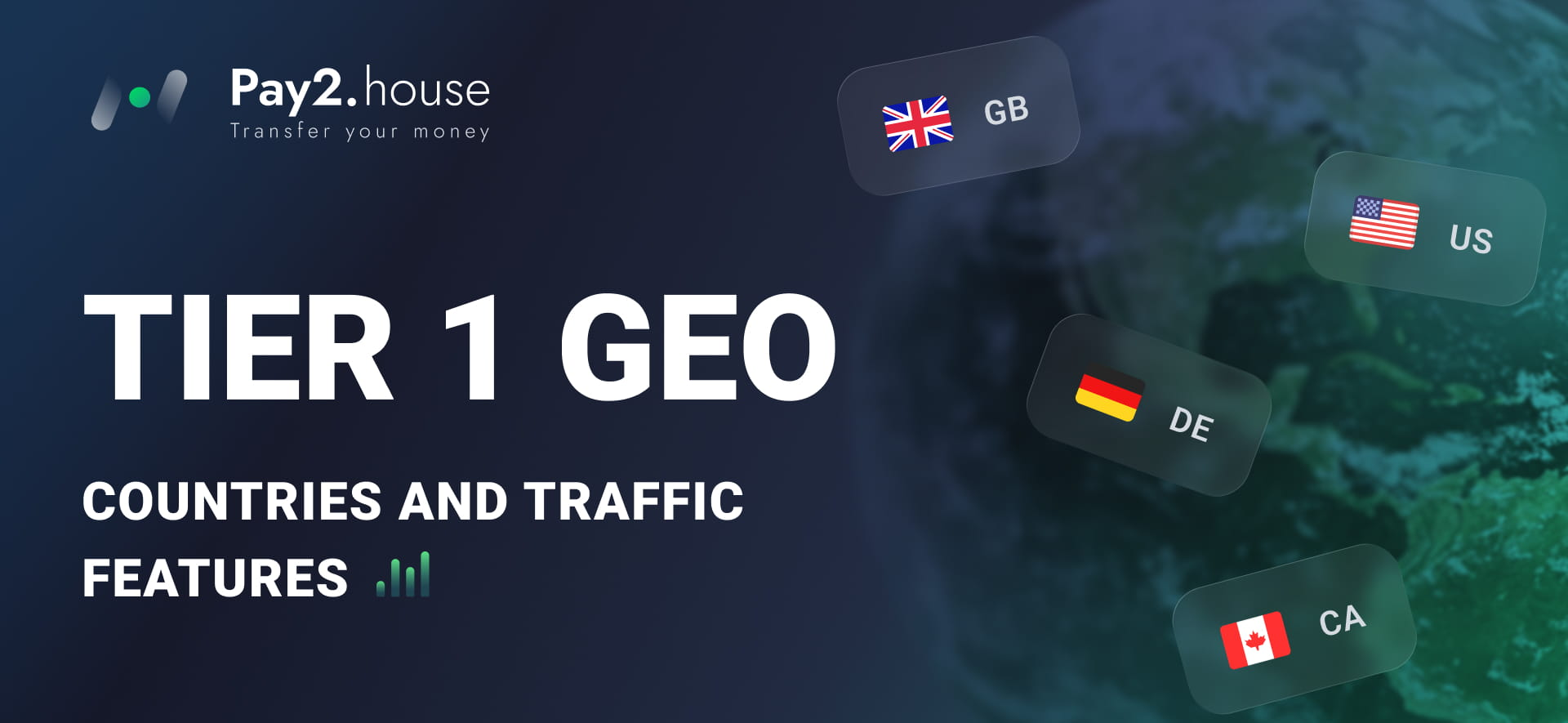
When choosing a GEO for an advertising campaign, teams often face a dilemma: launch in more affordable markets or enter Tier 1, where an attractive audience comes with intense competition.
The United States, United Kingdom, Canada and Australia are often placed in Tier 1. This is an informal classification, however, and the list varies between sources. Treat the tier as a starting point for market research, not a fixed rule.
In Tier 1, advertisers usually compete with more businesses for the same users. Before launch, a team should assess its offer and creatives alongside its test budget, ad accounts and payment setup, especially if it plans to scale.
Here is why traffic can cost more in these markets and what to check before starting a campaign.
Which countries are considered Tier 1?
Digital marketers often group GEOs into tiers to get an initial sense of market conditions, competition and acquisition costs. Tier 1 commonly includes:
- the United States;
- the United Kingdom;
- Canada;
- Australia;
- some Western European countries.
A country's tier does not predict how well a campaign will perform. Traffic costs depend on the ad platform, vertical, audience, season, placements and advertisers competing in the auction at that moment. Two campaigns in the same tier can therefore have very different economics.
If you are comparing different groups of markets, see our guide to choosing a GEO for traffic arbitrage.
Why can Tier 1 traffic cost more?
Most major ad platforms allocate impressions through an auction. When many advertisers want to reach the same audience, competition for each impression rises. This is especially noticeable in popular verticals and periods of high advertising demand.
Costs may be affected by:
- the number of advertisers in the auction;
- the chosen vertical;
- audience size and quality;
- ad format and placement;
- seasonality;
- campaign optimisation strategy;
- the quality of the creative and landing page.
“Tier 1 is always expensive” is an oversimplification. Advertisers in developed markets often face stronger competition, so acquiring enough qualified traffic may cost more, but the actual price depends on the campaign.
What does this mean in practice?
What matters is how market conditions affect the launch, not the tier label itself.
| Market feature | What it means for the team |
|---|---|
| High competition | Monitor campaign economics closely |
| Higher traffic costs | Testing mistakes may cost more |
| Many advertisers | Creatives must work harder to win attention |
| Mature market | Localisation and audience insight matter |
| Growing ad spend | Prepare the budget and payment setup in advance |
A Tier 1 launch is therefore a combination of the offer, budget, creatives, audience and technical preparation rather than a country choice alone.
What should you check before launching in a Tier 1 GEO?
1. Offer economics
A high payout does not automatically make a Tier 1 campaign profitable. Consider both the revenue from a conversion and the cost of acquiring it. If acquisition costs rise faster than the potential payout, a larger payout will not save the campaign.
Assess the whole funnel: traffic cost → conversion rate → acquisition cost → payout → final margin. The more expensive the traffic, the more important it is to know in advance which metrics make the campaign viable.
2. Test budget
Before launch, you cannot know which combination will work. A team may need to test several creatives, audiences, landing pages, ad approaches and placements. With expensive traffic, a failed hypothesis can use up the test budget quickly. Yet an excessively small budget may not generate enough data for a sound decision.
Testing too many hypotheses at once is a common mistake. When the budget is split across many combinations, each receives too little data. It then becomes difficult to tell whether a hypothesis failed or simply lacked traffic.
Before launch, decide:
- how much the team can spend on the entire test;
- how many hypotheses it will test;
- how the budget will be divided;
- which metrics will trigger a stop or continuation decision;
- what reserve will remain for another test or scaling a successful combination.
Prioritise hypotheses and test them in sequence. This cannot guarantee success, but it helps the team collect useful data before the budget runs out.
3. Localisation
Tier 1 is not one uniform audience. Users in the United States, United Kingdom, Canada and Australia differ in language, wording, units of measurement, currency, culture, visual preferences, reactions to advertising and product expectations.
Translating a successful creative into English is therefore not enough. Check that the ad message, landing page and offer fit the specific market.
4. Payments and budget allocation
Payments may be easy to overlook in a small test. They become more important when a team runs several ad accounts, tests multiple combinations or increases its spend.
Plan how funds are allocated between accounts, which cards pay for ads, which currencies are needed, who monitors spending, what happens if a payment fails and how quickly work can resume.
That is where a payment service becomes part of the workflow. With multiple ad accounts, teams need to see where the budget goes, which cards serve which tasks and what each card spends. Pay2.House lets teams issue virtual cards for advertising and online services, manage accounts and transactions in one interface, and organise team access.
A payment service does not change auction prices or make a campaign profitable by itself. Its role is to prevent payment operations from becoming a bottleneck while the team tests and scales ads.
When might Tier 1 be the wrong starting point?
Tier 1 does not have to be the first market you launch in. If the budget is tight, the offer economics are unproven or the team is testing a new vertical, the cost of gathering data may add risk.
Compare several GEOs by test cost, potential payout, competition, audience characteristics, available budget and room to scale. Use the tier as an initial guide, then make the launch decision using the metrics of the actual campaign: traffic cost, payout, expected conversion and budget.
Conclusion
Tier 1 offers access to large, developed markets but also brings more competition for audience attention. Choosing a GEO requires more than looking at a country or the payout on an offer.
Consider traffic costs, offer economics, test budget, localisation, ad materials and payment readiness together. A Tier 1 launch makes sense when the team understands the market economics and can properly test its hypothesis.



 Telegram
 Email
Email








Seja o primeiro a partilhar a sua opinião!
Valorizamos os seus comentários. Diga-nos o que pensa.