


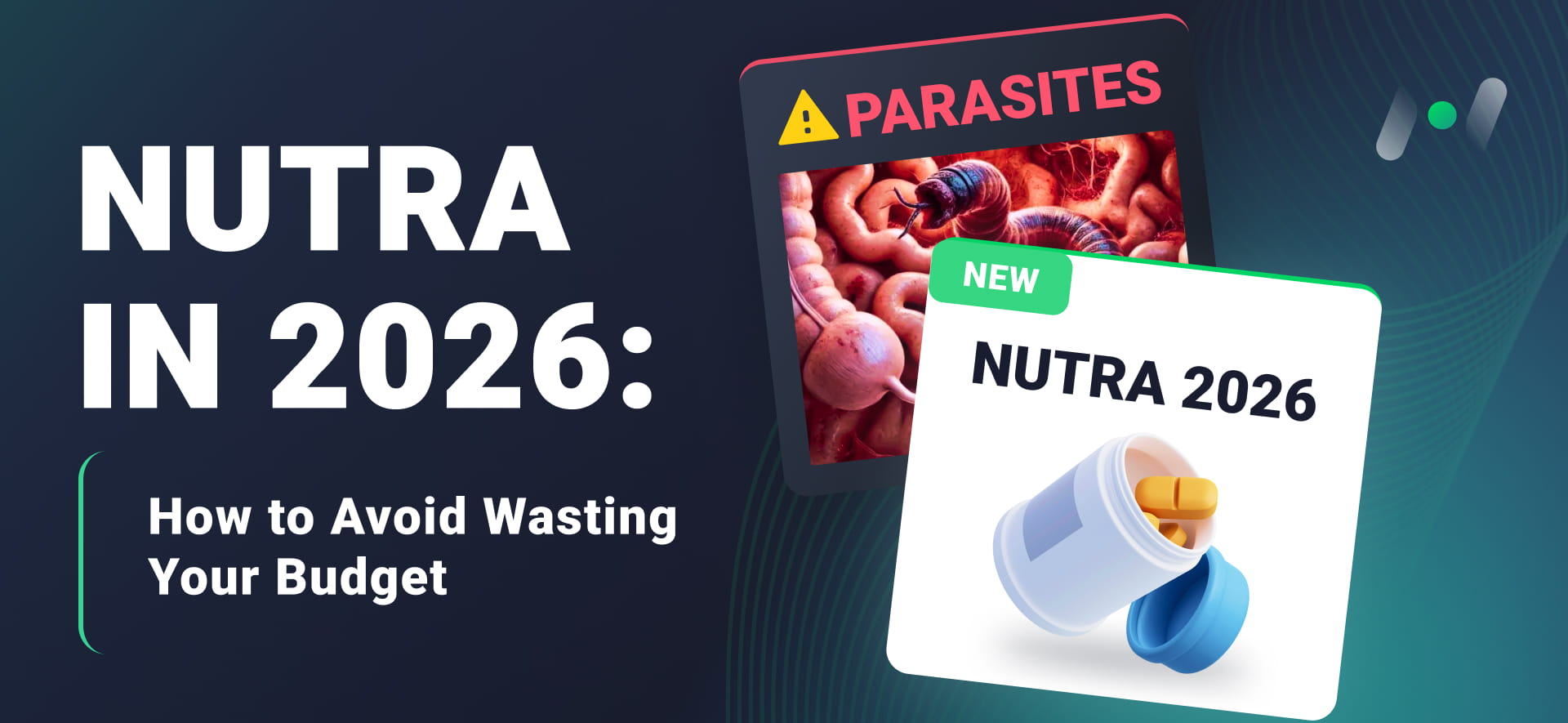
If your workday in 2023-2024 began with searching stock photos for the most horrifying parasite pictures, blurred frames of "healing in 3 days," or cut-out faces of famous TV hosts - it is time to turn the page.
In 2026, aggressive shock content and cheap manipulations in nutra no longer provide the stability they used to. The moderation algorithms of Meta, TikTok, and Google recognize forbidden words, false promises, and manipulative visuals much faster. Even if a creative passes the initial review, it can get restricted before the campaign gathers enough data.
The user has changed too. People react more cautiously to magic pills for all diseases but are willing to buy products that promise a clear improvement in life quality, have transparent ingredients, and are easy to use.
How can you run nutra profitably in these new realities, keep your accounts safe, and avoid burning test budgets? Let's figure out exactly what needs to be changed in creatives, pre-landers, and campaign testing.
1. Why the soft approach beats aggression
The main problem with aggressive creatives is low lead quality, a high number of canceled orders, and a constant risk of bans.
Even if a screaming creative passes moderation, it often faces two barriers:
- Low lead quality (Low Approve). People who click on shock headlines often expect instant results and are not ready to pay real money during a call with a call center operator.
- Expensive infrastructure. The constant replacement of accounts, creatives, and other setup elements gradually eats up the margin and prevents the funnel from consistently accumulating data.
Soft-Nutra offers a different model. You are not selling a "cure for a severe disease," but a wellness solution: vitamin complexes, vitality-boosting remedies, joint care products for active people, sleep supplements, or healthy lifestyle support during weight management.
2. Secrets of effective creatives in 2026
Instead of scaring the user, work with their real daily needs and emotions.
Main formats
- UGC and AI-realism. Videos in the format of "unboxing," "daily routine," or "my morning ritual" from micro-influencers. AI avatars can also be tested, but you should not pass off a fictional character as a real buyer. Use images and voices you have the rights to, and add AI content labeling if the platform requires it. For example: "What helped me get my energy back after thirty and stop living on five cups of coffee."
- The "Problem - soft solution" concept. Instead of "Get rid of joint pain in one day," use: "Three habits that help me easily go for walks with my grandchildren."
- Pinterest and TikTok aesthetics. Light tones, pleasant frame logic, demonstrating the product's texture or consumption process: a glass of water, a capsule, natural ingredients.
The golden rule of a 2026 creative: it should look organic in the user's feed, not resemble a TV shop ad from the 2000s. However, the commercial nature of the video and the use of AI should not be hidden.
3. How to build a pre-lander people believe
If the creative promises gentle care, but on the pre-lander the user is met with a fake interview with a doctor and pictures of organs in formalin, you will lose trust along with the conversion.
What should be on a pre-lander that actually sells:
- Transparent ingredients. Natural extracts, vitamins, trace elements, usage instructions, and important precautions. The modern buyer increasingly studies the ingredients before ordering.
- Convenient storytelling format. A blog of a real person - for example, a fitness trainer, a stay-at-home mom, or an active senior - rather than a fictional "chief surgeon of the country."
- Social proof without falsehood. Real reviews and before/after photos in a moderate format: no radical changes in three days or guaranteed results. Before launching, check if the specific advertising platform allows such a format.
- Interactive Widgets. Simple quizzes like "Answer 3 questions and find out what care suits your skin/body type." This increases CR through engagement. Such a test should help with product selection, not imitate a medical diagnosis.
4. Budget preservation strategy during tests
Media buyers most often drain their budgets not only because of a bad offer but also due to chaotic testing.
| Test stage | How to optimize costs |
|---|---|
| GEO selection | Beginners with a small budget can look at specific Tier-2 and Tier-3 countries. They often have lower CPM and an audience highly familiar with the COD model. But each GEO must be checked separately for approval rates, redemption, logistics, and advertising restrictions. |
| A/B testing | Do not launch 20 different videos simultaneously. Make three different hooks - the first three seconds - and test them on a single main video body. |
| AI content generation | Use AI for localizing text, subtitles, voiceovers in the GEO language, and creating creative variations. Always check the translation, pronunciation, and rights to the images and voices used. |
| Stop-loss | Do not tie the campaign stop solely to a universal metric like 1.5-2 payouts. Consider the target CPA, approval rate, redemption rate, margin, and the amount of data already collected. |
5. Launch checklist in 2026
- Offer. Check the affiliate network's rating and reviews about the approval rate in the specific GEO. Choose products with a clear positioning niche - for example, not just "for weight loss," but "keto support" or "natural metabolic booster." Also, check the product documentation and ensure that the stated properties can be used in advertising in the chosen GEO.
- Traffic source. Meta (Facebook and Instagram). Great for UGC and native videos. TikTok Ads. Works well with short recommendation videos, strong hooks, and platform-adapted presentation. Pinterest Ads. Can become an additional traffic source for the female wellness audience in Tier-1 and Tier-2, but its effectiveness needs to be tested on the specific offer.
- Creative. Check visual and text triggers. No promises of a 100% result, unverified medical claims, using other people's faces without permission, or shock footage. The creative, pre-lander, and the offer itself must talk about the same product and not contradict each other.
- Analytics. Set up a tracker, such as Keitaro or Voluum, and track not only CPL but also the order confirmation rate from the call center, redemption, and returns. A cheap lead does not always mean a profitable campaign. A funnel with a higher CPL can earn more if it brings an audience with realistic expectations and a better approval rate.
Conclusion
In 2026 arbitrage, the winner is not the one who finds another loophole in moderation, but the one who better understands buyer psychology and knows how to consistently guide them from the creative to the order.
The soft approach does not guarantee automatic ad approval or a stable ROI. But it helps the funnel live longer, simplifies scaling, and reduces dependence on the constant replacement of accounts and creatives.


 Telegram
 Email
Email




Be the first to share your opinion!
We value your feedback — share your thoughts.