


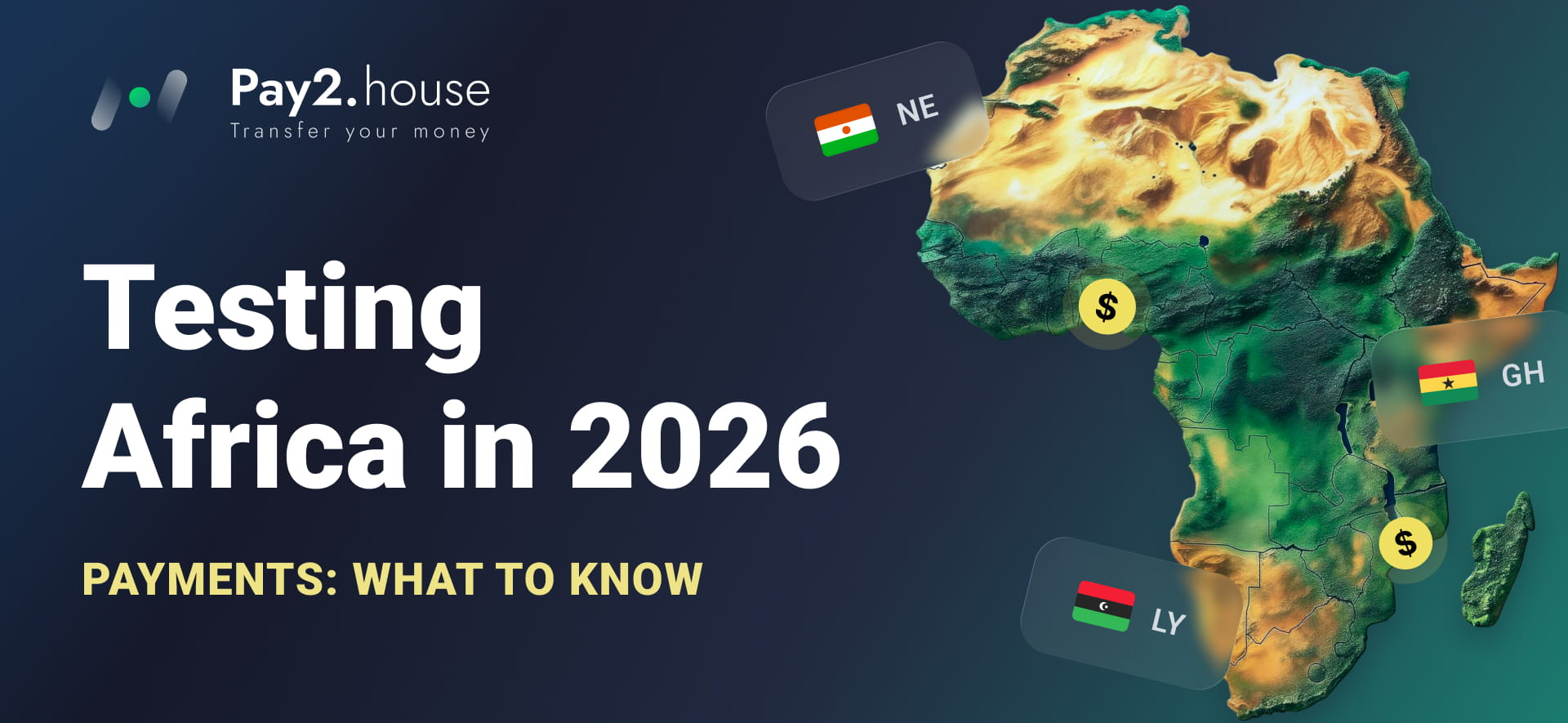
Africa and other emerging markets are increasingly appearing in media buying test plans. The reason is simple: teams are looking beyond the same familiar GEOs and testing where a specific offer, traffic source, and funnel may work better.
But entering a new market is not just about changing the GEO in an ad platform.
It can affect creatives, audience behavior, conversion patterns, currencies, and the way users pay. At the same time, the media buying team still has to manage its own advertising payments, subscriptions, and operational expenses.
That creates two separate questions:
- Will the funnel work for users in this GEO?
- And: Will the team's payment setup remain manageable as the number of GEOs and accounts grows?
This distinction matters especially in Africa, where markets can differ significantly from one another.
Kenya, Nigeria, South Africa, and Egypt, for example, have different digital ecosystems, payment habits, and audience behavior. A campaign approach that works in one of these markets cannot automatically be transferred to another.
So the useful question is not whether "Africa is a good GEO".
It is whether a specific market fits the offer and whether the team is ready to manage the operational side of testing it.
Why Emerging Markets Are Getting More Attention
Teams enter new GEOs for different reasons. Some are looking for audiences they have not tested before. Others work with offers whose demand differs significantly by region. Expanding the list of tested markets also reduces dependence on a small number of countries.
At the same time, digital payments continue to grow across many emerging economies.
According to the World Bank's Global Findex 2025 report, 42% of adults in low- and middle-income economies made a digital merchant payment in 2024, compared with 35% in 2021. This is a global figure covering developing economies, not an Africa-specific conversion rate.
Mobile money also plays an important role across many African markets, particularly in Sub-Saharan Africa. The GSMA State of the Industry Report on Mobile Money 2026 found that mobile money services processed more than $2 trillion in transactions worldwide in 2025.
These trends do not automatically make a GEO profitable.
Growing internet access, wider adoption of digital payments, or potentially lower traffic costs do not guarantee that an offer will convert. They simply mean that there are more markets worth evaluating instead of automatically concentrating every test in the same Tier-1 countries.
The decision still comes down to the combination of offer, audience, traffic source, funnel, and economics.
For a broader approach to selecting markets, see our guide on how to choose a GEO for traffic arbitrage.
Africa Is Not One GEO
One of the easiest mistakes when discussing African markets is treating them as a single category.
In practice, the differences can be significant.
| GEO | What to consider when testing |
|---|---|
| Kenya | Mobile money plays a major role in everyday payments. Check whether the offer supports familiar payment methods such as M-PESA, how mobile checkout works, and whether the landing page performs well on smartphones. |
| Nigeria | Bank transfers and local payment services are important parts of the payment ecosystem. Test the available checkout methods, transaction confirmation process, mobile performance, and conversion quality. |
| South Africa | Card payments, electronic bank transfers, and services such as PayShap are part of the local ecosystem. Check which methods are actually available through the advertiser's checkout rather than assuming all users can access the same options. |
| Egypt | Arabic-language localization, pricing in Egyptian pounds, and locally supported payment methods deserve particular attention. Services such as InstaPay and the Meeza payment ecosystem may be relevant depending on the offer and payment provider. |
This does not mean that one market is inherently easier or more profitable than another.
It means that a campaign that works in Kenya should not automatically be copied into Nigeria or South Africa with only the GEO setting changed.
Localization needs to go beyond the country name in the advertising dashboard.
For example, a landing page can be translated correctly and still perform poorly if prices are displayed in an unfamiliar currency, the payment method is unavailable to the target audience, or the checkout experience does not match local expectations.
The same applies to device performance. A landing page that loads quickly on a desktop connection may behave differently on a lower-end smartphone or a slower mobile network.
The practical approach is to evaluate each GEO as a separate combination of audience, offer, traffic source, and conversion flow.
A New GEO Changes More Than Targeting
When a team launches campaigns in a GEO it already knows well, many parts of the process are familiar.
The team understands the audience, has previous campaign data, and usually has some idea of what to expect from the funnel.
A new GEO introduces more unknowns.
The creative may require a different angle. The offer may convert differently. Users may behave differently after the click. The payment step may also become a new source of friction.
At the same time, the media buying team has its own operational payment layer to manage.
The team still needs to pay advertising platforms, tracking tools, proxy services, browsers, subscriptions, and other online services used in daily work.
These payments often have little connection to the currency or payment habits of the audience being targeted.
For example, a team may:
- run campaigns targeting users in Nigeria;
- receive campaign revenue in a local or offer-specific currency;
- pay Meta or another advertising platform in USD;
- fund its payment infrastructure through another currency or asset;
- pay several operational SaaS subscriptions in USD or EUR.
The campaign geography and payment geography are therefore often different.
When only one or two campaigns are active, that difference may be easy to manage. As the number of GEOs and accounts grows, it becomes part of the team's operational workload.
Local Payment Habits Can Affect the Funnel
Payment differences matter most when the offer requires the user to make a purchase, subscription payment, or another financial action.
Imagine two campaigns with similar advertising metrics.
Both generate a healthy CTR. Both bring traffic at a comparable CPC. Users reach the landing page in both GEOs.
But in one market, the final payment step does not match the methods users normally expect or trust.
From the advertising platform's perspective, the campaigns may look almost identical at the top of the funnel.
The difference appears later.
One GEO may produce significantly fewer completed purchases despite similar click-level performance.
That is why GEO testing should not stop at CPC, CTR, or even landing-page conversion.
The team should look at the full journey:
Ad → Click → Landing Page → Registration or Lead → Payment Action → Final Conversion
If the campaign loses users near the payment stage, the problem may not be the creative or traffic quality at all.
For example, if an offer targets Kenya but the checkout only supports international card payments, it is worth checking whether adding a locally supported payment method could improve the user experience. This is a hypothesis to test, not a guaranteed conversion improvement.
Before launching, media buyers should check:
- which payment methods the advertiser actually supports in the target GEO;
- whether prices, fees, and billing terms are clear in the local currency;
- whether the checkout works correctly on common mobile devices;
- whether additional payment verification steps interrupt the conversion flow;
- whether successful and failed payment events can be measured separately.
The more useful question is not only:
"Are we getting traffic?"
It is:
"Does the complete funnel work for users in this market?"
What Experienced Media Buyers Check Before Increasing Spend
In affiliate marketing communities, campaign case studies frequently show why testing a GEO requires more than finding inexpensive traffic.
Media buyers compare landing pages, review individual placements, monitor conversion quality, and adjust campaigns based on actual results rather than assuming that a successful offer will work equally well in another country.
Several practical principles are especially useful when testing unfamiliar markets.
Start with a clearly defined GEO and offer.
Combining several countries in one test can make the statistics difficult to interpret. If one market converts well and another performs poorly, the average result may hide both.
Testing countries separately gives the team a clearer understanding of traffic costs, conversion rates, and potential profitability.
Check the conversion flow before buying significant traffic.
If the offer depends on a particular mobile operator, payment method, or device type, verify that the available traffic matches those requirements.
This is particularly relevant for mobile subscription offers, where the supported carrier and billing flow can directly affect whether a conversion is possible.
Test landing pages rather than assuming one version works everywhere.
A familiar creative or pre-landing page may perform differently after localization. Language, pricing, mobile performance, and the explanation of the offer can influence what happens after the click.
Published affiliate campaign case studies have documented situations where testing different pre-landing pages changed campaign performance after the initial approach underperformed.
Analyze more than the first conversion event.
For lead-generation campaigns, cheap leads do not necessarily mean profitable traffic.
Review approval rates, confirmed conversions, and actual payouts where those data are available. For purchase-based campaigns, evaluate completed purchases rather than relying only on registrations or checkout starts.
Do not confuse a profitable test with a scalable campaign.
A campaign can show positive ROI with limited traffic and become less profitable when spending increases.
Before scaling, check whether sufficient traffic volume is available, whether CPA remains acceptable, and whether the results hold across more than one small sample.
These practices do not guarantee success. They help media buyers identify which assumptions have been tested and which still need verification.
Managing Advertising Payments Across Multiple GEOs
The team's own payment setup becomes more important as testing expands.
Consider a simple setup.
A team runs campaigns in one GEO, manages two advertising accounts, and pays for a few work-related services. The person responsible for payments can usually understand where each transaction belongs.
Now the team launches three more GEO tests, adds new advertising accounts, and introduces additional tools into the workflow.
The number of transactions increases alongside the campaign activity.
At some point, a question that used to take seconds becomes less obvious:
"What was this charge for?"
A transaction might belong to a specific advertising account, a GEO test, an ongoing campaign, a tracker subscription, or another operational service.
The problem becomes more visible when something fails.
If a transaction is declined, the team needs to determine whether the issue affects one account, one card, one service, or a larger part of the payment setup.
When payment methods have clear roles, this investigation becomes much easier.
Why Payment Separation Helps
Payment organization does not mean creating a separate card for every $10 expense.
The purpose is to create enough structure that transactions remain understandable.
For example:
| Activity | Example of payment organization |
|---|---|
| Meta advertising accounts | Dedicated cards assigned to individual ad accounts |
| TikTok advertising accounts | Separate cards for relevant ad accounts |
| New GEO tests | Defined testing budgets linked to specific campaigns and accounts |
| Trackers and analytics | Dedicated subscription card |
| Team software | Operational card for approved work-related services |
A solo buyer may only need a few payment methods.
A large media buying team working with dozens of accounts may need a more detailed structure.
The useful principle is the same: a payment method should have a clear enough purpose that the team can identify what was affected when a charge appears or a payment fails.
Declines Become Harder to Diagnose at Scale
Payment declines are relatively simple to investigate when a team runs one advertising account.
With twenty accounts, several platforms, and multiple ongoing GEO tests, the same issue becomes more operationally expensive.
Suppose a payment fails.
The team needs to determine which advertising account was affected, whether the issue is limited to one transaction, whether the card has sufficient funds, and whether the problem originates from the advertising platform or payment provider.
A clear card structure does not prevent every decline.
What it does is reduce the amount of time needed to understand where the problem occurred.
That becomes particularly useful when a team is scaling campaigns and interruptions affect active spend.
Currency Adds Another Cost Layer
Currency can also change the economics of a GEO test.
The country being targeted may use one currency. The advertising platform may bill the team in another. Revenue may be tracked in a third currency, while the account itself is funded differently.
For example:
- Campaign revenue → Local or offer currency
- Advertising platform billing → USD
- Funding → Another currency or funding method
- Operational tools → USD/EUR
This means the number visible in the advertising dashboard is not always the team's complete cost.
Depending on the setup, additional costs may include:
- currency conversion;
- funding costs;
- transaction fees;
- service fees connected with the payment infrastructure.
That difference matters most when margins are already narrow.
A campaign may look attractive when the team compares revenue only with advertising spend. After including the relevant payment and operational costs, the actual margin may be lower.
However, card top-ups should not automatically be counted as additional advertising expenses. Teams need to distinguish transfers between balances from actual advertising charges and service fees to avoid counting the same spending twice.
For accurate comparisons, revenue and expenses should also be converted into a consistent reporting currency.
That does not automatically make the campaign unprofitable.
It simply gives the team a more accurate number before increasing the budget.
Example: Testing Kenya and Nigeria
Imagine a team launches two new markets at the same time.
Both campaigns promote the same type of offer, use the same payout model, and receive equal testing budgets.
The results might look like this:
| Metric | Kenya | Nigeria |
|---|---|---|
| Advertising Spend | $500 | $500 |
| CPC | $0.10 | $0.08 |
| Clicks | 5,000 | 6,250 |
| Confirmed Purchases | 50 | 25 |
| Revenue | $750 | $375 |
| CPA | $10 | $20 |
| ROI | +50% | -25% |
Illustrative figures only. Both campaigns use a hypothetical $15 payout per confirmed purchase. These are not market averages or actual campaign results. Additional operational costs are excluded.
At first glance, Nigeria appears more attractive because its CPC is lower.
The team receives 1,250 more clicks for the same advertising budget.
But the final results tell a different story.
Kenya generates more confirmed purchases and higher revenue, while Nigeria remains unprofitable in this example.
This does not prove that Kenya is a better GEO than Nigeria.
It shows why cheap traffic alone is not a sufficient reason to scale.
The team should now investigate the difference.
Is the checkout performing worse in Nigeria? Is the landing page less suitable for the audience? Does traffic quality vary between placements or devices? Are there differences in offer eligibility or conversion tracking?
Without additional data, the team cannot identify the cause from CPC and purchase totals alone.
If the analysis reveals that a particular placement is consistently unprofitable, the media buyer may pause that segment while continuing to test other traffic.
If the problem appears at the payment step, the advertiser's available checkout methods may need to be reviewed.
Payment organization matters here too.
When testing budgets, advertising accounts, and card transactions are clearly assigned, the team can reconcile actual spending more easily and avoid mixing the results of different experiments.
The payment setup does not determine which GEO wins.
It makes it easier to understand what each test actually cost.
Before Scaling a New GEO, Check More Than Campaign Metrics
Advertising performance should remain the main part of campaign analysis.
But before moving from a test budget to larger spend, it also helps to check the operational side.
Review:
- performance across the entire funnel, not only CTR or CPC;
- confirmed conversions, approval rates, and actual payouts where applicable;
- whether results are analyzed separately for each GEO;
- where users abandon the funnel;
- whether the payment step fits the local market;
- whether landing pages work on the devices and connections used by the target audience;
- whether individual placements or traffic segments are consistently unprofitable;
- whether conversion tracking and postback data are correct;
- the full cost of funding and running the campaign;
- which payment methods are connected to which advertising accounts;
- how recurring transactions are organized;
- what happens operationally when a transaction is declined;
- whether the campaign has enough data and traffic volume to justify scaling.
The larger the campaign structure becomes, the more useful these checks are.
For more details on expanding successful campaigns, see our guide on how to scale performance campaigns across traffic sources and GEOs.
Where Pay2.House Fits In
Virtual cards are one practical way to keep payment activity separated as the number of accounts, campaigns, and subscriptions grows.
Pay2.House provides virtual cards for advertising payments, subscriptions, and supported work-related online services.
For a media buying team, this means payment methods can be organized around the team's actual workflow.
For example, different virtual cards can be assigned to:
- separate advertising accounts;
- different advertising platforms;
- operational expenses associated with specific projects;
- recurring subscriptions;
- other supported work-related services.
The goal is not to create as many cards as possible.
The goal is to create a structure that makes transactions easier to identify.
With separate cards and transaction histories, teams can monitor advertising payments and compare actual charges with campaign budgets.
If a payment issue occurs, the team has a clearer starting point for investigating the problem.
At the same time, Pay2.House manages the team's own payment infrastructure. It does not replace the local checkout methods that customers use to purchase products or services in African markets.
This distinction is important when evaluating a new GEO: the advertiser needs a suitable payment experience for its customers, while the media buying team needs an organized way to manage its advertising expenses.
What Changes When You Expand Into New Markets
Testing Africa and other emerging markets involves more than selecting another country in an advertising platform.
Every GEO has its own audience, competitive environment, digital ecosystem, and user behavior.
Local payment habits can affect what happens after the click. Traffic costs, device performance, localization, and the availability of the right conversion flow also influence results.
At the same time, the media buying team's own payment setup becomes more complicated as campaigns, advertising accounts, subscriptions, and currencies increase.
That is why successful expansion requires looking at two separate payment questions:
Can users complete the payment step in this GEO?
And:
Can the team clearly manage the payments required to run the campaign?
The first affects conversion.
The second affects operations.
For Pay2.House users, virtual cards can provide one part of that operational structure by helping media buyers separate advertising payments, subscriptions, and other supported online work expenses.
When a team launches its first test in a new GEO, the campaign itself usually gets most of the attention.
As that activity scales, payment organization becomes part of what keeps the entire setup understandable.



 Telegram
 Email







Be the first to share your opinion!
We value your feedback — share your thoughts.