


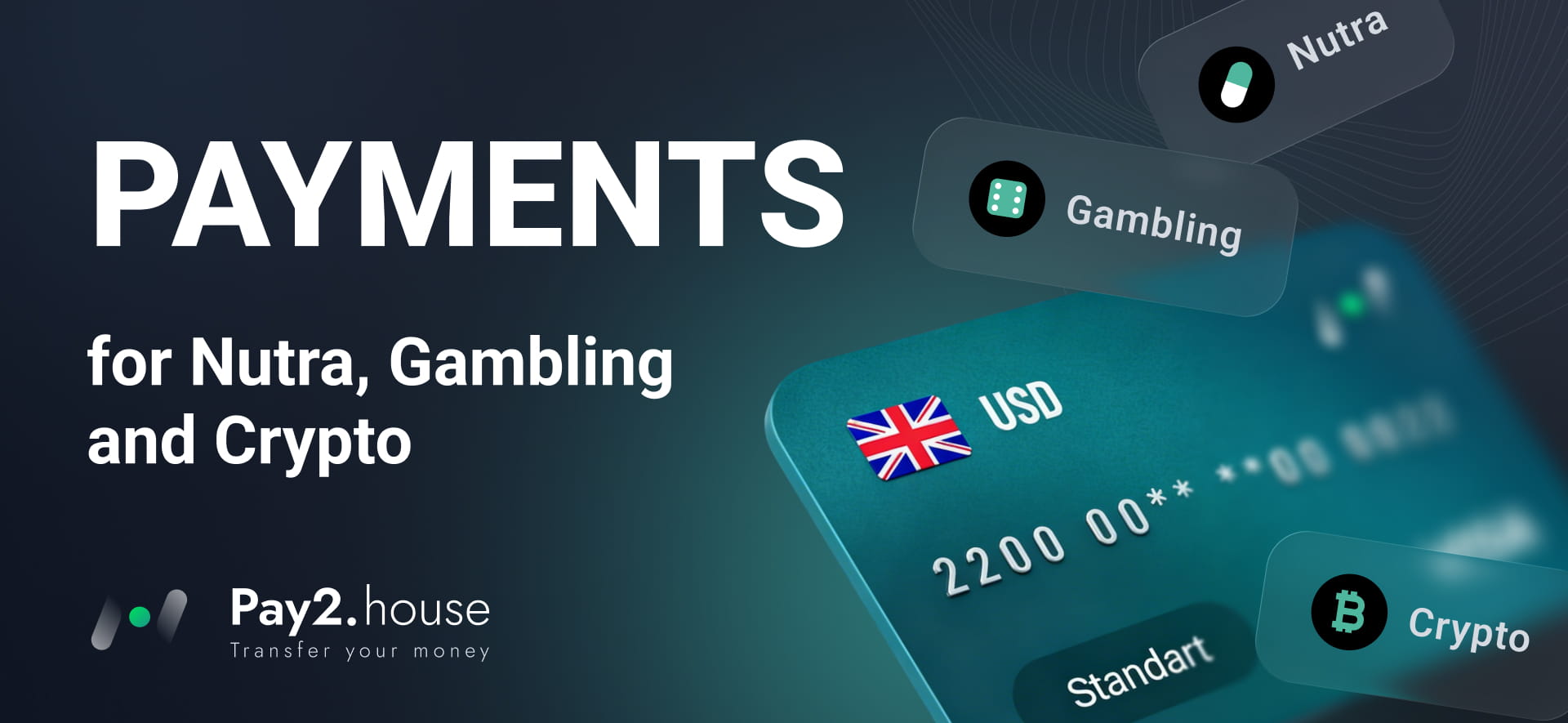
There is no universal payment solution in digital marketing and media buying. A method that works well for classic e-commerce or a mainstream brand may be ineffective for Casual Games, while a payment strategy for Nutra may not meet the needs of teams working with Crypto and financial offers.
Advertising platforms such as Facebook Ads, Google Ads, TikTok Ads, and others use their own risk assessment systems and regularly review advertising and payment accounts. This means that campaign stability depends not only on account quality, proxies, and the overall setup, but also on the payment infrastructure: the card BIN, issuing bank, available limits, currency, 3D Secure support, and the actual transaction approval rate.
For an affiliate marketing team, it is not enough to find virtual cards for advertising. The payment model must match the specific vertical.
Let’s look at the payment requirements of Nutra, Casual Games, and Crypto and identify the card parameters that matter most in each case.
1. Nutra: Payment Stability, Approval Rates, and Budget Control
Nutra is a vertical where advertising campaigns can run for an extended period, making payment method stability especially important.
There is usually no need to constantly issue dozens of new VCCs. It is more important for the linked card to process advertising charges consistently without creating additional billing issues.
Payment characteristics in Nutra
- Card demand: moderate. The priority is VCC quality and stability rather than the maximum number of cards.
- Transaction pattern: small payments at the beginning of a campaign followed by a gradual increase in advertising spend.
- Key parameter: a low Decline Rate.
If the issuing bank regularly declines transactions or the card does not have enough available balance, this may lead to billing problems and additional reviews of the payment profile.
When a new payment method is added or verified, the advertising platform may also place a small temporary authorization on the card. The card should therefore remain active, have sufficient funds, and support the required transaction type.
Practical tips for Nutra
- Do not change the card without a reason. If the payment method is working consistently, frequent replacement only makes the account’s billing history more complicated.
- Increase the advertising budget gradually. For scaling, it is more convenient to use cards with easily monitored balances and limits.
- Evaluate BINs based on actual approval rates. Do not focus only on the country or card type. Consider payment statistics, GEO, currency, and compatibility with the required advertising platform.
- Monitor the balance and authorization holds. It is advisable to keep a reserve on the card so that an automatic charge does not fail because of insufficient funds.
For Nutra, the optimal strategy is not constant card rotation, but a stable payment method that can be used alongside gradual campaign scaling.
2. Casual Games: Mass Issuance and Flexible Card Management
Casual Games are verticals subject to increased scrutiny from advertising platforms. The ability to launch a campaign depends on the GEO, product format, local legislation, licenses, and the rules of the specific advertising system.
For media buying teams, this often means a higher operational workload. They may need to work with multiple advertising accounts, launch new campaigns quickly, and manage payment methods without delays.
That is why mass virtual card issuance and centralized management are especially important in this vertical.
Payment characteristics in Casual Games
- Card demand: high. The team may need to issue a large number of VCCs on a regular basis.
- Transaction pattern: active advertising spend, frequent changes in payment scenarios, and the need to manage working cards quickly.
- Key parameters: issuance speed, the number of available BINs, the absence or size of a Decline Fee, simple closure of unnecessary cards, and fast balance top-ups.
For teams using dozens of cards at the same time, even a small fee for each unsuccessful transaction can noticeably affect total costs.
Practical tips for Casual Games
- Separate payment methods between advertising accounts. This simplifies expense analytics and helps identify the source of a problem more quickly if payments stop processing.
- Monitor the Decline Fee. If an advertising account continues trying to charge an inactive card automatically, decline fees may accumulate.
- Analyze BIN performance. If linking or payment approval rates consistently decline for a particular BIN, test another card pool.
- Automate card issuance. For larger teams, services with mass VCC creation, centralized management, and API access can be especially useful.
In Casual Games, the main requirement for payment infrastructure is speed and scalability. A payment service should allow the team to issue, fund, monitor, and close cards quickly without unnecessary manual work.
3. Crypto and Financial Offers: High Limits, 3DS, and Currency Conversion Control
In Crypto and financial verticals, advertiser requirements depend heavily on the specific GEO and product type. Exchanges, cryptocurrency services, investment products, and other financial offers may require licenses, additional verification, or certification from the advertising platform.
Before choosing a payment card, check whether the specific product can be advertised in the selected GEO and what requirements Facebook Ads, Google Ads, or another platform imposes.
If the advertising account meets these requirements, the payment infrastructure becomes the next priority.
Payment characteristics in Crypto
- Card demand: generally lower than in large-scale Casual Games campaigns. Stability and sufficient limits are particularly important.
- Transaction pattern: larger advertising budgets and, consequently, higher charge amounts.
- Key parameters: high daily and monthly limits, 3D Secure support, issuer bank stability, and clear currency conversion terms.
Practical tips for Crypto
- Check limits in advance. If the team plans to scale the advertising budget, the card should support the required amounts without constant manual payment method changes.
- Align the card currency with the advertising account currency. At high volumes, even a small FX conversion fee can create significant additional costs.
- Use cards with 3D Secure support. For transactions requiring additional authentication, quick access to 3DS confirmation is essential.
- Evaluate BINs based on practical parameters rather than an assumed “trust level.” The issuing bank, GEO, currency, available limits, and actual advertising payment statistics all matter.
For Crypto and financial verticals, the optimal payment strategy involves less random card rotation and more attention to limits, stability, currencies, and control over large advertising budgets.
Comparing Payment Requirements for Nutra, Casual Games, and Crypto
| Parameter | Nutra | Casual Games | Crypto and Finance |
|---|---|---|---|
| Card demand | Moderate | High, with mass issuance | Low to moderate |
| Typical workload | Gradual scaling | High operational activity | Large advertising budgets |
| Critical factor | Low Decline Rate and payment stability | Issuance speed, BIN availability, Decline Fee | High limits, 3DS, and FX conversion |
| BIN management | Consistent approval rates | Ability to change the card pool quickly | Compatibility with GEO, currency, and budget |
| Strategy | Stable card and gradual spend | Scalable management of multiple VCCs | Control of large payments and currency conversion |
Pay2.House Payment Infrastructure for Nutra, Casual Games, and Crypto
Different advertising verticals require different card workflows. A payment service should therefore do more than issue VCCs. It should help the team manage the broader financial infrastructure behind its campaigns.
Pay2.House offers tools that can be adapted to different media buying scenarios.
Mass issuance and card management
Teams can create virtual cards for advertising and manage them from one account. For larger-scale processes, API tools can be used to automate selected operations.
BIN selection for different use cases
Multiple BIN options make it possible to test different card variants for Facebook Ads, Google Ads, TikTok Ads, and other advertising platforms while considering GEO, currency, and transaction type.
USDT top-ups
Cryptocurrency top-ups through USDT TRC20 can make it easier to manage working funds within an advertising payment infrastructure.
Team features
Access distribution, expense control, and centralized card management are especially useful for teams with several media buyers working at the same time.
Accordingly, a Nutra team may prioritize payment stability, a Casual Games team may focus on mass issuance and fast VCC management, while a Crypto team may place greater emphasis on limits, 3DS, and control over larger advertising budgets.
Conclusion
The main principle is simple: payment infrastructure should be selected together with the advertising strategy, not separately from it.
The number of cards, available BINs, limits, currencies, 3DS support, transaction costs, and budget management model should match the vertical, GEO, and team scale.
This approach helps build a payment workflow that does not need to be completely rebuilt every time campaigns are scaled, the number of accounts increases, or a new business direction is launched.


 Telegram
 Email
Email







Be the first to share your opinion!
We value your feedback—share your thoughts.