


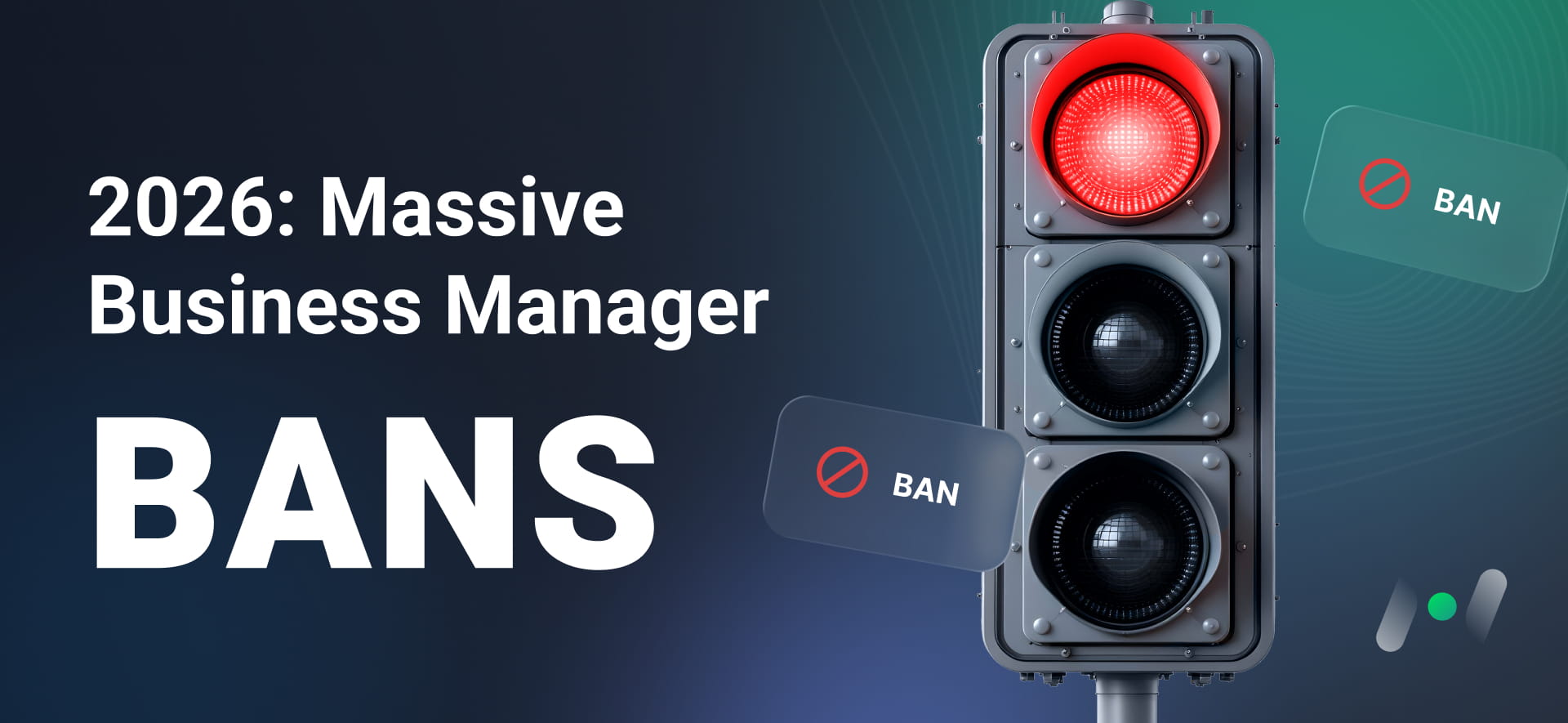
June 2026. Arbitrage chats are burning. Business Managers are falling one after another – among newcomers, experienced teams, and those who warmed up accounts for months. We break down what's happening, why it's not random, and what to do right now.
What's Happening: Wave of Bans Without Warning
For two weeks, media buyers have been documenting systematic Business Manager outages – even BMs with warming and spending history are getting hit. The suspected cause is an update to the System Risk Control algorithm, which Meta rewrote as part of its transition to AI moderation.
Key detail: none of the affected received a clear explanation from Meta – only the standard "policy violation" without specifying the exact violation.
Experienced media buyers from LinkedIn and forums report the same pattern: the first 24 hours after a ban are the critical window. If you don't react quickly, your chances of recovery drop sharply.
How to React: Step-by-Step Protocol from Media Buyers
This is not theory – it's practical experience gathered from forums and media buyer communities:
Step 1 – Diagnosis (first 30 minutes)
- Go to business.facebook.com/accountquality and determine what's blocked: personal profile, ad account, or the BM itself.
- Check Support Inbox inside Business Manager (Business Settings → Support Inbox) – there are sometimes hints.
- Don't touch active campaigns in other accounts – any sudden action can pull down neighboring BMs.
Step 2 – Appeal (first 24 hours)
- If you have spending history of $500+ – try live chat through Business Help Center, this gives priority.
- In the appeal text: factual, no emotions, one request – don't spam.
- Attach documents: business registration, account owner ID, screenshot of payment method.
- Include BM ID directly in the text – this speeds up processing.
Step 3 – If Appeal Failed
- Don't create a new BM under your name immediately – this is a trigger.
- Identify which exact asset caused the block (usually ad account or pixel).
- Ask a trusted colleague with a clean history to create a new BM and rebuild infrastructure from scratch, don't migrate pixel and pages from the old account.
- Register domain again, create a new page.
How Not to Get Banned: Preventive Protection
Media buyers on forums have developed a working protection setup:
- Multiple administrators with clean history – if one account falls, the cabinet isn't lost completely.
- Don't give everyone Admin role – use Advertiser or Analyst role where possible, Admin rights only for 1–2 trusted people.
- Minimum constant spend – even $2–5 every few weeks keeps the account "alive" and protects from automatic deactivation.
- Verified BMs with spending – accounts with spending history pass ban waves much softer.
- Language trick on creative rejects: in campaign settings → "Languages" section → select rare language → attach maximum white creative → launch.
- Backup BM always ready – don't wait for ban, create backup early and keep it warmed.
Andromeda Algorithm: Why Campaigns Behave Like Crazy
Parallel to bans, media buyers faced chaotic campaign behavior – budgets burn suddenly or don't spend at all. This is the result of full rollout of Andromeda algorithm in April 2026.
Andromeda is not just a targeting update. It's a new logic for the entire auction: the algorithm reads signals from the creative itself and decides who and when to show ads. Detailed audience settings are now just hints, not hard restrictions.
What Changed in Practice:
- One adset instead of several – launch one campaign with 1 adset and 10–20 creatives inside.
- Broad targeting – narrow audiences in 2026 lead to budget burn.
- 7 days without changes – don't touch campaign during learning period, otherwise you reset everything.
- Weekly creative replacement – prevents algorithm and audience "fatigue".
- CAPI + Pixel simultaneously – without dual event transmission you lose minimum 30% of optimization data.
- Send all micro-events (ViewContent, AddToCart, InitiateCheckout) – give algorithm to catch audience portrait before purchase.
Key Metrics: What to Watch in Ads Manager Right Now
| Metric | What It Affects | Action Threshold |
|---|---|---|
| CPM | Cost of entering auction | Sudden spike = storm, better to wait |
| CTR | Creative quality and relevance | Below 0.8% – kill adset |
| CPA | Real cost of target action | Must be below offer payout |
| CR (conversion) | Traffic quality after click | Dropped = landing or attribution issue |
| ROI | Final profitability | Calculate manually/through tracker |
Important: starting July 1, 2026, Meta introduces hidden +2–5% fee on ad cost in several countries – it doesn't show in Ads Manager but real CPA increases. Calculate this now.
Virtual Cards for Traffic: Rules for 2026
Billing is one of the key vulnerability points in Meta Ads. Incorrect payment setup can wipe entire setup, even if account is perfectly warmed.
What works based on media buyer data and communities:
- One card – one ad account, never use one card across multiple unrelated cabinets.
- Balance must be on card before billing cycle – don't wait for last moment, empty card = campaign suspension.
- Don't reuse cards from banned accounts – Meta remembers payment methods.
- Top up gradually – sudden spending spike on new card triggers System Risk Control.
- Enable real-time notifications – track every billing event, anomaly = signal.
- Keep backup card ready – at least one extra card protects from campaign stop during payment technical failure.
- Wait 2–24 hours after card binding before first launch – let Meta "see" new payment method.
Pay2.House solves this systematically: instant card issuance per cabinet, USDT TRC20 top-up, and complete balance isolation. When one account is at risk – others keep working.
What Else to Know in June 2026
1. New Meta Transparency Rules 10.5/10.6a
Since May 2026, Meta requires advertising intermediaries to disclose vendor_id when consolidating accounts. This means if you manage multiple ad cabinets for different clients or teams, you must clearly indicate which Business Manager belongs to you. Without this – automatic block of all linked accounts.
2. 47+ Changes in Meta Ad Policy
Since early 2026, Meta introduced 47+ changes affecting key verticals:
- Crypto advertising – now requires special permission levels (crypto tiers) for different crypto offer types.
- AI disclaimers – if creative uses AI-generated content, must add disclaimer about it.
- Financial offers – stricter requirements on claims about guaranteed profit, passive income, "fast money".
3. Threads Ads
Meta opened ad inventory in Threads for all advertisers, new placement with low competition.
4. Advantage+
Advantage+ became mandatory standard – adapt campaign structure, don't try to disable it.
Conclusion
Ban waves in Meta Ads are now normal, not random. Andromeda rewrote rules, hidden Meta fees increase real traffic cost, and old protection methods don't deliver previous results. In 2026, winners are not those who react to problems post-factum, but those who build infrastructure early: separate accounts, separate cards, and clear protocol for first 24 hours after block.
This is why payment part today is not just technical detail, but element of budget protection and liquid stability. Pay2.House helps media buyers isolate risks, control expenses, and quickly issue new cards for ad cabinets without delays. When market stays unstable, reaction speed and payment infrastructure control become direct competitive advantage.


 Telegram
 Email
Email



Be the first to share your opinion!
We value your feedback — share your thoughts.