



Landing Page Builder as a Tool for Traffic Quality Control
Traffic Qualification Through Landing Pages: Reducing Post-Click Losses
In traffic arbitrage and product-based businesses, it’s long overdue to move away from the simplified mindset that “a click is the only cost.” This perspective is incomplete and often dangerous when evaluating advertising efficiency.
Indeed, in CPC models, a user’s actual visit to a landing page almost always represents a paid click – a fact that cannot be reversed by page structure alone. However, the landing page determines whether this paid visit becomes a useful business action or turns into a chain of further losses.
Traffic → Click → Landing Page → Lead → Call Center → Purchase → Return
The click is only the first point of expense in the sales chain. The most significant financial losses in product-based businesses often arise later – when irrelevant, unqualified, or empty traffic proceeds deeper into the funnel.
| Stage | Source of Loss |
|---|---|
| Landing Page | Unqualified traffic |
| Form | Junk leads |
| Call Center | Calls without purchase intent |
| Logistics | Failed purchases / unclaimed orders |
| Advertising | Algorithm degradation due to low-quality traffic |
This is why a well-designed landing page — particularly one built with a flexible page builder — functions as a mechanism for qualifying and filtering out irrelevant audiences after the click, preventing them from progressing to the later, much more expensive stages of the funnel.
At this stage, the landing page ceases to be just a page with an offer and becomes the first marketing barrier between a paid click and financially toxic outcomes for the business.
This article isn’t about saving on clicks. It’s about applying professional logic, where the landing page serves as a traffic quality control tool before costs related to lead processing, call centers, and logistics begin to escalate.
The Click as a Technical Event, Not a Financial Outcome
Let’s establish one thing from the start:
- a landing page cannot cancel the cost of a click in CPC-based advertising models such as Facebook, Google, or TikTok;
- if a user has reached the page, the click has already been paid for;
- the landing page does not control the billing event itself.
That is the fundamental reality.
However, a landing page can prevent irrelevant traffic from converting before it begins to create systemic losses – distorting algorithms, flooding CRM systems with junk leads, burdening call centers, and driving up operational costs.
These are fundamentally different levels of control.
What “Costs” Actually Mean
Costs are not limited to the click itself. In reality, the most significant expenses emerge further down the chain: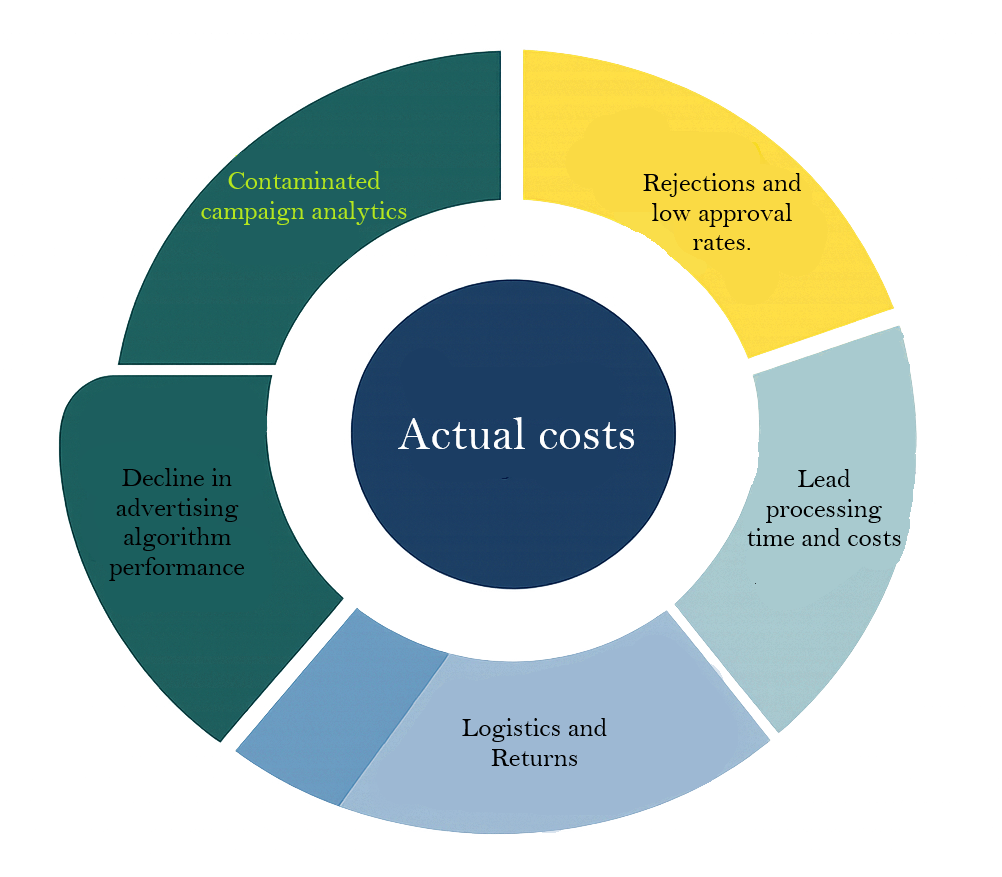
This is where the concept of financially toxic traffic emerges – traffic that ultimately costs far more than the click itself.
A landing page can prevent this traffic from generating expensive downstream consequences within the funnel.
Budget Spending ≠ The Click
This is one of the key mindset shifts that separates a beginner’s approach from a professional one.
In the traditional view, an arbitrage budget is often reduced to traffic acquisition costs – essentially, the price of the click. But in practice, a click only opens the door to later expenses.
That is why in traffic arbitrage and product-based businesses it is more accurate to talk about budget spending after the click, not just the click itself.
The Difference in Approaches
| Beginner’s Mindset | Professional Mindset |
|---|---|
| Budget = Click | Budget = Click + total downstream costs after the click |
| The main problem is high CPC | The main problem is low-quality traffic inside the funnel |
| The filter means not paying for the click | The filter means preventing unnecessary downstream losses |
| The landing page is a page with an offer | The landing page is a barrier and a qualification mechanism |
| Optimization means reducing the cost per click | Optimization means reducing the cost of downstream consequences |
In this context:
- a landing page does not reduce the cost of the click;
- a landing page saves money after the click by preventing unnecessary losses from escalating.
The “Empty Traffic” Problem Appears at the Landing Page Level
Most problems related to low-quality traffic are traditionally addressed at the level of advertising platforms, postbacks, or analytics systems. In practice, however, the landing page is where the actual quality of traffic becomes visible – and where it either begins to be controlled or is ultimately lost.
Typical warning signals include:
- a high volume of clicks with minimal meaningful actions;
- rapid user drop-off (high bounce rate);
- leads without real purchase intent;
- activity resembling bot behavior or random, low-intent users.
A landing page without clear logic, filtering mechanisms, and a structured interaction flow effectively fails to distinguish between different audience quality levels. In such cases, it stops being a neutral page and begins to amplify the problem of low-quality traffic.
This is why arbitrage professionals rarely work with static landing pages. It is far more effective to use landing page builders that allow full control over the page scenario.
A well-designed builder provides enough functionality to turn a landing page into a practical first-stage user qualification tool. Even during the testing phase and initial launches, a free-tier builder can support this logic and help analyze traffic behavior before scaling budgets.
One such tool is LP-Mobi – a landing page builder where pages are assembled from independent modules that can be freely combined, hidden, or rearranged. This makes it possible to design a page not as a static template with an offer, but as a managed qualification scenario – adjusted according to the traffic source, audience awareness level, and the specific goals of user qualification.
Landing Page Builder: Value Beyond Templates
The true value of a landing page builder lies in controlling user behavior logic, not in publishing speed or design aesthetics.
As a component of a well-tuned sales system, it provides three key capabilities:
- Page Logic Control
Thanks to modularity, you control the user journey: what the visitor sees first, where they linger, and at which point they leave or continue.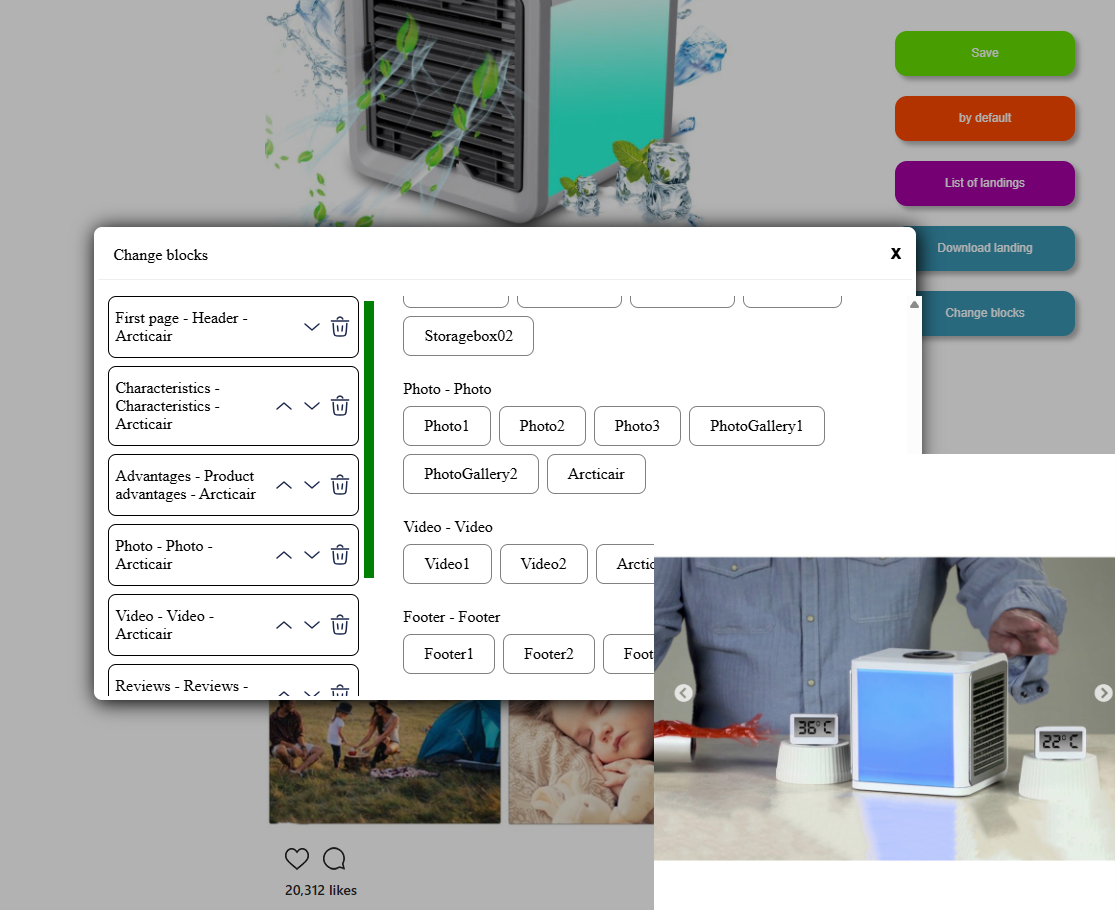
- Testing Without Code Rework
Traffic filtering is an ongoing experiment – adjusting copy, CTAs, block order, and offer rigidity. A landing page builder allows quick changes without involving developers.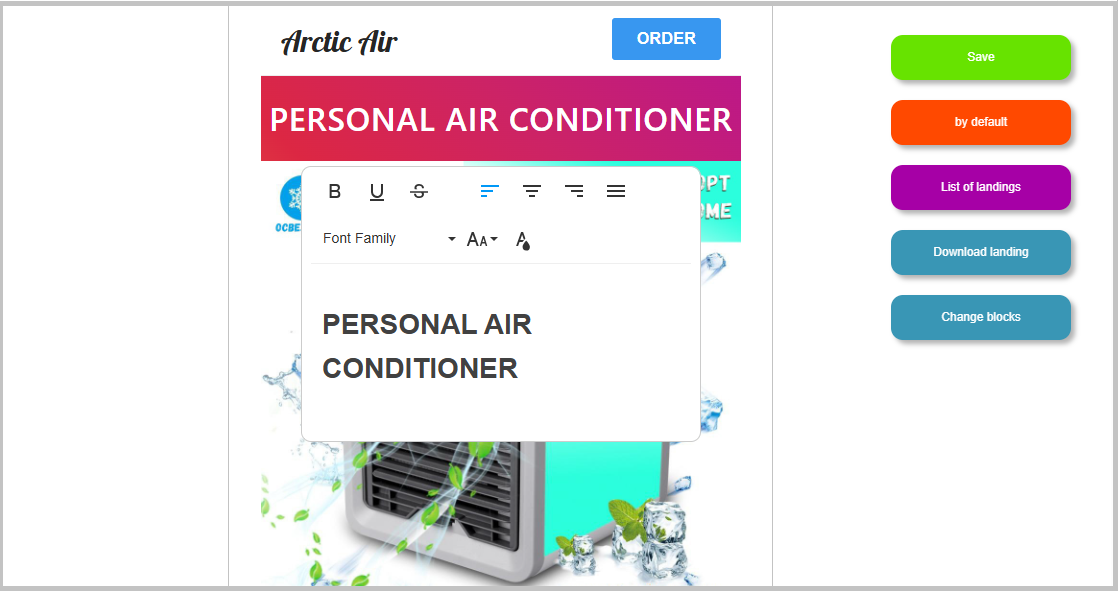
2. Traffic Source Adaptation
Different sources (Facebook, TikTok, native ads, push notifications) require different presentation formats. The builder lets you create customized versions of the page for each channel, while maintaining the base structure and interaction flow, enabling you to scale traffic without breaking logic.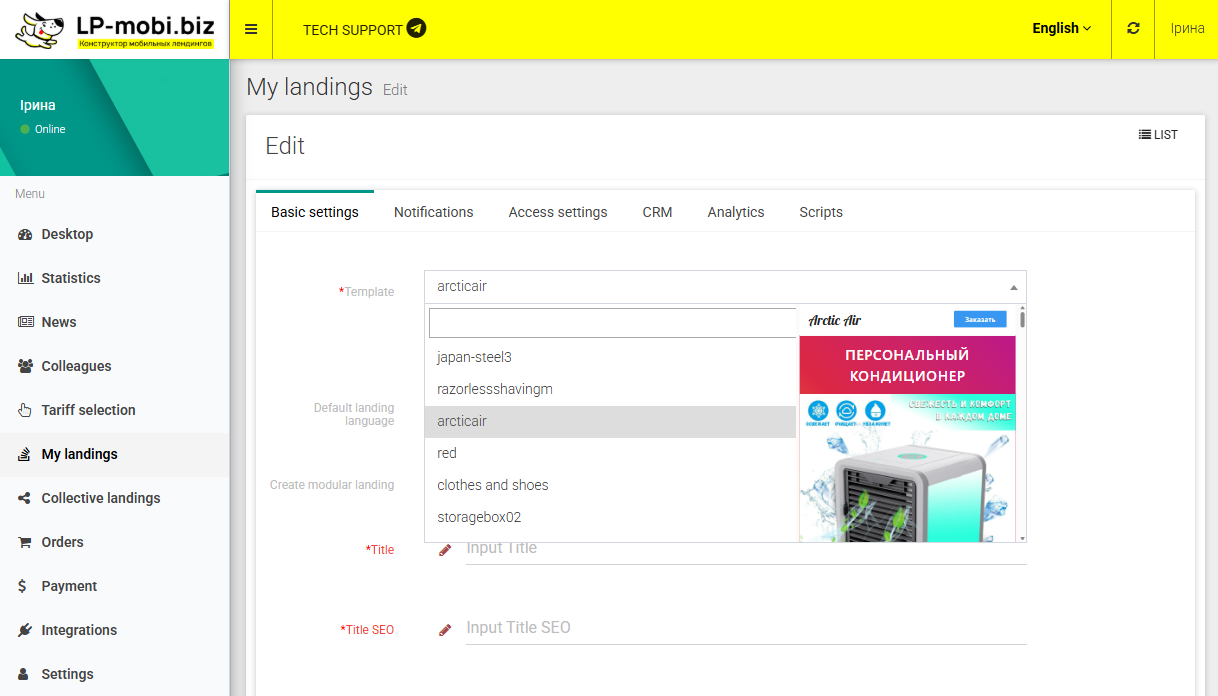
User Filtering Mechanics Through a Well-Designed Landing Page
A landing page acts as the first behavioral filter, weeding out irrelevant users before their activity can generate financial or operational losses.
For the arbitrage professional, this translates into budget savings and higher-quality leads. For product-based businesses, it means fewer fake orders, more predictable logistics, and a cleaner CRM.
1. Protecting Advertising Algorithms
Modern ad networks such as Google, Facebook, and TikTok rely on optimization algorithms that learn from events reflecting genuine user interest:
- submit – the user fills out a lead form;
- lead – a lead that meets the advertiser’s criteria;
- conversion – a completed action such as a purchase or confirmed order.
If a landing page accepts everyone indiscriminately, including random users, the algorithm learns from low-quality signals. As a result, the advertising system begins optimizing toward weak, empty, or fake interactions.
A landing page filter addresses this problem by:
- Reducing low-quality events. Many users without purchase intent never reach key events tracked by the algorithm.
- A user clicks “Submit” but does not complete the form – the submit event is not triggered.
- A bot or script navigates the page without real intent and exits before meaningful engagement occurs.
2. Feeding only relevant data to algorithms. The ad system learns from valuable signals, not random or fake actions.
- If the landing page checks user intent through several steps such as confirming terms or selecting a product variant, the algorithm sees real engagement patterns instead of accidental clicks.
Outcome: Budget efficiency when scaling campaigns. Money isn’t wasted on empty signals – it is invested in users who can genuinely generate business value.
2. Why a Cheap Click Can End Up Being Expensive
Even the cheapest click can generate significant indirect costs if the lead is not qualified.
“Paid click” ≠ “Paid lead”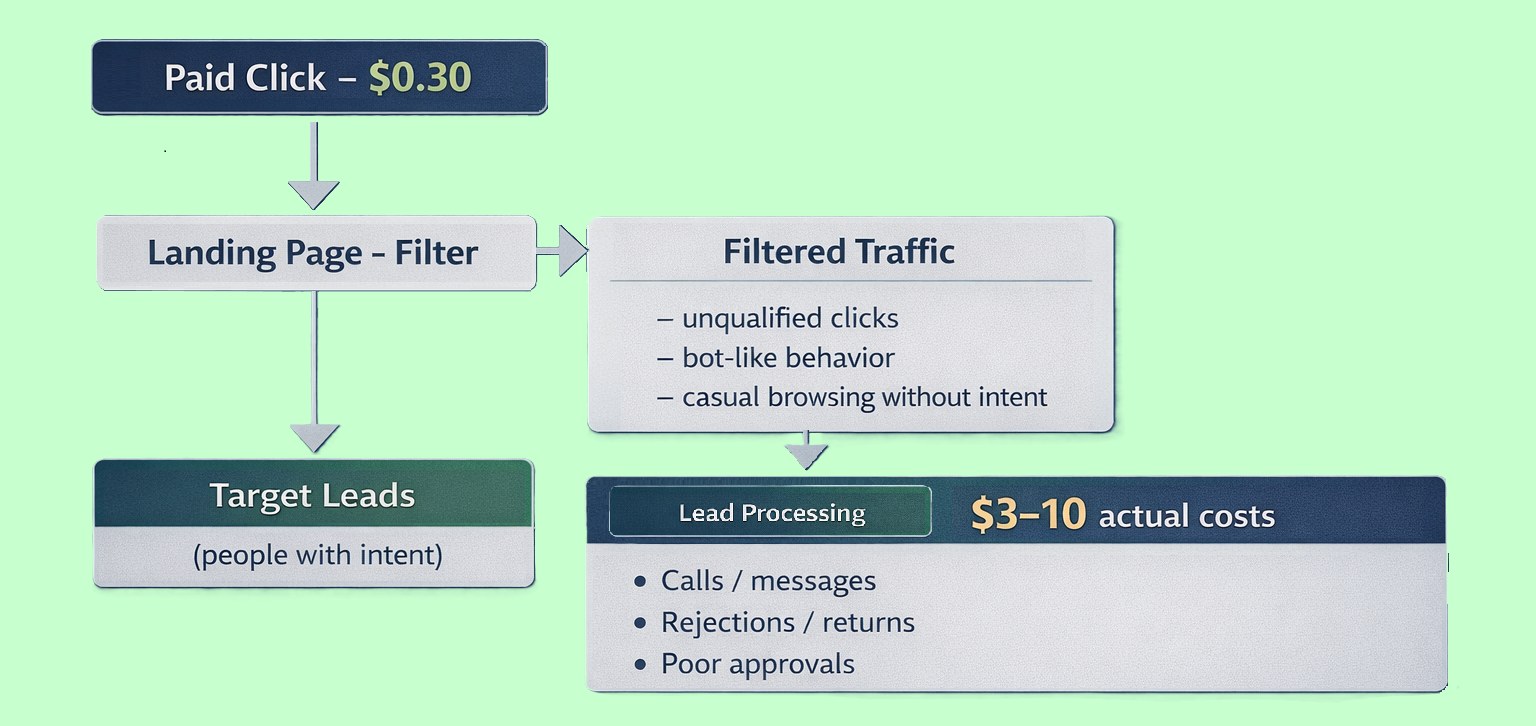
Landing page-level filtering reduces financial losses.
A properly designed landing page filters out users without purchase intent, leaving only an engaged audience.
In other words, you pay for the click, but you avoid additional costs associated with processing low-quality leads.
Order processing expenses become controlled and predictable.
3. Pre-Qualification of Users
A landing page built with a page builder allows the creation of multi-step interaction logic, where the user does more than just submit a form — they sequentially confirm their intent.
This can be implemented through:
- clarification of key conditions such as price, format, delivery, and geography;
- intermediate screens with offer details;
- confirmation of interest through deliberate actions such as selecting an option, checking a box, or taking a “Learn More” step before submitting.
Each additional step can increase lead quality, provided it is logically linked to the offer. Users who complete all steps understand in advance:
- what exactly is being offered;
- under what conditions;
- what actions are expected next.
As a result, fewer submissions reach the CRM, but with a higher level of intent.
For product-based businesses, this has direct practical benefits:
- fewer fake orders submitted “automatically” or out of curiosity;
- reduced return rates, since conditions are clear before checkout;
- improved purchase rates due to more informed decision-making by the customer.
A properly designed landing page thus takes on part of the qualification process that would otherwise fall to managers or order processing systems.
This reduces the load on the CRM, stabilizes key metrics, and makes processing costs more predictable.
Effectively, the landing page filters traffic before it generates costs that exceed the value of the click.
4. Copy and Structure as a Filtering Tool
A properly designed landing page does not aim to please everyone – this is a deliberate choice, not a conversion mistake.
Its goal is not to collect the maximum number of submissions, but to filter users by intent before they take action.
Clear wording, concrete conditions, and transparent limitations act as the first filter, deterring non-target audiences during the page view – which, in traffic arbitrage, is not a drawback but a prerequisite for a sustainable budget.
How this works in practice:
- Copy filters “curious” but unready users. Vague phrases like “great offer” or “suitable for everyone” generate many clicks but produce weak intent. Specific wording clarifies:
- who the product is for;
- in what format it is offered;
- under what conditions it works.
This reduces the number of submissions but increases their quality.
2. Wording manages expectations. When users immediately see the real conditions such as price, geography, delivery method, and interaction format, they either continue consciously or leave before creating additional costs.
- post-submission drop-offs;
- fake orders;
- load on call centers and logistics.
3. Page structure reinforces filtering. The order of blocks also acts as a selection scenario, guiding the user consciously through the funnel: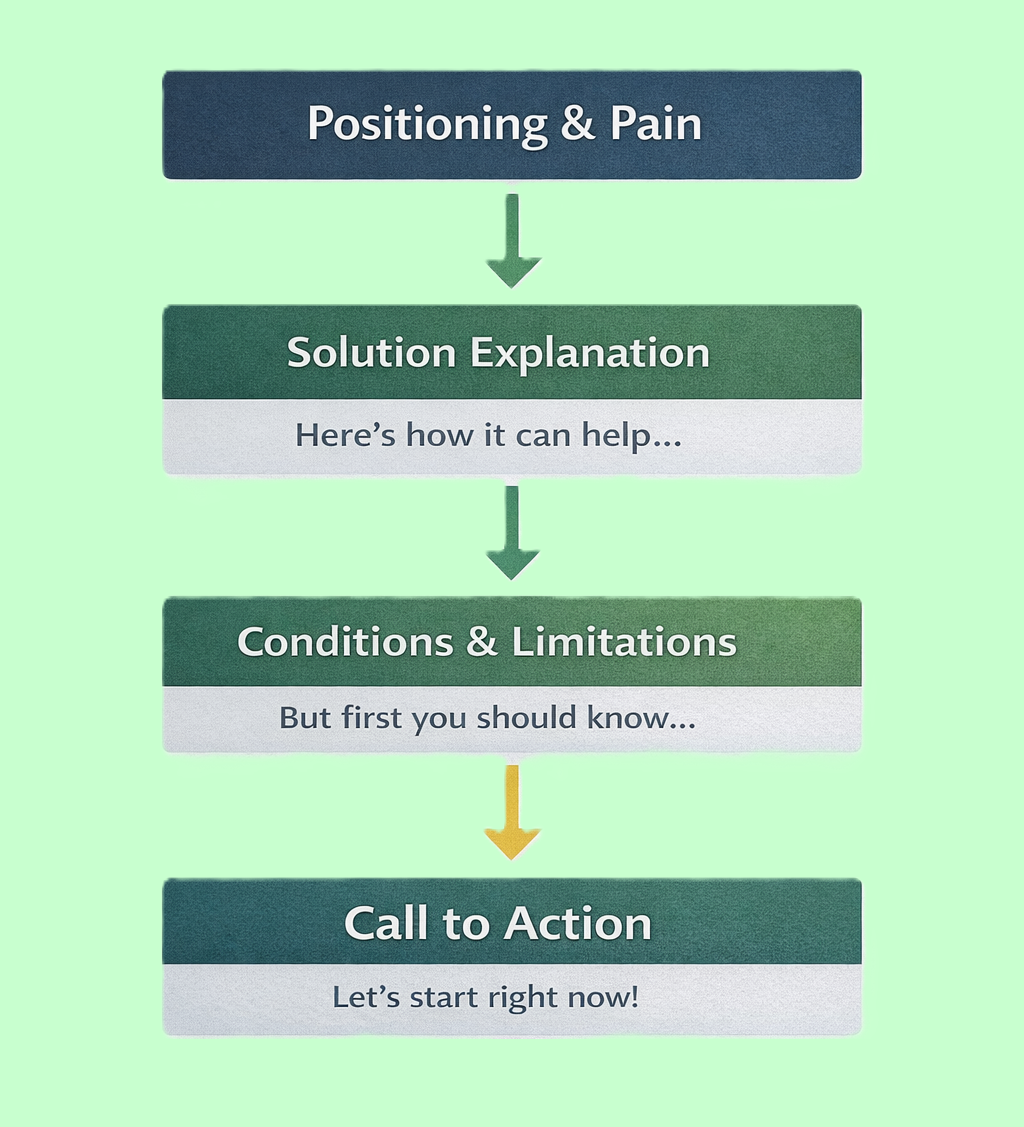
If at any stage the user realizes the offer “isn’t for them,” that is saved budget, not lost conversion.
A landing page that presents its offer honestly and clearly functions as a qualification tool, not a mass lead magnet. This is not a downside – it is a strategic advantage.
How a Landing Page Prevents Low-Quality Traffic from Converting Before Additional Costs
A landing page should act as a filter, blocking irrelevant traffic before it generates additional financial losses after the click.
1. Pre-Qualification via the First Screen
The first 3–5 seconds determine whether a user stays on the page. If the user doesn’t match the target audience profile, they should leave immediately instead of moving deeper into the funnel.
What works:
- clear positioning – who the product is for, without vague generalizations;
- specific pain points rather than “better life” messaging;
- clarification of conditions before the user scrolls further.
This filters out random clicks from users who are just curious.
2. Deliberate Micro-Actions Instead of a Single CTA
A landing page built in a page builder can be structured as a sequence of steps, not just one CTA.
Examples of micro-filtering:
- “Learn More” button instead of “Submit Form”;
- intermediate blocks with offer details.
Each additional step reduces the number of low-intent users while increasing the quality of those who complete the process.
3. Copy as a Filter, Not Decoration
A common mistake is trying to “sell to everyone.” Proper copy repels non-target audiences.
Page builders make it easy to:
- quickly adjust wording;
- test varying offer rigidity;
- add restrictions such as conditions, requirements, and format.
If a user reads and understands that the offer “isn’t for them,” you’ve already saved budget.
4. Page Structure as a Selection Scenario
A good landing page is not just a collection of blocks but a stepwise intent validation scenario:
- Awareness of the problem
- Explanation of the solution
- Detailing conditions
- Social or logical proof
- Action
The builder allows you to easily reorder blocks and identify where low-quality traffic drops off.
5. Traffic Source Adaptation = Fewer Random Clicks
One of the most powerful control mechanisms is creating separate landing pages for each traffic source:
- tailored copy and tone;
- different visual accents;
- different “warm-up” levels.
A page builder lets you scale this logic without technical delays, avoiding dumping traffic into a generic page.
A landing page prevents low-quality traffic from moving deeper into the funnel, where every mistake costs far more than the click itself.
Why This Matters for Both Beginners and Professionals
For beginners, a page builder helps avoid wasting budget at the start: with simple settings, they can reduce the number of random submissions.
For professionals, the landing page becomes part of a control system:
- analyzing user behavior;
- optimizing interaction flows;
- managing traffic quality before it moves further down the funnel.
A landing page builder is not about launch speed or page design. Above all, it is a traffic qualification tool that allows you to:
- avoid converting every click into a submission;
- filter out irrelevant users before lead processing or call center involvement;
- work with real user intent, not just click metrics.
The earlier audience quality control is introduced in the system, the less money the business spends correcting the consequences of low-quality traffic.
This is why, in many cases, the landing page becomes the first marketing filter, determining whether a user proceeds to the later, much more expensive stages of the funnel.
A landing page does not save on the click itself – it:
- saves money after the click;
- protects optimization algorithms;
- reduces real business losses.
In short, a landing page builder is one of the key tools for traffic quality control, operating post-click at the point where losses start to scale.



 Telegram
 Email
Email









Be the first to share your opinion!
We value your feedback — share your thoughts.