


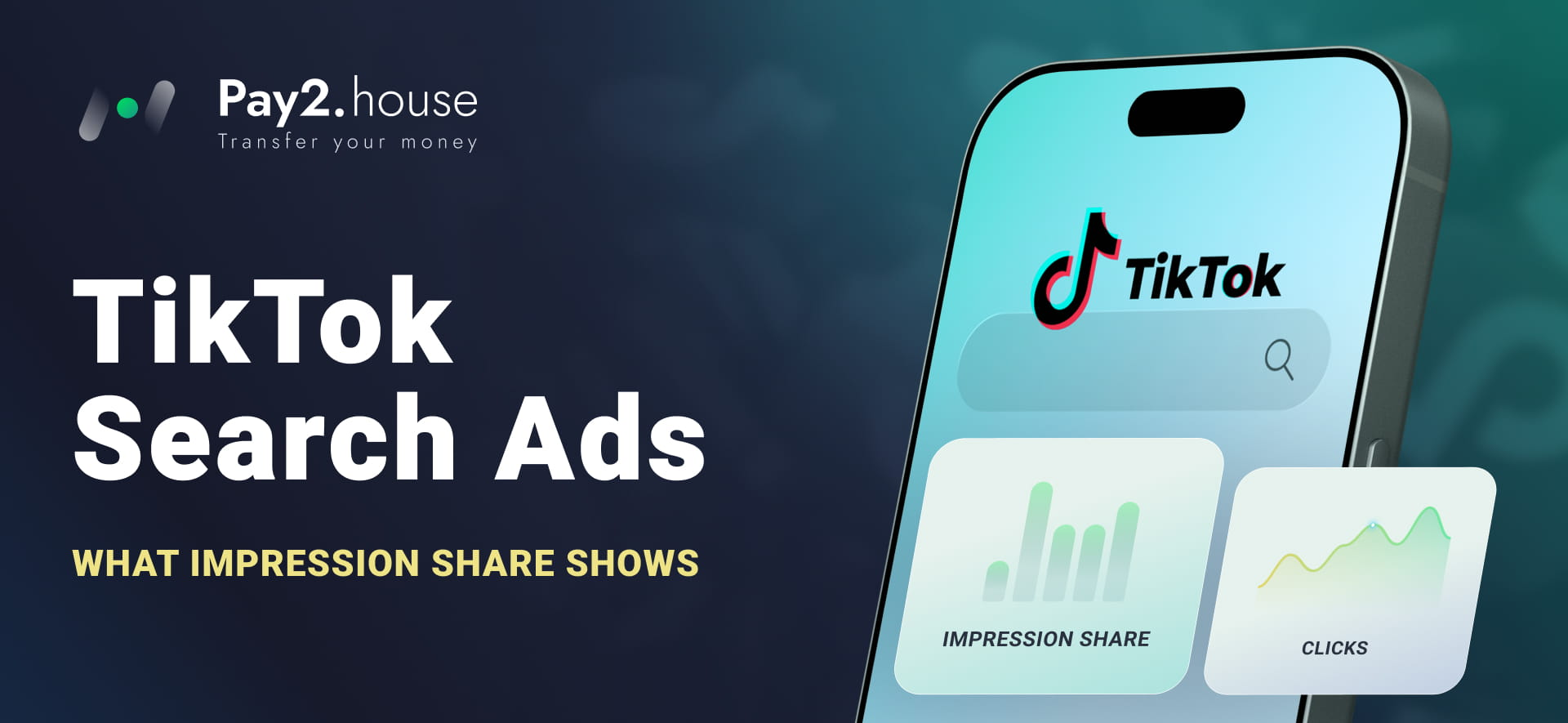
TikTok is expanding its search advertising analytics. In October 2026, the platform introduced two new diagnostic metrics for Search Ads – Impression Share and Top 1 Impression Share. They show what share of eligible impressions your ads receive and how often they appear in the first ad position.
For media buyers, these metrics offer another way to assess campaign potential. They can help identify keywords with room to scale, gauge how competitive ads are, and see where there may be room to grow within an existing budget.
A low impression share does not always mean missed conversions, and a high impression share does not guarantee profitability. Here is how the new TikTok Search Ads metrics work, what to look for in your reports, and when it makes sense to increase your budget.
What Is Impression Share in TikTok Search Ads?
Impression Share is the percentage of eligible search impressions your ads actually received.
The metric is calculated using this formula:
Impression Share = (impressions received / total eligible impressions) × 100%
For example, an Impression Share of 30% means your ads received roughly a third of the impressions they were eligible for under the current conditions.
The metric covers only the impressions available to the advertiser. Eligibility depends on keywords, campaign settings, and other auction requirements. Total TikTok search traffic falls outside the calculation.
Keep location targeting, keyword coverage, reporting periods, and campaign settings in mind when comparing impression share across campaigns.
A low Impression Share can indicate room to expand reach. First, find out what is limiting ad delivery.
What Does Top 1 Impression Share Measure?
Top 1 Impression Share is the percentage of eligible impressions in the first sponsored search result that your ads received.
While Impression Share measures overall visibility in search, Top 1 Impression Share shows how well your ads compete for the most prominent sponsored placement.
The two metrics use different denominators:
- Impression Share – impressions received as a share of all eligible search impressions
- Top 1 Impression Share – first-position impressions received as a share of all eligible first-position impressions
For example, if Impression Share is 60% and Top 1 Impression Share is 10%, your ads capture a substantial share of eligible search impressions but win the first sponsored position much less often.
The 10% figure refers to eligible first-position impressions. Because the two metrics use different denominators, you cannot use Top 1 Impression Share to determine what share of the campaign's actual impressions appeared in the first position.
A low Top 1 Impression Share may be acceptable. If a campaign already delivers conversions at an acceptable CPA, competing for the first position can increase costs without a corresponding gain in profit.
Where to Find the New Metrics
You can analyze Impression Share and Top 1 Impression Share in TikTok Ads Manager for eligible search campaigns.
The new metrics are available at the advertiser, campaign, and keyword levels. You can use them to assess overall search visibility and identify opportunities across different keyword segments.
The metrics may appear for Search Ads Campaign and TopSearch. Availability depends on the ad account, market, campaign type, and stage of the rollout.
TikTok offers three ways to place ads in search:
Search Ads Campaign – dedicated search campaigns with keyword targeting, bid controls, and search term reporting.
TopSearch – a separate CPM-based format designed for the first sponsored position in search. If an ad fails to win that position for a given query, it does not automatically move to a lower ad slot.
Automatic Search Placement – an option that extends standard campaigns into search results without the manual keyword controls used in Search Ads Campaign.
If the new metrics are missing from your reports, check whether the feature is available for your account before troubleshooting campaign settings.
How to Use Impression Share Alongside CPA
A common mistake is to assess impression share in isolation from conversion cost and quality.
Impression Share measures search visibility. To assess campaign profitability, read it alongside CPA, CTR, CPC, CVR, conversion volume, and revenue.
Low Impression Share and an Acceptable CPA
This can be an opportunity to scale.
If the campaign consistently delivers conversions at your target CPA and receives only a portion of eligible impressions, test whether you can increase volume.
Start by checking whether the campaign spends its full daily budget.
If it does, a gradual budget increase may help you pick up additional impressions. After the change, track Impression Share, conversion volume, and how CPA moves.
If impression share rises but CPA increases, the test may not have scaled efficiently.
Low Impression Share and Unspent Budget
If a campaign is already underspending, raising the budget cap is unlikely to solve the problem.
Possible reasons include:
- Bids that are too low to compete
- A keyword list that is too narrow
- Restrictive keyword match types
- Ad creative that is poorly aligned with the search query
- Narrow geographic targeting or low search demand
In this case, check delivery by ad group and keyword before changing your settings.
Campaign type also matters. Keyword-level bidding is supported in Search Ads Campaign with the Traffic objective. Bid controls may differ for other objectives.
High Impression Share and Expensive Conversions
A high share of impressions cannot make up for poor campaign economics.
If CPA exceeds your target, use the Search Terms Report to see which queries are driving traffic.
Then check:
- Whether the search terms match the offer
- Which keywords are consuming budget without producing results
- Whether irrelevant queries should be added as negative keywords
- Whether the ad creative and landing page match search intent
- Whether recorded conversions correspond to verified target actions
Increasing bids or budgets before reviewing these factors may simply drive up costs.
High Impression Share and a Stable CPA
The campaign is already capturing a substantial share of eligible impressions while maintaining acceptable campaign economics.
Further growth may be possible within the existing budget.
You can test additional keyword groups, different search intents, new ad creative, or individual geographic markets.
This lets the team reach new pockets of search demand while reducing reliance on scaling a single campaign.
How to Increase Impression Share in TikTok Search Ads
Review Keywords and Match Types
TikTok recommends using at least 20 relevant keywords per ad group. Use that number as a starting point for building sufficient reach, since campaign performance still depends on the keywords you choose.
A keyword list that is too narrow can limit the search auctions your ads are eligible to enter.
Use the Keyword Suggestion Tool and Search Terms Report to expand your keyword list.
TikTok also introduced Keyword Packs, ready-made groups of related keywords in the Keyword Suggestion Tool. They can include branded and category terms, and recommendations take search volume, CPC, and competition into account.
These packs make it easier to find new keywords to test. Review each suggestion for relevance before using it.
Keyword match type also affects reach:
- Broad match helps you reach more query variations
- Phrase match gives you more control over which queries match your keywords
- Exact match limits reach to the most specific queries
Broader matching can help you collect data early on. Once you have reviewed the search terms, refine your keyword list and exclude irrelevant traffic.
Check That Your Creative Matches Search Intent
Creative that performs well in the recommendation feed may perform differently in search.
Someone who enters a specific query already has a goal, whether that is finding a product, comparing options, or solving a problem.
The ad should address that goal, and the landing page should deliver on the promise made in the creative.
If the keyword, ad, and landing page are poorly aligned, increasing the budget will do little to improve relevance.
Wait for Enough Data Before Changing the Campaign
A new Search Ads Campaign needs time to complete its learning phase.
This typically takes 3–7 days. As a benchmark for gathering enough signals, TikTok recommends 15–20 conversions for Web Conversion or 60–100 clicks for Traffic.
Account for reporting delays as well. Some Search Ads metrics may update with a delay of around eight hours, and keyword-level conversions are best evaluated three days after the event.
Base scaling decisions on more than a few hours of impressions or a handful of conversions.
A Practical Approach to Scaling Search Ads
Consider a typical scenario.
A media buyer sees that one keyword group delivers conversions at an acceptable CPA but has a low Impression Share.
Before raising the budget, the media buyer checks the following in order:
- Budget utilization. If the campaign regularly reaches its daily limit, it makes sense to test a gradual budget increase.
- Search terms. If some of the budget goes to irrelevant traffic, refine the keyword list first.
- Conversions and CPA. If performance is stable and there is enough data, test the campaign at a higher volume.
- Impression Share after the change. If impression share and the number of profitable conversions both increase, scaling makes sense.
If CPA goes up, identify what changed. Possible factors include auction competition, new queries, cost per click, and the landing page conversion rate.
A higher Impression Share is useful when it brings additional traffic while keeping campaign economics within acceptable limits.
For more on managing budgets and profitability, read “How to Maintain ROI When Scaling”.
How to Manage Ad Spend While Scaling
When a team increases Search Ads budgets or tests additional keyword groups, it is important to monitor both campaign performance and actual charges.
This is especially relevant for media buyers working across multiple ad accounts and geographic markets.
With Pay2.House, you can use virtual Visa and Mastercard cards to pay for TikTok Ads and track transactions on each card.
To manage ad payments, your team can:
- Assign cards to different ad accounts and projects
- Monitor balances and review charge history
- Use Auto Top-Up to automatically add funds when a card reaches a set balance threshold, provided there are enough funds in the account
- Manage cards and budgets as a team
This can reduce manual work as you scale, though individual payments may still fail.
Use TikTok Ads Manager and your tracking platform to evaluate Impression Share, CPA, and keyword performance. Pay2.House helps you manage the payments behind those campaigns.
For more on advertising on the platform, read “TikTok Ads in 2026: Why Media Buyers Are Returning to the Platform”.
Conclusion
Impression Share and Top 1 Impression Share give media buyers a clearer view of how visible and competitive their ads are in TikTok search.
The new metrics can help you identify opportunities for growth. Evaluate them alongside CPA, conversions, search terms, and profitability.
If a campaign delivers results at an acceptable cost, a low Impression Share can be a reason to test additional volume. If the campaign is underspending or CPA exceeds your target, review the settings, keyword coverage, and traffic quality first.
Effective scaling starts with identifying which additional impressions can deliver profitable conversions. A 100% impression share is unnecessary for that goal.


 Telegram
 Email






Be the first to share your opinion!
We value your feedback — share your thoughts.