



For global brands, cross-border e-commerce teams, and digital marketing agencies, managing multiple social media accounts across international markets is now common. A brand may need to publish regularly on platforms such as Facebook, Instagram, TikTok, YouTube, LinkedIn, and X, while adapting its approach to each market.
As the number of accounts grows, content preparation, cross-platform publishing, performance analysis, ad campaigns, and payment management become more complex. Teams must switch between platforms to upload content repeatedly, schedule posts, review metrics, and reconcile ad spend.
The key to managing multiple accounts efficiently is to build a repeatable workflow that connects content creation, distribution, performance analysis, ad management, and payments.
1. Why Does Managing Multiple Social Media Accounts Get More Complex?
The challenges of managing multiple accounts generally fall into three areas.
Cross-platform publishing creates repetitive work. Each social platform has its own management interface and publishing process. Even when the same content needs to reach several accounts, teams may have to upload assets, enter captions, and set publishing times repeatedly.
Publishing schedules and team collaboration become harder to coordinate. Accounts may target different markets and follow different posting frequencies and schedules. When plans are spread across spreadsheets and platform dashboards, teams need extra time to check progress and clarify responsibilities.
Content operations and ad payments follow separate workflows. Teams typically use social media management tools to schedule content, ad platforms to manage campaigns, and payment tools or finance systems to reconcile costs. Because these processes are disconnected, organizing information and coordinating work take more time.
Efficient multi-account management therefore requires improving the overall workflow, rather than optimizing just one task.
2. Build a More Efficient Multi-Account Content Creation Workflow
Efficient distribution starts with solid content preparation. A reusable system for producing and organizing content and assets reduces repetitive work and lays the groundwork for bulk publishing.
Build a Reusable Content and Asset Library
Teams can organize approved copy, images, videos, and product materials into categories so they can be reused across different content tasks.
For example, a product update can be turned into a Facebook post, visual assets for Instagram, and video content for TikTok or YouTube.
Reusing content does not mean publishing exactly the same material on every platform. Teams should still adapt it to each platform’s format, audience habits, and account positioning.
Use AI to Support Content Creation and Localization
For brands targeting multiple countries and regions, translating and adapting content is an important part of daily operations.
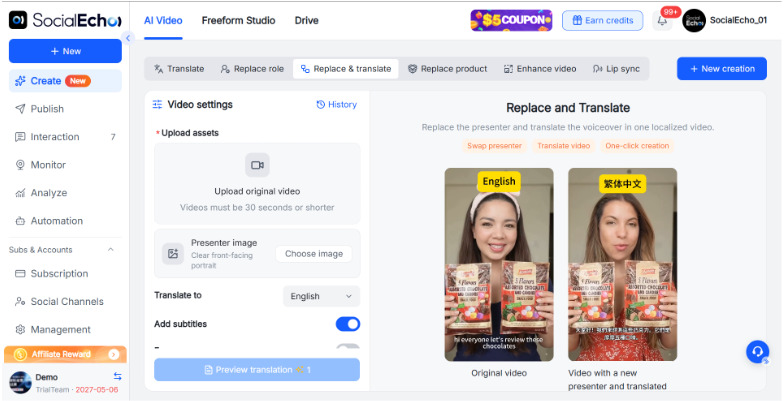
AI tools can help write social media copy, translate content, adjust tone, and prepare versions in different languages more quickly. For video, these tools can also assist with subtitles, language adaptation, and editing assets.
SocialEcho integrates AI content creation into social media workflows, helping teams prepare content for publishing and then distribute it across multiple accounts.
3. Improve Distribution with Cross-Platform, Bulk, and Scheduled Publishing
Once content is ready, distributing it accurately and efficiently to the right platforms and accounts becomes a core part of multi-account management. SocialEcho’s account management and publishing features help reduce repetitive tasks and make distribution easier to plan.
Cross-Platform Publishing: Reach More Channels
Brands often use multiple social platforms to reach different audiences. Preparing each publishing task separately means repeatedly switching between dashboards and spending more time on manual work.
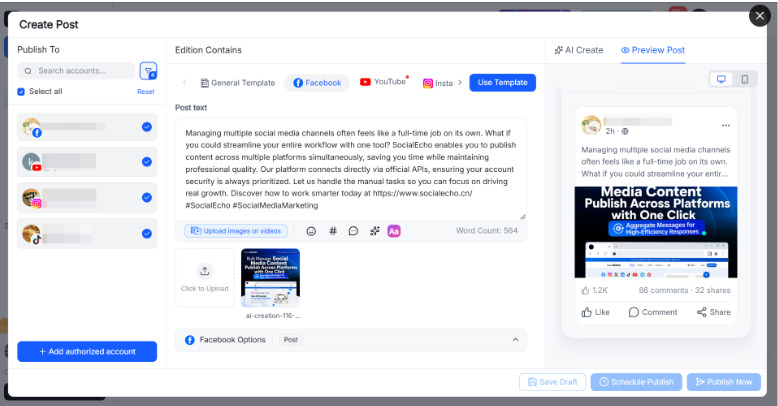
Cross-platform publishing lets teams coordinate distribution across platforms in one workflow, while adapting copy, assets, and publishing settings to each platform’s format and audience.
For example, a product launch can use one central theme to create a Facebook post, Instagram visuals, and a TikTok video, with publishing scheduled according to each platform’s needs.
The goal of cross-platform publishing is not simply to copy the same content everywhere. It is to preserve the core message while adapting the content to each channel.
Bulk Publishing: Cut Repetitive Work Across Accounts
When a brand manages several social accounts or an agency serves multiple clients, uploading content to each account one by one can take considerable time.
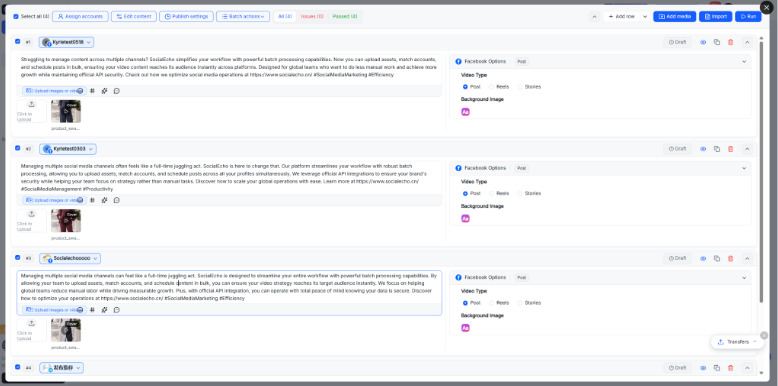
SocialEcho supports multi-account management and bulk publishing, allowing teams to organize content centrally and assign distribution tasks to target accounts with less repeated data entry.
Bulk publishing is especially useful when multiple pieces of content need to be distributed across multiple accounts. By preparing assets in advance, teams can upload assets in bulk, match them to accounts, schedule posts in bulk, and publish them in bulk through SocialEcho. This makes distribution more efficient while leaving room for platform-specific adjustments and final checks.
Scheduled Publishing: Plan Your Posting Schedule in Advance
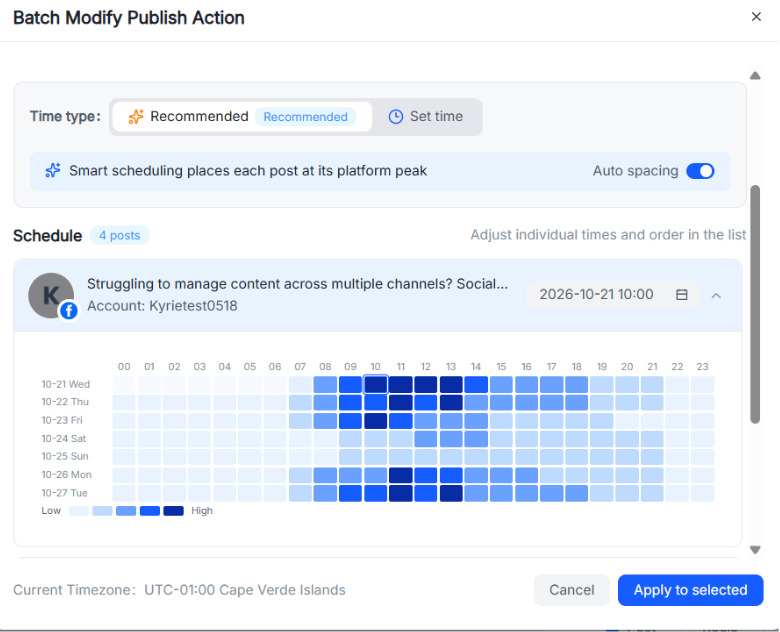
When serving international markets across time zones, publishing often needs to be planned ahead. If every post has to be published manually at a specific time, team members must keep monitoring the schedule.
Scheduled publishing separates content preparation from the actual publishing time. Teams can plan a content calendar in advance and set publishing times for each account, reducing last-minute work.
By combining cross-platform, bulk, and scheduled publishing, teams can turn scattered tasks into a more organized workflow and spend more time on content planning and optimization.
4. Use Analytics to Keep Improving Multi-Account Performance
Publishing is not the end of social media operations. Reviewing account and content performance helps teams understand how audiences respond and informs future content planning.
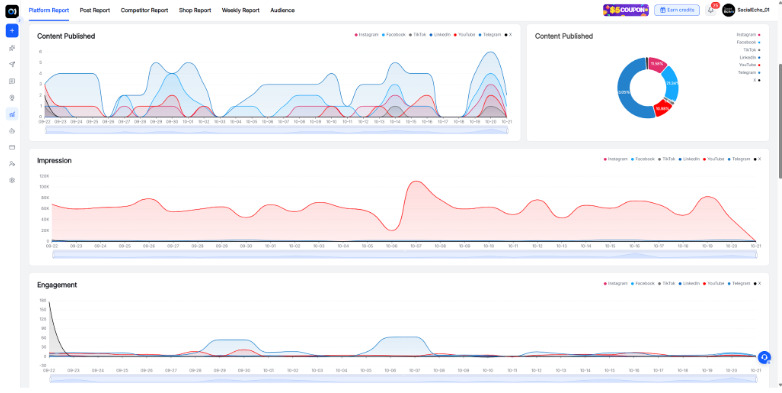
SocialEcho provides social media analytics to help teams review account and content performance, reducing the need to open each platform dashboard and compile data manually. The available metrics depend on each platform and the data it provides.
Teams can compare engagement across posts, monitor publishing activity on different accounts, and consider audience and platform differences when deciding which content to reuse or adjust.
For example, if a type of video performs well on one platform, a team can adapt it for other platforms and refine its content strategy based on the results.
This creates an iterative workflow that connects content creation, cross-platform distribution, and performance analysis.
5. Simplify Ad Payments and Track Spend Across Accounts
Media buyers, affiliate marketers, and digital marketing agencies managing multiple ad accounts need to track not only campaign performance but also payment methods, transaction records, and account balances.
Pay2.House provides virtual payment cards to help these teams manage ad payments. By assigning payment methods to specific projects or ad accounts and regularly reconciling transactions with ad bills, teams can track which costs belong to which activities more clearly.
Where supported by their payment plan, teams can also use balance management or automatic top-ups to reduce the risk of payment issues interrupting ad campaigns.
SocialEcho focuses on social content creation, publishing, and performance analysis, while Pay2.House focuses on ad payment management. Choosing the right tool for each task can reduce repetitive work and bring more structure to content operations and ad spend management.
Conclusion: Build a Scalable Multi-Account Workflow
Managing multiple social media accounts involves more than adding accounts to a single dashboard. Efficiency depends on how well content preparation, cross-platform distribution, scheduling, performance analysis, and ad payments work together.
Teams can start by using AI to repurpose existing assets and reduce the work involved in creating videos for different markets. They can then improve distribution with cross-platform, bulk, and scheduled publishing, use analytics to refine their content plans, and track costs through a clear ad payment process.
SocialEcho helps teams organize social media content creation, multi-account distribution, and performance analysis. Pay2.House provides ad payment services for media buyers, affiliate marketers, and digital marketing agencies. Defining each tool’s role and integrating them into a clear workflow helps teams manage day-to-day operating costs as they scale.
Frequently Asked Questions (FAQ)
1. How can I manage multiple social media accounts efficiently?
Use a social media management tool that supports multi-account management, cross-platform publishing, bulk publishing, and scheduled publishing to bring everyday tasks into one workflow. SocialEcho helps teams manage connected social accounts, schedule content distribution, and review relevant performance data.
2. How can I publish content to multiple social media platforms at once?
Use a social media management tool that supports cross-platform and bulk publishing. Prepare your content in advance and select the target platforms or accounts. Before publishing, check each platform’s content formats, asset requirements, and publishing settings to ensure the content fits the channel.
3. How can I schedule posts for multiple social media accounts?
Use a scheduling tool to plan a content calendar and set publishing times for each target account. This helps maintain a consistent posting rhythm and reduces manual work. Teams operating across time zones should also plan around when their target audiences are most active.
4. How can I adapt one video for different countries and markets?
Use AI video repurposing tools to adapt an existing video’s language, voice-over, subtitles, on-screen talent, products, or visual quality, then create versions for each target market. Before publishing, check translation accuracy, product details, visual quality, and audio-video sync, and confirm that you have the necessary rights for commercial use.
5. How can I manage payments and spending across multiple ad accounts?
Organize payment methods by project or ad account, reconcile ad bills with transaction records regularly, and monitor available balances and payment status. Tools such as virtual payment cards can help eligible teams manage ad spend in a more structured way.

 Telegram
 Email



Be the first to share your opinion!
We value your feedback — share your thoughts.