


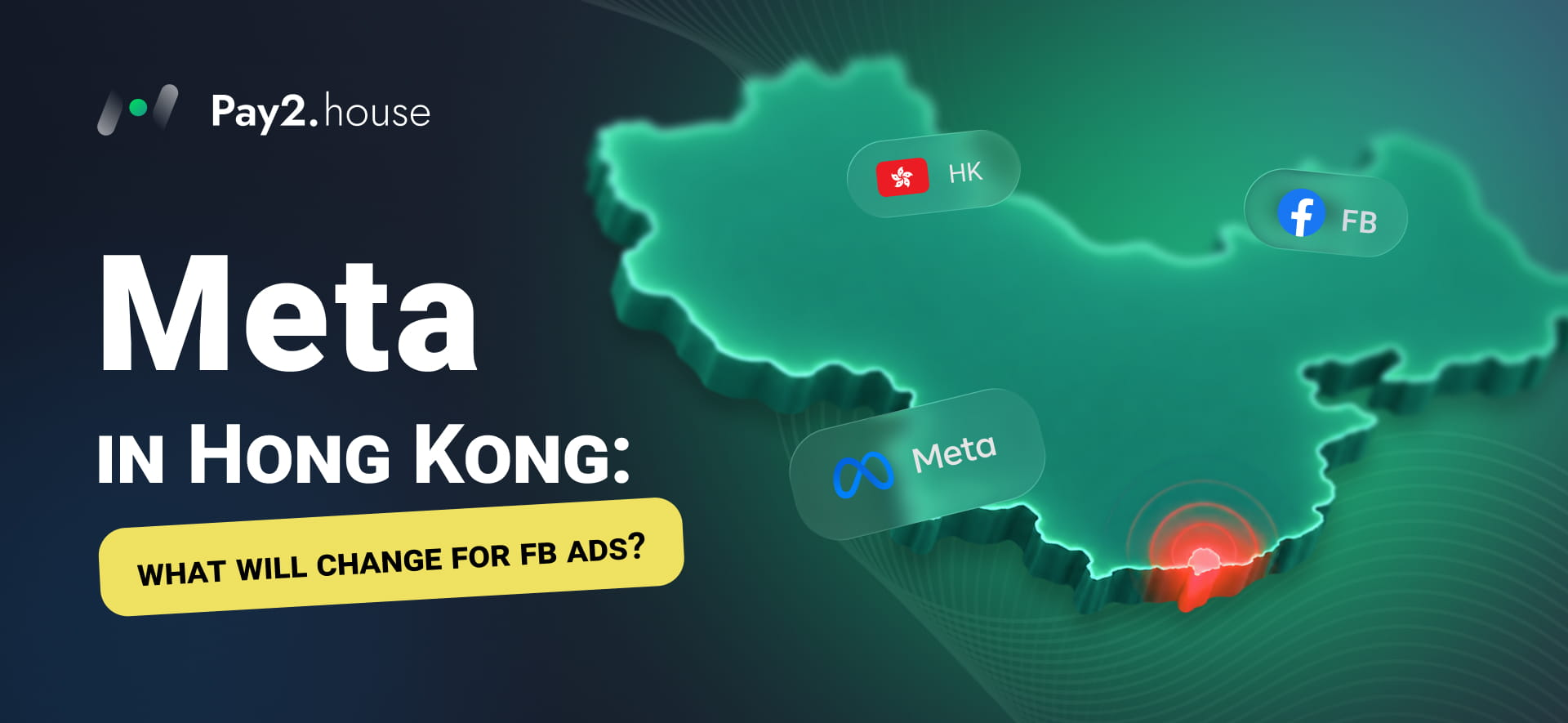
Hong Kong agency accounts have long been a popular solution for teams working with large Facebook Ads budgets. The ability to launch campaigns through resellers, utilize credit lines, and avoid paying for each account separately made this model highly convenient for scaling.
However, by late 2026, numerous questions have surfaced surrounding HK accounts. Arbitrage communities are buzzing about new advertiser verifications, changes to partner programs, and potential restrictions on agencies. Discussions intensified particularly after reports of additional verification for Chinese companies via Alipay.
Against this backdrop, some market participants are already declaring the end of the ISP model. Others continue working with agency accounts and see no reason to abandon them entirely.
So, what is actually happening? Is Meta closing Hong Kong accounts, what will happen to credit lines, and should media buyers transition to their own advertising infrastructure?
We analyze which changes are confirmed, which remain market rumors, and what teams working through resellers need to verify.
Why HK Accounts Became Popular Among Media Buyers
For a media buyer, an ad account is more than just a place to create campaigns. It determines how a team manages its budget, accesses advertising tools, and resolves restriction issues.
When a team operates across multiple GEOs, runs dozens of campaigns, and handles massive traffic volumes, the convenience of the advertising infrastructure becomes paramount.
This is precisely why agency accounts from Hong Kong gained such widespread adoption.
How the ISP Model Works
In the arbitrage community, ISP often refers to a partner model where access to ad accounts and billing is provided through agencies or resellers.
In practice, the scheme might look like this:
- An agency or partner works with the advertising platform and has access to specific tools, including credit lines, if provided by Meta.
- A reseller offers ad accounts or campaign management services to clients.
- The media buying team receives access to the agreed-upon advertising assets and launches campaigns.
- Payments are settled according to the contract terms with the intermediary, typically through an upfront deposit or periodic billing.
It is crucial to note that an agency account, a credit line, and partner status are not the same thing. Different providers operate under entirely distinct legal and payment frameworks.
Why Teams Chose Agency Accounts
The primary advantage wasn't some guaranteed "trust," but rather the organizational convenience.
- Centralized Billing. Instead of managing separate payment methods for each ad account, a team could settle accounts with a single provider.
- Handling Large Budgets. Some agencies provided access to infrastructure capable of supporting substantial ad spend. However, available limits always depended on specific agreements.
- Intermediary Support. In certain cases, the reseller assisted with advertiser registration, access rights, billing issues, and communicating about restrictions.
- Streamlined Operations. For a team managing multiple projects, working through a single partner saved significant time.
However, this model has a downside: the team's operations depend not only on Meta but also on the infrastructure provider.
If the reseller encounters problems, clients can be affected, even if their own ad campaigns comply perfectly with the rules.
What is Actually Changing in Meta's Operations in 2026
Currently, several distinct issues concerning Hong Kong accounts are being conflated: additional advertiser identification, partner programs, credit lines, and ad account quality.
Treating them as one massive global shift is incorrect.
Meta Expands Advertiser Verification
In March 2026, Meta announced plans to increase the share of ad revenue from verified advertisers from roughly 70% to 90% by year's end.
The company attributes this move to combatting fraudulent advertising and striving to increase transparency within the ad ecosystem.
For media buyers, this means Meta is paying increasing attention not just to the campaigns, but to who is actually behind them. Depending on the country, ad category, and account specifics, the platform may request identity verification, company registration details, or further information about the advertiser.
Crucially, there is no single, uniform procedure for all ad accounts. For example, since November 1, 2026, additional advertiser identification requirements apply in Thailand, while financial advertising faces separate checks in various regions.
Against this backdrop, Hong Kong draws particular attention, as changes in verification procedures for Chinese advertisers have raised questions about the future of agency accounts and reseller operations. We will examine these changes and their potential impact on media buying in detail.
New Verifications via Alipay: What We Know
In late October and early November 2026, industry publications reported an expansion of checks for Chinese advertisers using Alipay.
This primarily affects companies from mainland China opening ad accounts via Onboarding Efficiency (OE).
OE is a Meta tool used to streamline the creation of new ad accounts for Chinese businesses. The standard process involves business data, a website or app, a Facebook profile, and a Page.
According to Chinese industry sources and Meta partners, starting in November, verification via Alipay has become an additional step when opening new accounts through OE.
Confirmation may be required from the company's legal representative.
It is also reported that existing advertisers may be subject to this verification during restriction reviews or if specific risk factors are identified.
However, Meta's public materials do not contain a complete confirmation of all conditions regarding the November verification expansion.
How This Might Affect Agencies
Imagine a scenario: a reseller opens ad accounts for several companies. Previously, a significant portion of the registration could be handled by agency staff.
If the procedure now demands personal confirmation from the business's legal representative, an additional coordination step is introduced.
For an agency, this creates a need to understand in advance:
- Which company is the actual advertiser?
- Who has the authority to verify its data?
- What documents will be required for registration?
- Will the company representative be available to participate in re-verification?
- What happens if verification is requested while an ad campaign is active?
The main risk here is not the verification procedure itself, but the dependency on the person or organization required to complete it.
If a reseller cannot engage the company's legal representative, restoring access or setting up a new account could face significant delays.
However, concluding that this spells the end of all Hong Kong ad accounts is premature.
Is Meta Closing ISPs and Hong Kong Agency Accounts?
This is the most pressing question currently debated in the market.
As of November 2026, there is no confirmed public decision from Meta regarding a blanket closure of all HK accounts, the termination of the entire partner model, or a mass cancellation of credit lines.
That said, individual agencies may face new verifications, altered cooperation terms, or restrictions on their advertising assets.
To the end-user media buyer, the consequences often look identical: the account is inaccessible, campaigns are halted, and support cannot provide a specific resolution timeline.
But the underlying causes vary widely.
For example:
- A specific ad account was restricted.
- The user managing the assets lost access.
- Company verification is required.
- The service framework through the intermediary changed.
- An issue arose with payments or the credit line.
Therefore, a reseller's message stating, "Meta is closing agency accounts," does not fully explain what actually happened.
Before moving budgets or seeking a new provider, teams must determine at which level the restriction occurred.
DASR: Why Ad Account Quality Matters for Resellers
Another topic frequently surfacing in discussions about agency accounts is DASR.
DASR stands for Disabled Ad Account Spend Rate. This metric represents the proportion of advertising expenditure attributed to accounts that were disabled due to policy violations.
It is used to evaluate the quality of a partner's advertising infrastructure.
It is critical not to confuse three distinct issues here:
- Ad rejection – A specific ad failed moderation.
- Payment decline – An attempted payment was unsuccessful.
- Disabled ad account – The advertising account itself was shut down.
These are separate events. A rejected ad does not mean an automatic account disablement, and a declined payment is not a violation of advertising policy.
In original reports, these three situations were often lumped together into one metric. In practice, assessing risks this way is flawed.
Why One Client's Problems Might Affect Others
If multiple advertisers operate through an agency's shared infrastructure, the problems of one client can potentially generate additional risks for the provider.
But it cannot be stated that a single rejection automatically leads to the blocking of all accounts within a Business Manager.
The consequences depend on the nature of the violations, the asset structure, Meta's rules, and the specific context.
For a media buyer, what matters more is how effectively the reseller manages these risks.
Before starting cooperation, it is vital to inquire how the agency responds to restrictions, how it segregates client assets, and what happens to access rights and funds if services are terminated.
Where the Agency Model Truly Creates Risks
Agency accounts can still be a convenient solution, but a team must have a clear understanding of its reliance on the provider.
1. Control Over Advertising Assets
Suppose a team runs campaigns for several months, testing audiences, gathering Pixel events, and optimizing ads.
If key assets belong to the reseller's Business Manager, complications may arise regarding retaining access if the partnership ends.
Furthermore, the ad account, Pixel, Page, and datasets are distinct assets. Ownership and the ability to transfer them must be verified separately.
Before launching any work, teams should clarify who owns the assets and what rights they hold.
2. Funds on the Intermediary's Balance
The second issue involves funds transferred to the reseller.
If a team makes an upfront deposit, it is crucial to understand exactly where that money is accounted for and under what conditions the unused balance will be returned.
Not every deposit automatically converts into a balance within Meta.
A situation may arise where funds have been transferred to the intermediary but not yet applied toward advertising costs.
Therefore, when evaluating a provider, consider not just their commission rate, but also their refund policies, reconciliation timelines, and settlement terms.
3. Dependency on Support
When an ad account is owned by a third-party organization, the team cannot resolve all problems independently.
If an account is restricted, teams sometimes have to wait for the intermediary to submit a request, receive a response, and coordinate the next steps.
This is especially frustrating during active scaling phases, when even a brief downtime impacts traffic volumes and campaign results.
4. Opaque Terms
A low commission rate looks attractive, but on its own, it reveals little about service quality.
A reseller might impose additional service fees, minimum deposit requirements, special conditions for specific ad categories, or limits on withdrawing remaining balances.
Comparing providers solely based on top-up percentages is therefore a flawed strategy.
What Does Working Through a Reseller Really Cost?
Let's consider a team with a monthly advertising budget of $50,000.
Reseller fees can vary significantly. For comparison, we will use three hypothetical commission rates: 5%, 10%, and 15%. These are examples for calculation, not confirmed average market rates for November 2026.
| Reseller Commission | Ad Budget | Additional Costs |
|---|---|---|
| 5% | $50,000 | $2,500 |
| 10% | $50,000 | $5,000 |
| 15% | $50,000 | $7,500 |
The difference between the first and third scenarios is $5,000 per month.
But this does not mean that transitioning to proprietary accounts will automatically save the entire sum.
Independent operations incur costs too: card issuance and maintenance, top-up fees, potential currency conversions, software, and employee time.
Additionally, an agency might provide supplementary services that a team would otherwise need to organize internally.
How to Properly Compare Models?
You must calculate not just the commission, but the total cost of the advertising infrastructure.
For instance, if a team uses virtual cards, expenses will depend on the number of cards, the payment service's pricing tier, top-up volumes, and transaction details.
If using an agency account, you must factor in the intermediary's commission, extra services, and the contract's financial terms.
Ultimately, one model might prove more convenient during the testing phase, while the other excels during stable, high-volume ad spend.
There is no one-size-fits-all solution for every team.
Agency Accounts or Your Own Business Manager: Which to Choose?
Transitioning to proprietary infrastructure is often viewed as a way to reduce reliance on resellers.
However, comparing these approaches solely by cost is misguided.
When Agency Accounts Might Be More Convenient
This model suits teams that prioritize centralized billing, agency-provided support, and straightforward operational processes.
This is especially true if the provider operates transparently, furnishes necessary documentation, and clearly outlines cooperation terms.
When You Should Consider Your Own Ad Accounts
Proprietary infrastructure may be better if the team wishes to independently manage access rights, payment tools, and business assets.
It also facilitates building an internal process for allocating ad spend across different projects.
However, owning a Business Manager does not immunize a team against Meta's restrictions.
It too must comply with platform policies, and in certain cases, undergo verification.
Why Some Teams Use Both Models
Instead of abruptly ditching agency accounts, teams can consider a hybrid operational structure.
For example, some campaigns might continue through an agency, while select projects run on proprietary ad accounts.
This approach allows a team to assess real costs, support quality, and operational load before overhauling their entire infrastructure.
The key is to avoid using alternative accounts to circumvent Meta's restrictions. Project segregation must align with platform rules and the actual business structure.
How to Organize Ad Payments When Moving to Proprietary Infrastructure
If a team decides to manage Facebook Ads payments independently, payment tools become a daily operational component.
The goal is not just to find a card that works on the ad platform, but to establish a clear financial workflow.
For instance, when working with multiple clients, it is more efficient to segregate expenses so you aren't trying to decipher which charges belong to which project at month's end.
For this purpose, Pay2.House virtual cards can be utilized.
The service allows you to issue cards for Facebook Ads and other online platforms, track transactions, manage balances, and handle cards collaboratively within a team.
For teams needing to regularly distribute advertising budgets, features like mass card issuance, Auto Top-Up, and API management tools are also available.
When selecting a payment solution, check available BINs, currencies, fees, and terms of service in advance.
Remember: possessing a virtual card does not guarantee successful linkage to any given ad account. Meta independently determines verifications, payment method availability, and account restrictions.
A payment tool organizes expenses but does not replace compliance with advertising policies.
What Should a Media Buyer Currently Using HK Accounts Do?
If your current accounts are functioning properly, do not overhaul your entire infrastructure based on industry chat rumors.
A more productive step is conducting a brief audit of your current model.
Review the Terms with Your Reseller
Clarify which company provides the ad accounts, who owns the key assets, and what conditions apply if restrictions are imposed.
Additionally, ascertain if there are changes to the procedures for opening new accounts and passing verification.
Sort Out Access Rights
Verify who controls the Pages, ad accounts, Pixels, and datasets.
If critical assets are held by the provider, discuss options for retaining access within Meta's rules beforehand.
Assess Financial Dependency
Review how much capital is held by the intermediary, how quickly reconciliations occur, and under what conditions unused balances can be retrieved.
Avoid increasing your deposit simply because a reseller promises legacy working conditions for the long term.
Prepare an Alternative Process
It is beneficial for a team to know in advance what actions to take if their provider stops servicing ad campaigns.
This could involve utilizing proprietary infrastructure, switching to another vetted partner, or distributing projects across several acceptable service models.
However, this alternative process must be technically and financially prepared, not just exist as an informal chat agreement.
If an Agency Account is Stopped: Where to Begin
Imagine a team running a large ad budget receives a notification that their account is inaccessible.
The initial impulse is to urgently find a replacement and migrate campaigns. But first, establish the cause.
- If ads were rejected, check the reasons for the rejections and verify compliance with platform policies.
- If the ad account was restricted, determine the reason, review available appeal procedures, and clarify who holds the authority to submit a request.
- If business verification is required, confirm who must complete it and what documentation is needed.
- If the issue lies with the reseller, clarify the status of provided assets, available funds, payments, and future service.
- If a payment failed, diagnose the problem separately: check billing details, balances, transaction history, and billing notifications.
Lumping these distinct situations into a single "Meta banned agency accounts" narrative is unhelpful.
Accurate diagnosis determines whether a team can restore operations without incurring additional costs.
FAQ
Is Meta Really Closing All HK Accounts?
As of November 2026, there is no public confirmation of a mass closure of all Hong Kong ad accounts. Individual restrictions and changes in agency terms do not signify the shutdown of the entire sector.
What Will Happen to ISPs and Credit Lines?
The market is discussing potential modifications to partner models, but there is no officially confirmed cancellation of all Meta credit lines.
Cooperation terms must be clarified directly with specific providers.
Do All HK Account Holders Need to Pass Alipay Verification?
There is no evidence of a universal requirement for all HK account holders. Reports regarding the new procedure relate primarily to Chinese advertisers utilizing OE, and specific cases involving re-verification.
Should We Fully Transition to Proprietary Ad Accounts?
This depends on your expenses, business structure, and the team's readiness to independently manage ad infrastructure.
Proprietary accounts grant more direct control over assets and billing, but they do not bypass Meta's checks and restrictions.
Can Virtual Cards Be Used Instead of an Agency Credit Line?
If the ad account supports card payments, virtual cards can be utilized to fund ads.
However, a credit line and card billing are fundamentally different models. The feasibility of switching must be verified for each specific ad account.
Conclusion
It is premature to declare the definitive end of the Hong Kong agency account era. Yet, the changes in 2026 indicate that the market is increasingly demanding transparency from advertisers and those operating through intermediaries.
For arbitrage teams, the central question today is not whether HK accounts will vanish, but the extent to which their business relies on a single provider.
If a team lacks control over its advertising assets, fails to grasp its billing structure, and does not know how to respond to restrictions, even a familiar operational model can become a source of financial risk.
Therefore, the best preparation isn't a rushed migration from one model to another, but establishing a clear infrastructure: transparent access rights, vetted partnership terms, manageable budgets, and a predefined action plan.
This approach empowers a team to maintain control over its operations, regardless of whether it utilizes agency accounts or proprietary advertising infrastructure.



 Telegram
 Email






İlk yorumu siz yapın!
Görüşlerinizi önemsiyoruz; düşüncelerinizi bizimle paylaşın.