


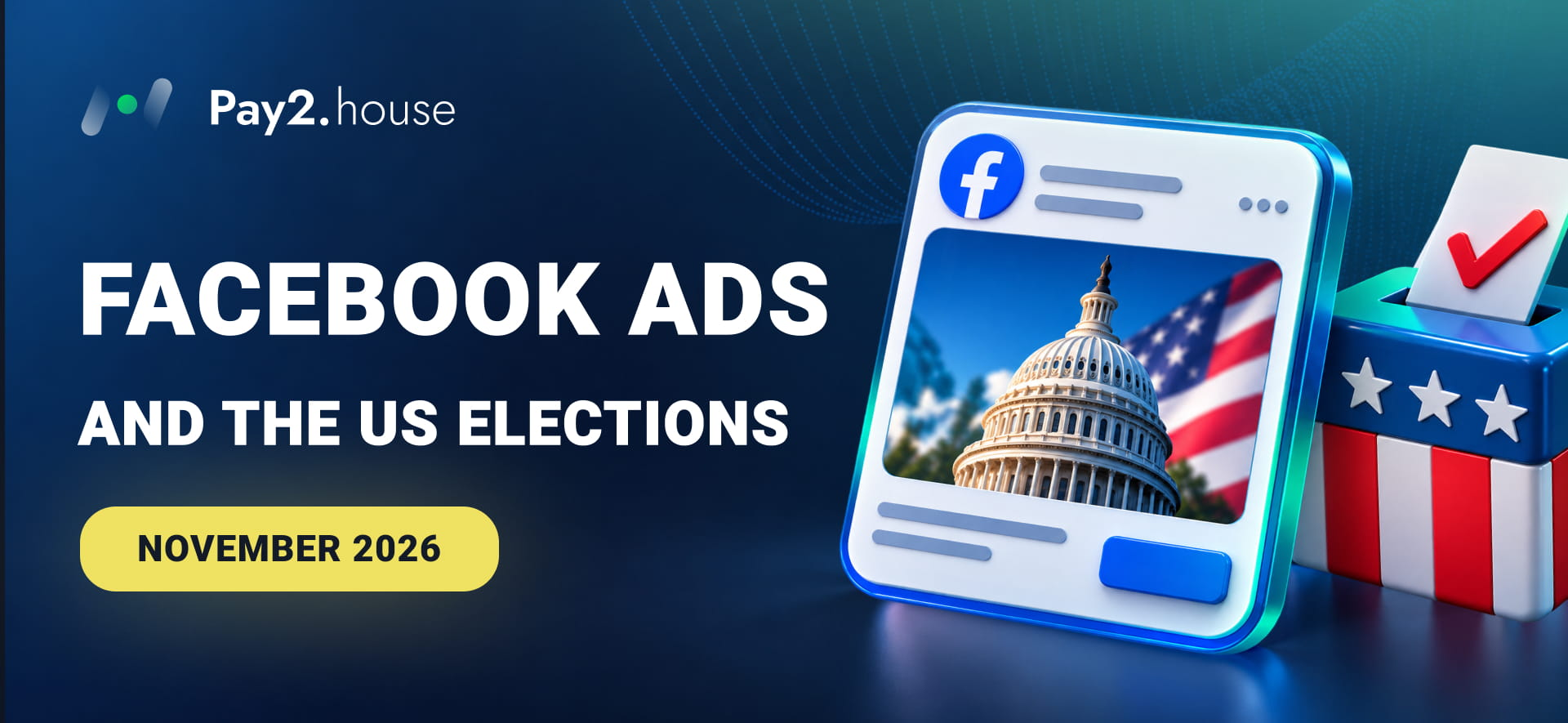
In affiliate marketing, there are periods when a familiar setup suddenly starts behaving differently than it did yesterday. Accounts get banned for no obvious reason, fresh autoreg accounts fail verification, Business Managers receive restrictions, and ad campaigns stop spending their usual volume. These problems can hit teams working in completely different verticals, from white hat offers and e-commerce to nutra and gambling.
One of the periods that affiliates traditionally watch closely is the American election season. In 2026, the US midterm congressional elections will take place on November 3. Meta has not announced mass blocks of commercial accounts in connection with this event, but the experience of previous election cycles shows why advertising infrastructure deserves extra attention during this period.
Let's look at what happened to Facebook Ads before, why elections can become an additional source of instability, and which problems teams that buy traffic should keep in mind.
Why Facebook Ads Can Get Turbulent During Elections Across All Verticals
The first thing to understand is that this is not only about political advertisers. In the affiliate space, the pre-election period matters mostly because of how it overlaps with the normal operation of the ad platform.
During major elections, political campaigns compete for the audience's attention. At the same time, in November the active part of Q4 begins: sales, Black Friday, Cyber Monday and preparation for the holiday season. Ad budgets grow, and advertisers from different segments start competing for the same audiences.
This can affect auction costs and campaign performance in different niches.
But growing competition for audiences is only one side of the issue. Affiliates are also worried about other things: ad account restrictions, unstable delivery, sudden changes in limits, and situations where a campaign is active but spend barely moves.
It is important not to mix up the causes here. Increased competition can influence the cost and effectiveness of ads, but by itself it does not explain an account ban or a stop in spending. And there is no basis to claim that all such problems are caused directly by the elections.
For teams working with white hat, nutra, gambling and other verticals, the practical takeaway is the same: do not assume that November will be a normal month just because your ads have nothing to do with politics.
What Happened During the US Elections in 2020, 2022 and 2024
To understand what to expect in November 2026, it helps to look at previous election cycles.
2020: A Technical Failure in Facebook's Ad Tools
In late October 2020, a few days before the presidential election, Facebook ran into technical problems in its advertising tools. The failure affected political campaigns of both parties and coincided with the introduction of restrictions on new political ads during the final week before the vote.
The company explained the situation as a combination of technical problems and confusion around the new rules. The incident became a reason to criticize the platform's readiness for a period of heavy load and heightened attention to political advertising.
For affiliates, what matters here is not the ban on political ads itself, but the fact that at the peak of the election campaign it was their ad launches that ran into a technical failure.
At the same time, this case does not prove that commercial accounts in all verticals suffered in a similar way. It shows something else: even a large ad platform is not immune to technical problems during a period when its processes and rules are changing.
2022: Political Ad Restrictions Became Part of the Usual Scenario
During the 2022 midterm elections, Meta again restricted the launch of new ads about elections, politics and social issues in the last week before the vote.
This approach had already been used in 2020. So by 2026, restrictions on political advertising are not a new measure that suddenly appears before another election.
However, Meta's public materials do not confirm that the elections in 2022 caused a mass ban wave of ordinary commercial ad accounts. It is important to separate official restrictions on political advertising from the problems that affiliates report in affiliate communities.
What Can Go Wrong in November: Problems Affiliates Know Well
When affiliates talk about a pre-election storm, they usually mean not one specific problem but a whole set of scenarios.
Profile or ad account loss. You can lose access to managing ad assets, face an ad account restriction, or get individual ads rejected. These are different situations, although in a team chat they may all be described with a single word – "ban."
Problems with autoregs and farmed accounts. Teams that work with prepared profiles and accounts may face additional checks or restrictions. At the same time, there is no confirmed data that the 2026 elections will automatically make autoreg accounts less durable. The outcome depends on the state of the specific account, compliance with Meta's rules and other factors.
Problems with linking and access. If the profile used to manage a Business Manager receives restrictions, it can complicate work with ad assets. Losing access to a profile and a ban on the ad account itself are not the same thing, so it is important to understand at which level the problem occurred.
Spend is not moving even though everything is active. Campaigns, ad sets and creatives may show as active, but actual delivery turns out to be much lower than expected or stops completely. Media buyers described similar situations in 2026 as well, but without diagnostics they cannot automatically be blamed on a general Meta failure.
Spend limit suddenly changes. If an account hits a spending restriction, increasing the campaign budget will not necessarily help. The daily budget and the ad account limit are different parameters, and they need to be considered separately.
Risk payment and declined transactions. Payment problems can come with ads being stopped or with additional restrictions. But a single declined payment does not prove that the account has fallen under a general pre-election filter.
All of these scenarios are familiar to the advertising market regardless of elections. What is special about the pre-election period is that it coincides with increased advertising activity and can amplify the consequences of any problems that arise in a working setup.
Why the Same November Can Play Out Differently for Different Verticals
There is no universal scenario for all affiliates. Even if teams work on the same platform, their results can differ greatly.
In white hat and e-commerce, extra competition for the audience can affect customer acquisition cost and campaign payback. In nutra and other performance verticals, not only the auction matters, but also passing moderation, account stability and the quality of ad materials. In gambling and other sensitive categories, additional difficulties may be related to the platform's existing restrictions and advertising requirements.
So it would be incorrect to claim that elections affect all verticals equally or that a ban wave will necessarily be massive. But assuming that the political season concerns only political advertisers is also too simplistic.
For an affiliate, it is more important to track the actual changes in their own setup: how CPM and cost per result are changing, whether delivery is stable, whether account restrictions have changed, and whether there are any payment problems.
What to Consider Before November 2026
Instead of trying to guess the date of the next ban wave, it is more useful to understand which events really affect ad performance.
First, follow changes to Meta's official rules, especially if your campaign touches political or socially significant topics. The company has confirmed that in the last week before the 2026 elections it will restrict new ads in the relevant categories. This is not a general ban on commercial advertising.
Second, evaluate delivery changes based on actual data. If spend dropped or the cost per result increased, do not automatically blame everything on the elections. You need to separate auction changes from account restrictions, campaign issues and payment errors.
Third, take Q4 seasonality into account. November is not only about elections, it is also the start of the active sales period. Growing competition for the audience can coincide with other changes, so it is better to compare metrics with the season and the specific geo in mind.
Finally, do not confuse user observations with confirmed causes. If complaints about account losses and spending problems appear in affiliate communities at the same time, it is a reason to monitor the situation closely, but not proof that all cases are related to the elections.
How Payment Infrastructure Relates to Spend Stability
Advertising problems do not always start with moderation. Sometimes a campaign stops because of a payment instrument, spending limits or a failed transaction.
For teams that use virtual cards, it is important to consider the terms of the specific service: available limits, currencies, fees and top-up rules. This helps organize ad spending, but it does not affect Meta's decisions about blocking accounts and does not guarantee uninterrupted spend.
Pay2.House provides virtual cards for paying for online services, including advertising platforms. For teams that work with several ad accounts and significant payment volumes, payment infrastructure is one of the elements of the overall workflow.
It is important to remember, however: a virtual card does not solve the problem of a profile ban, does not guarantee a higher spend limit and does not remove moderation restrictions. Its purpose is to provide a convenient payment tool within the available terms.
Conclusion: The Pre-Election Storm Is a Reason to Look Beyond a Single Ad Account
The experience of previous elections shows that Meta introduces special restrictions for political advertising, and in 2020 the platform's ad tools did face technical problems. User discussions in 2024 also recorded complaints about reduced spend limits, ad rejections and unstable ad results during a period when the elections coincided with an active Q4.
But this does not mean that a mass ban wave across all verticals will necessarily happen in November 2026. There is no official confirmation of such a scenario.
For affiliates, something else matters more: do not assume that the problems affect only political advertising, and at the same time do not attribute every account loss or spend stop to the elections. In November, it is worth tracking more closely how your setups actually perform, changes in the auction, the state of your ad accounts and payment restrictions.
In affiliate marketing, stability is determined not only by how well a campaign is set up, but also by how quickly the team understands what exactly has stopped working. And in a period when the elections coincide with an active Q4, this becomes especially important.
To pay for your ad expenses, use Pay2.House virtual cards. Register, activate the promo code START15 and get $15 on your bonus balance for issuing cards.



 Telegram
 Email
Email




Be the first to share your opinion!
We value your feedback — share your thoughts.