


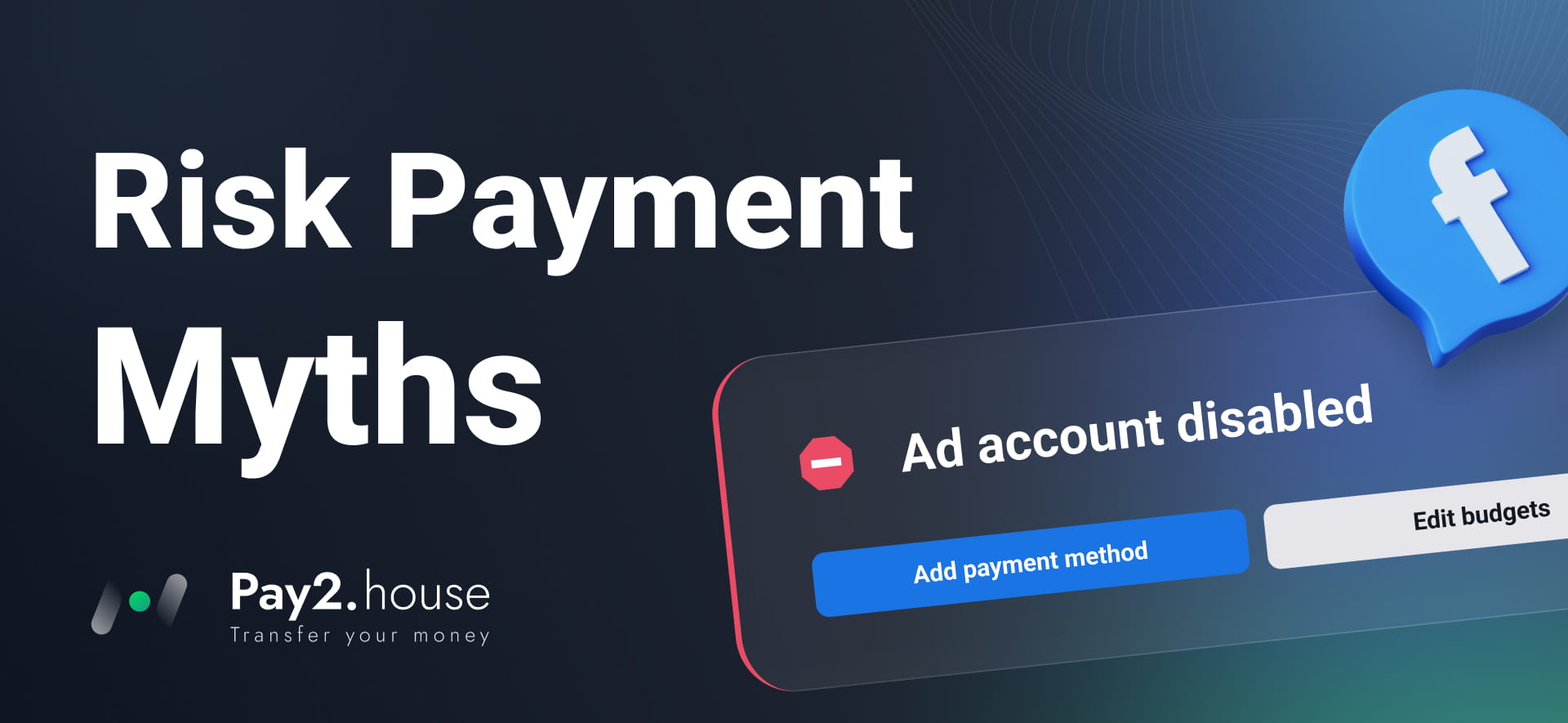
Risk payment in Facebook Ads is one of the most common problems for affiliate marketers and media buyers. It is especially relevant for those who are just starting to work with ad accounts, virtual cards and a large number of advertising assets.
Beginners often look for the reason for payment restrictions in the wrong place. Some believe that Facebook can send an account into risk payment because of the cardholder name. Others think the problem is the absence of 3DS. Some are sure that the card must always have a large balance.
In practice, it works differently. Facebook does not evaluate one small detail, but the entire payment and advertising setup. That is why it is important to separate real risk factors from myths that often appear in chats and make normal work harder.
What really affects risk payment
There are three key factors that can actually increase or reduce the risk of payment problems in Facebook Ads.
1. A high-quality advertising setup
Facebook looks at the full context of the ad launch. The card and payment method matter, but so do the account itself, proxy, environment, antidetect browser, action history and launch logic.
If the setup looks unstable or suspicious, the risk of payment restrictions becomes higher.
For example, problems may appear if:
-
the account looks weak or poorly prepared;
-
a low-quality proxy is used;
-
the environment does not match the logic of the account;
-
the ad account is launched too aggressively and without a proper warm-up logic;
-
one account has too many failed payment attempts.
In such cases, the issue is not one card, but the entire combination of factors.
2. Reliable advertising assets
Stable work requires proper advertising assets: accounts, cards, proxies, antidetect tools and payment infrastructure.
If one element of the setup is weak, it can affect the entire launch. For example, even a good card will not fix the situation if the account is already problematic or the environment looks unnatural.
For Facebook Ads, it is especially important that all assets match each other and do not create unnecessary suspicion.
3. A clean BIN
A BIN is the first digits of a card number. It identifies the issuing bank, card type, country and payment network.
If a BIN has already been widely used in suspicious setups, has often generated declines or has become known as problematic, the risk of payment restrictions may be higher.
That is why it is important to use working and clean BINs, not just any virtual card.
Popular myths about risk payment
Now let us look at what is often considered a reason for risk payment, although in practice these are not the main factors.
Myth 1. The cardholder name must match the account name
One of the most popular myths is that if the card is issued under one name and the Facebook account uses another name, this alone causes risk payment.
In practice, Facebook does not see the cardholder name in the same way as a bank or payment provider does. Therefore, a name mismatch itself is not a direct reason for risk payment.
But there is an important nuance.
If the account goes into manual review, a moderator may pay attention to the overall logic of the data. That is why it is better not to use completely random or illogical information.
The correct approach is simple: the data does not have to be perfect, but it should look logical and should not raise extra questions.
Myth 2. 3DS reduces risk payment
3DS is an additional payment confirmation: a code, push notification or another verification method from the bank.
Many people believe that having 3DS makes a card more reliable for Facebook Ads and reduces the risk of payment restrictions.
In practice, 3DS is not a key factor for risk payment. It may be convenient or inconvenient for the user, but by itself it does not solve the payment risk problem in Facebook.
If the setup is weak, 3DS will not save it. If the setup is normal, the absence of 3DS will not necessarily create a problem.
Myth 3. The card must have a large balance
Another common myth is that a card with a small balance supposedly looks suspicious to Facebook.
In practice, a large card balance is not a factor that by itself reduces risk payment.
It is much more important that the card works properly, fits the task and does not belong to a problematic BIN. It is also important not to bring the card to a negative balance and not to create a series of declined transactions.
If the card has enough funds for the planned charge, that is already enough. A large reserve of money on the card does not make the setup safer.
What you need to remember
Facebook does not send an account into risk payment simply because of the cardholder name, the presence or absence of 3DS, or the size of the card balance.
The main reasons are usually deeper:
-
a weak advertising setup;
-
poor or unprepared accounts;
-
low-quality proxies and environment;
-
problematic cards;
-
overused or burned BINs;
-
frequent declined transactions;
-
illogical payment activity.
So instead of looking for the cause in small details, it is better to analyze the whole setup.
How to reduce the risk of payment problems
To work more steadily, it is important to build proper payment infrastructure:
-
use a separate card for each advertising account;
-
do not make many failed payment attempts in a row;
-
monitor the card balance in advance;
-
do not use the same payment approach for every account;
-
work with quality accounts, proxies and antidetect tools;
-
choose working BINs for the specific task;
-
unlink old or blocked cards in time.
Risk payment is not a random error caused by one detail. It is usually the result of a general evaluation of the account, card, payment history and advertising setup.
Conclusion
You should not believe every piece of advice from chats. The cardholder name, 3DS and a large balance are not the main reasons for risk payment in Facebook Ads.
What matters most is the quality of the full setup: account, card, BIN, proxy, antidetect browser, launch history and payment behavior.
If the setup is built poorly, small tricks will not help. If the setup is high quality, the risk of problems becomes lower.
A clear head, reliable advertising assets and proper payment infrastructure are much more useful than myths and scare stories.


 Telegram
 Email
Email





Be the first to share your opinion!
We value your feedback — share your thoughts.