


Short answer: You can buy a Facebook Business Manager — verified or aged, with or without an attached ad account — from marketplaces, individual sellers, and single-supplier stores such as AccsZone, which lists Facebook Business Manager and ads-account products with USA IP registration, email access, and instant, automated delivery backed by a replacement warranty. Before buying anywhere, check the account type, its history, what's included (email access, 2FA, cookies), and the seller's delivery and support process — a verified or aged label alone never guarantees ad approval or scaling.
If you're searching for where to buy a Facebook Business Manager, you're probably trying to launch or scale campaigns without waiting out Meta's slow account-warming process. This guide covers what a Facebook Business Manager actually is, the different account structures available, what to check before buying a verified or aged BM, how the AccsZone purchase process works, and how advertisers commonly fund campaigns once an account is set up — including virtual-card options through Pay2.House.
What Is a Facebook Ads Account?
A Facebook ads account is the combination of a personal Facebook profile and an ad-management layer — either a personal Ads Manager or a Business Manager (recently rebranded by Meta as Business Portfolio) — that lets you create campaigns, set a budget, and run ads across Facebook and Instagram. Every ad on Meta's platforms runs through an ad account tied to a profile, so the underlying profile's status, verification level, and history directly affect what the ad account can do.
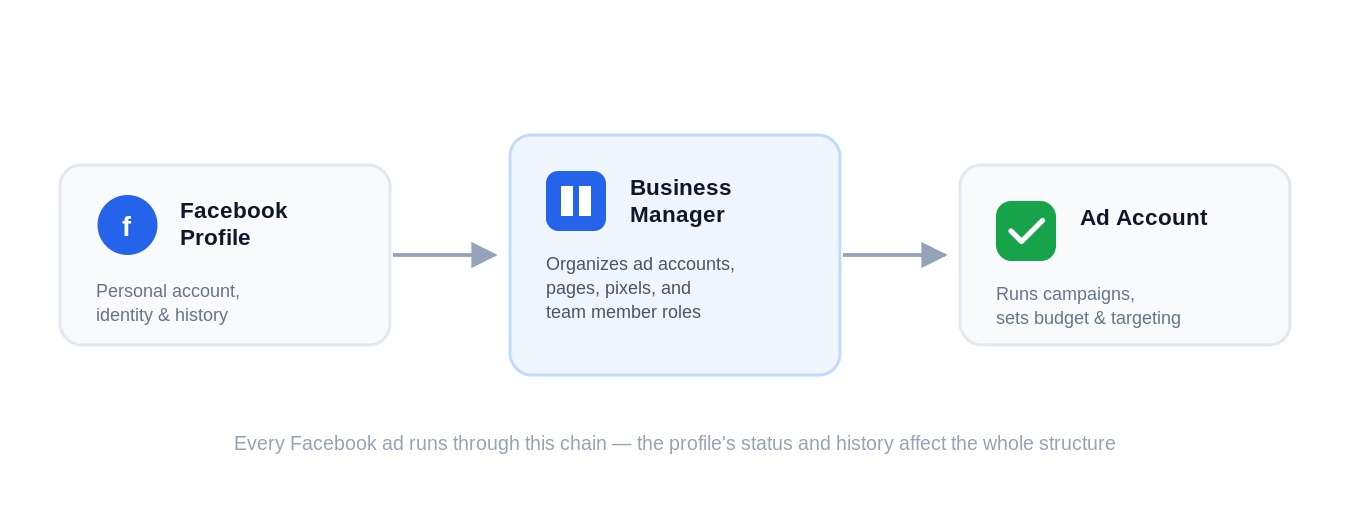
In practice, "buying a Facebook ads account" usually means buying a profile that already has an ad-management layer configured and, in many cases, activated — so a buyer doesn't have to build that structure themselves from a brand-new profile.
Why Do Advertisers Buy or Use Different Ads Account Structures?
New Facebook profiles typically need a warm-up period — adding friends, posting, using the account normally — before Meta trusts it enough to run ads reliably. That process can take days or weeks, which is slow for anyone who needs to launch campaigns now. Common, legitimate reasons advertisers look at pre-configured or aged ad accounts instead of starting from zero:
-
Agencies and media buyers managing several client accounts who need to separate budgets and campaigns across distinct ad accounts.
-
E-commerce businesses that need to launch a campaign quickly around a product drop or seasonal push.
-
Affiliate marketers running multiple offers who need account structures that match each vertical.
-
Freelancers and consultants who need a dedicated ad account per client rather than mixing everything into one.
-
Businesses replacing a disabled or restricted account and needing to get back to advertising without a lengthy rebuild.
In every case, the ad account is a tool for running campaigns within Meta's advertising policies — not a way around them. Meta's own Advertising Standards and Business Help Center apply to every ad account regardless of how it was set up.
Types of Facebook Advertising Accounts
Not all Facebook advertising accounts are structured the same way. Here's a general comparison:
| Account Type | Best For | Main Consideration |
|---|---|---|
| Personal Ad Account | Individual advertisers running one or two campaigns | Limited business-management flexibility; tied directly to one profile |
| Business Manager / Business Portfolio | Teams, agencies, and multi-account operations | More structured management, roles, and asset sharing across users |
| Aged Account | Buyers seeking an account with established history | History is only one factor — it does not guarantee approval, higher limits, or fewer restrictions |
A Business Manager (Meta's business-management layer) lets a company or agency organize ad accounts, pages, pixels, and team members under one structure with defined roles and permissions — which is why most accounts sold for advertising purposes include an activated Business Manager rather than just a personal Ads Manager.
What Should You Check Before Buying an Ads Account?
Whatever marketplace or seller you use, review these points before purchasing:
-
Account type — personal ad account vs. Business Manager–enabled, and how many BMs are attached.
-
Age and history — when the underlying profile was created, and whether that's disclosed and verifiable.
-
Current status — whether the account and any attached BM are currently active with no existing restrictions.
-
What's included — email access, password, 2FA method, cookies, recovery details.
-
Product description accuracy — does the listing clearly state IP/region, verification method, and friend count (if any)?
-
Delivery method — instant/automated delivery vs. manual, seller-coordinated handover.
-
Support and replacement terms — what happens if the account doesn't work on first login.
-
Seller reputation — sales history, stock transparency, and how long the seller has operated.
-
Platform-policy considerations — any account you buy still has to be used within Meta's advertising and account-authenticity policies.
Where to Buy Facebook Ads Accounts
Buyers generally choose between three types of sources:
-
Peer-to-peer marketplaces where individual sellers list accounts, often with escrow protecting the transaction.
-
Freelance or forum sellers, which carry more variability in quality, communication, and delivery time.
-
Single-supplier stores that produce and list accounts directly, with a fixed product catalog, visible stock counts, and a standardized delivery process.
When comparing providers, the same checklist above applies: look at what's actually written in the product description, not just the headline claim, and confirm how disputes or non-working accounts are handled before you pay.
Why Consider AccsZone?
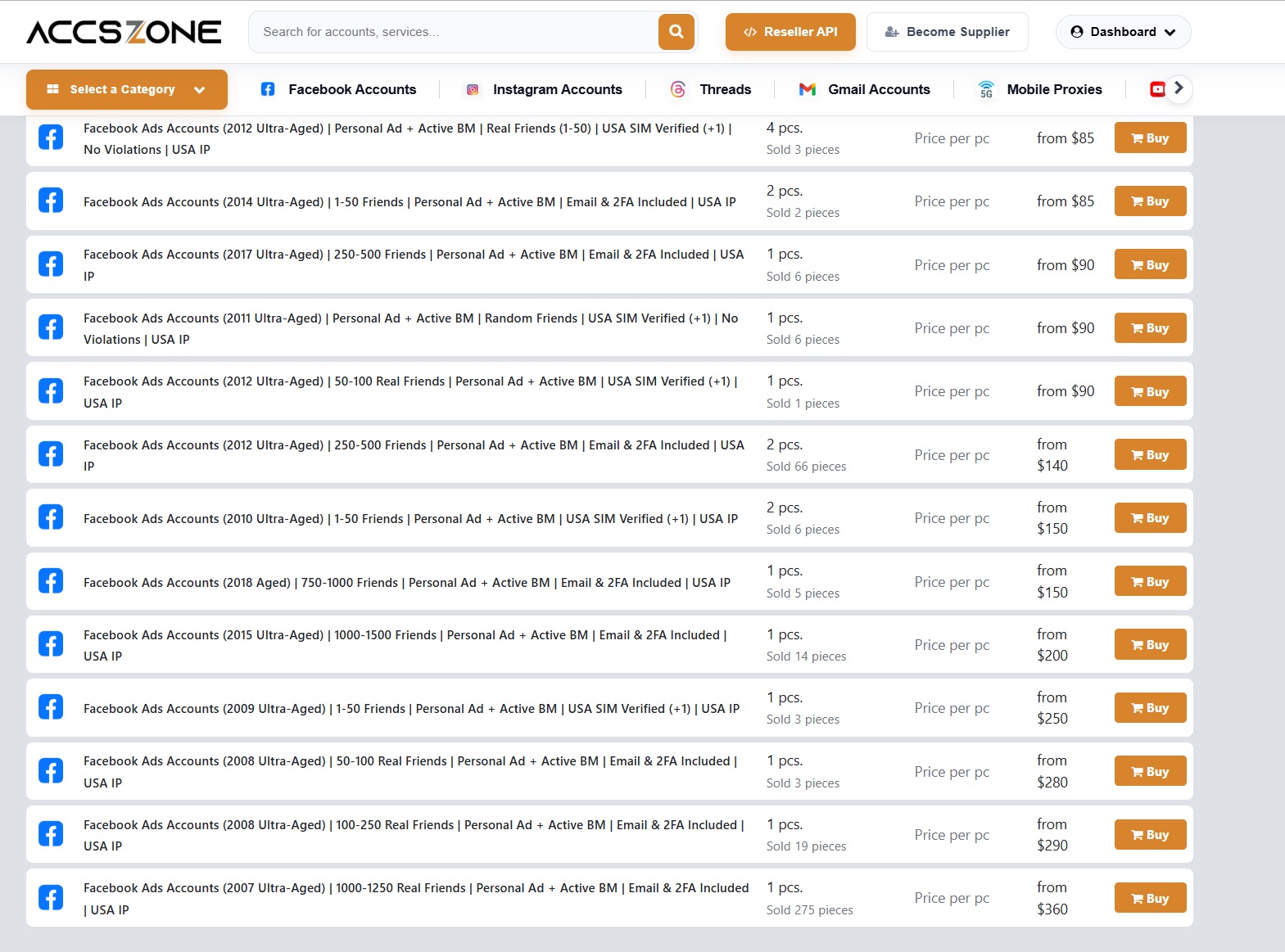
For buyers comparing account marketplaces, AccsZone is one option worth considering because it lists Facebook advertising accounts as a dedicated product category rather than mixing them in with general social accounts. Each listing shows live stock, unit pricing, and a specification list, so buyers can compare products directly instead of messaging a seller back and forth.
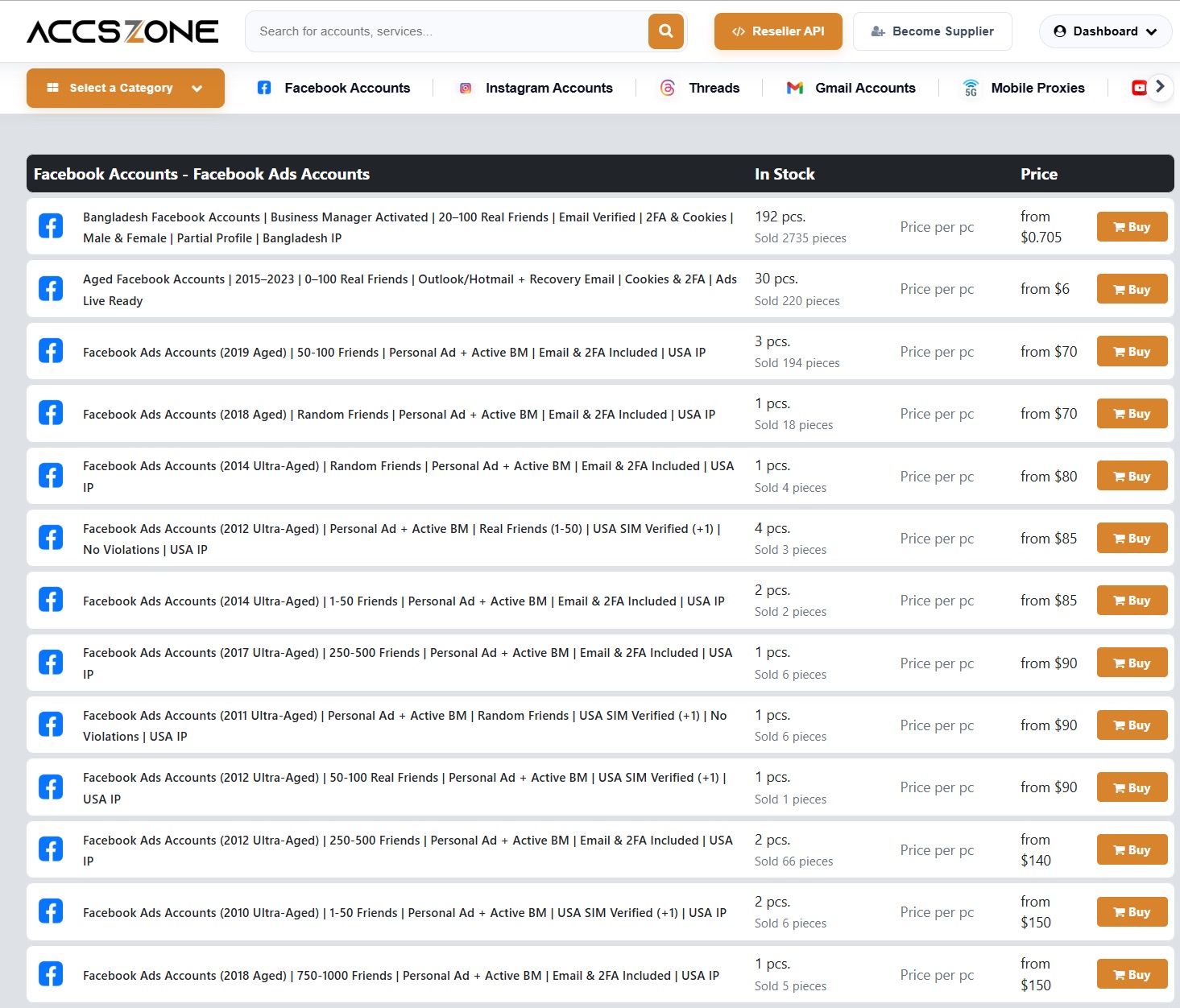
What's currently listed in AccsZone's Facebook Ads Accounts category, as an example of the range on offer:
| Product | Specification | Starting Price |
|---|---|---|
| Bangladesh Facebook Accounts | Business Manager activated, 20–100 friends, email verified, 2FA & cookies | from $0.71 |
| Aged Facebook Accounts (2015–2023) | 0–100 friends, Outlook/Hotmail + recovery email, cookies & 2FA, ads-live ready | from $6.00 |
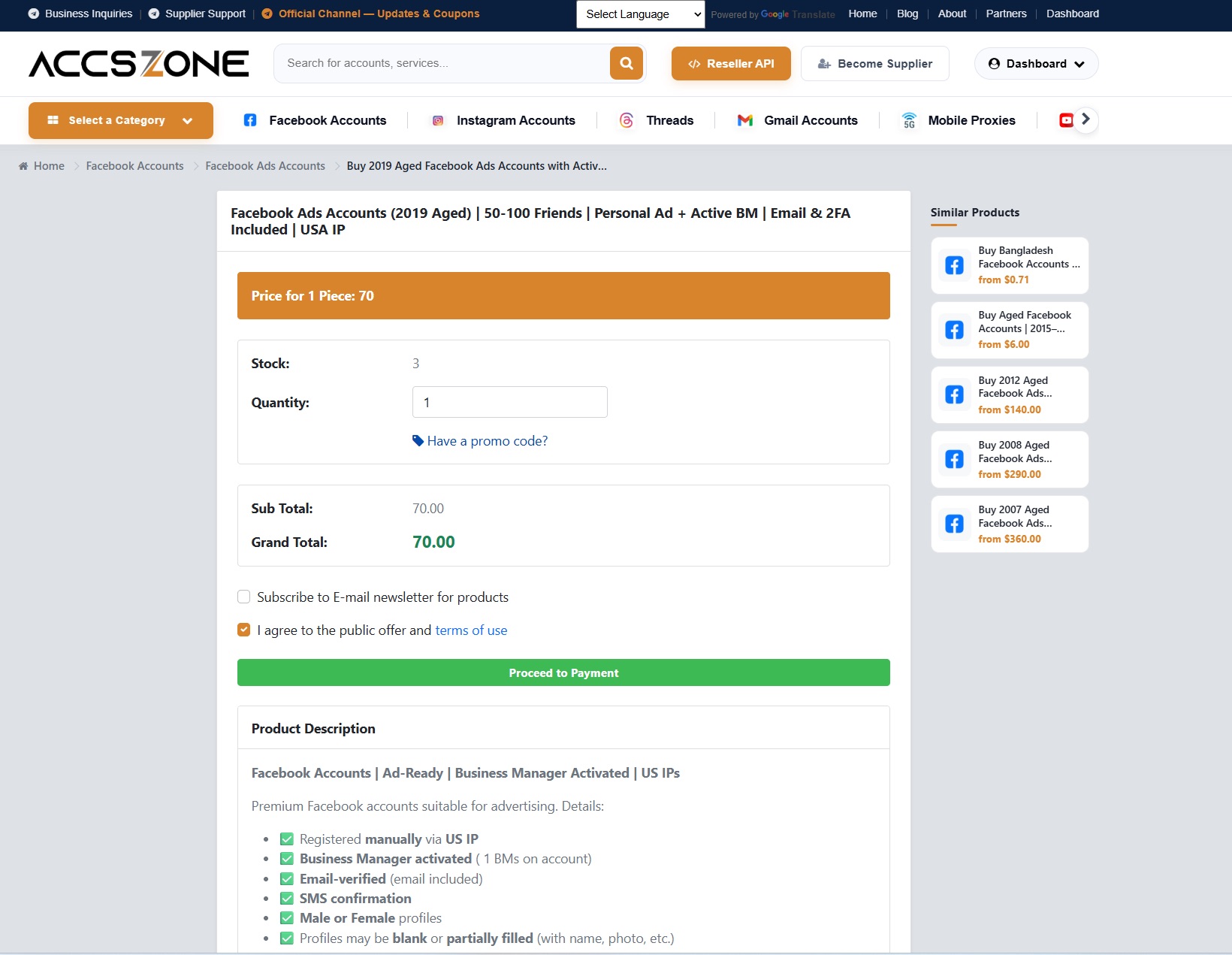
| Facebook Ads Accounts (2019 Aged) | 50–100 friends, Personal Ad + active BM, email & 2FA included, USA IP | from $70 |
| Facebook Ads Accounts (2012 Ultra-Aged) | Personal Ad + active BM, 1–50 real friends, USA SIM verified, no violations, USA IP | from $85 |
| Facebook Ads Accounts (2007 Aged) | Active BM, 1,000–1,250 friends, USA IP | from $360 |
Exact stock, pricing, and available listings change over time — check the live category page for current availability before purchasing.
Beyond the product range, a few things are worth noting about how AccsZone operates:
-
Detailed product descriptions. Listings specify registration method (manual, USA IP), verification type (email, SMS), what's included (email access, 2FA), and friend count where relevant — so buyers know what they're getting before checkout.
-
Visible live stock. Each listing shows exact units in stock and units already sold, rather than a vague "available" label.
-
Instant, automated delivery. Orders are delivered through the platform immediately after payment, without waiting on a seller to manually hand over credentials.
-
Replacement warranty. AccsZone states that every order includes a replacement warranty and escrow-safe checkout.
-
Bulk and single-unit purchasing. Listings support ordering one account or multiple units of the same product.
-
A broader catalog. AccsZone also lists Google Ads accounts, Instagram, Gmail, and 40+ other categories, which is useful if your advertising stack spans more than one platform.
None of this changes the underlying reality: any Facebook ads account, however it's sourced, operates under Meta's policies. Account history and setup are a starting point, not a guarantee.
How to Buy a Facebook Ads Account From AccsZone
-
Visit AccsZone and open the Facebook Accounts category.
-
Select "Facebook Ads Accounts" from the subcategory list to see only ad-ready listings.
-
Compare available products by account age, region, and what's included.
-
Read the full product description — registration method, verification type, friend count, and data format.
-
Check live stock shown on the listing before ordering.
-
Choose your quantity — single unit or bulk, depending on the listing.
-
Proceed to payment and complete checkout.
-
Receive your account through the platform's automated delivery, typically formatted as email, password, 2FA, and recovery details.
-
Follow the onboarding steps below before actively using the account for campaigns.
What to Do After Receiving Your Account
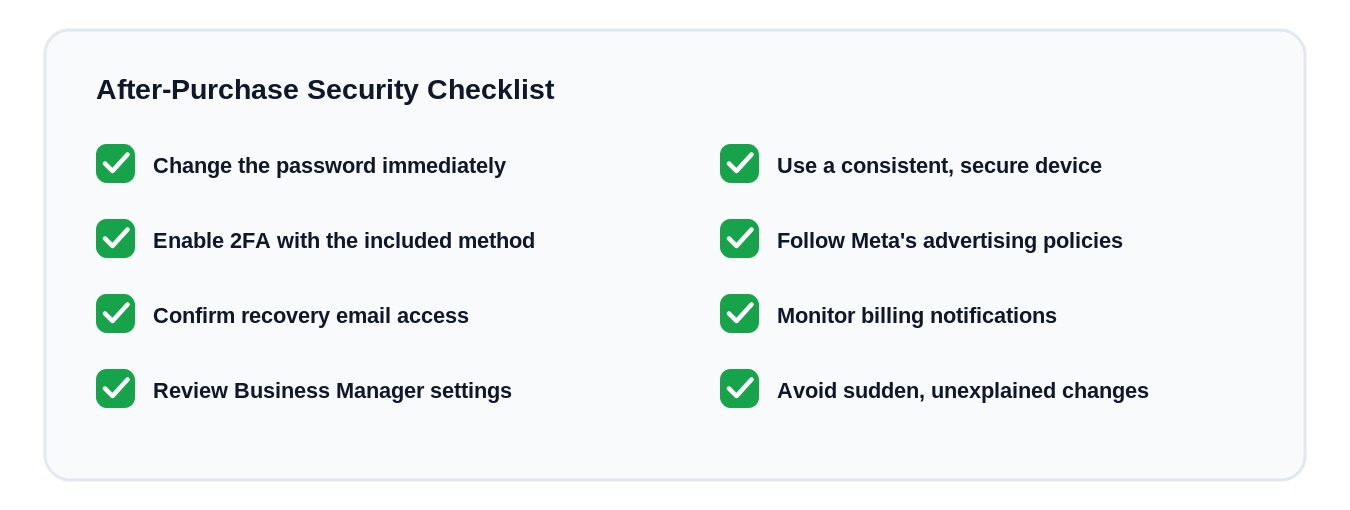
Once you receive login credentials, treat onboarding as seriously as the purchase itself:
-
Secure the credentials immediately — change the password and store the new one in a password manager, not a plain text file.
-
Log in through the email account first to confirm access to recovery email, then to Facebook itself.
-
Enable and store 2FA properly using the method included with the account (authenticator app or included 2FA key).
-
Review account and Business Manager settings before making any changes — confirm what's already configured rather than guessing.
-
Upload a profile photo if the listing recommends it, since this can help with account recovery if Meta requests self-identification.
-
Use a consistent, secure device and network when logging in and managing the account, rather than switching environments unpredictably.
-
Follow Meta's advertising policies for the campaigns you run — the account's setup doesn't override platform rules.
-
Monitor account and billing notifications closely in the first few days of use.
-
Avoid sudden, large, unexplained changes to account details right after taking ownership.
Some teams use browser-profile management tools (separate browser environments for separate business accounts) purely to keep different Business Managers and clients isolated from each other for organizational purposes. That kind of separation is a legitimate account-management practice, but it doesn't override Meta's policies or guarantee that an account will be approved or stay active — platform enforcement is based on account behavior and policy compliance, not on what browser or network setup is used.
How to Pay for Facebook Advertising
Once an ad account is active, you need a funding method Meta will accept. Meta's official payment options generally include major credit and debit cards, PayPal in supported regions, and in some markets, direct bank transfers or local payment methods — availability depends on your country and account setup. Check Meta's payment methods documentation directly for a full, current list, since supported options change by region.
Many advertisers, particularly agencies and media buyers running several accounts, use dedicated virtual cards rather than a single personal or business card — this makes it easier to separate budgets per account or per client and track spend without mixing transactions.
Using Pay2.House Virtual Cards for Advertising Payments
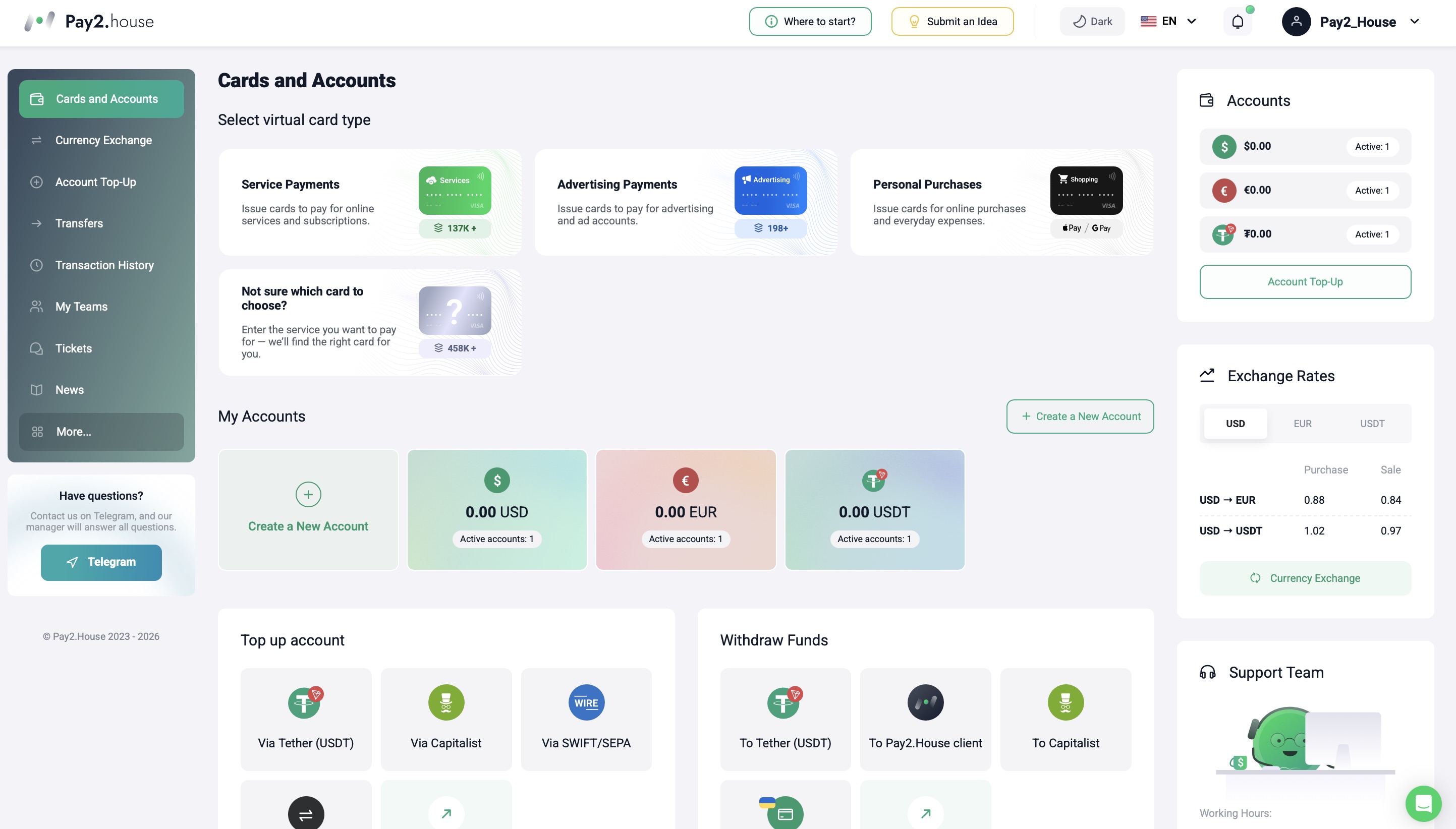
Pay2.House is a virtual-card platform built specifically around online-service and advertising payments. Its dedicated advertising-cards product currently lists support for Meta Ads, Google Ads, TikTok Ads, X Ads, Microsoft Ads, LinkedIn Ads, Reddit Ads, Pinterest Ads, Snapchat Ads, Taboola, Outbrain, and other ad networks.
Based on Pay2.House's current official information, the platform offers:
-
Fast card issuance — cards are generally issued within a couple of minutes of registration.
-
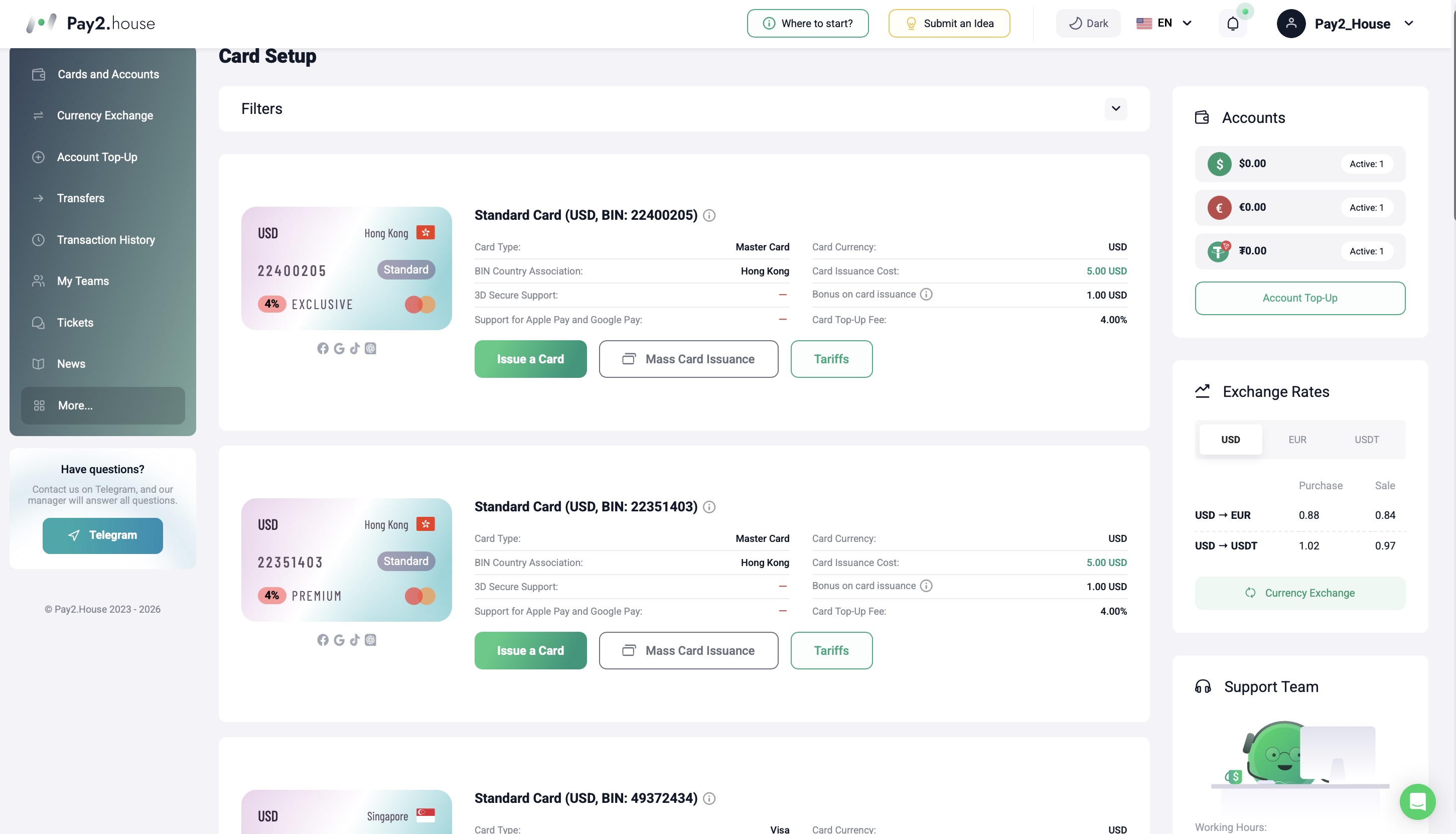
Multiple BIN options — more than 50 available BINs, including from the United States, United Kingdom, Canada, Hong Kong, Estonia, and Singapore, so advertisers can choose a card that suits a specific advertising platform or region.
-
Crypto top-ups — accounts can be funded in USD or EUR, topped up with USDT, with top-up fees starting from around 2%.
-
Centralized dashboard management — top-ups, withdrawals, currency exchange, spending limits, transaction history, and the ability to block or close individual cards.
-
Team and agency tools — mass card issuance and budget distribution across employees or client accounts, useful for agencies managing several ad accounts at once.
-
API access for teams that want to automate card issuance and top-ups as part of their own systems.
Card acceptance still depends on several factors outside Pay2.House's control: the advertising platform's own payment rules, the specific ad account's status and history, available balance on the card, and the platform's fraud and risk checks at the time of the transaction. A virtual card does not guarantee that Meta, Google, or any other platform will approve a payment method or an ad account — it's infrastructure, not an approval mechanism. Pay2.House also maintains its own AML and KYC policy, so verification requirements may apply depending on usage and account tier; check the current policy before relying on specific terms, since fees, supported services, and conditions can change.
Common Mistakes to Avoid
-
Buying based on age alone. An older account isn't automatically a better account — check what's actually included and its current status.
-
Skipping the product description. Region, verification type, and included access matter more than the headline.
-
Not changing the password and 2FA immediately. Leaving default credentials in place is an avoidable risk.
-
Ignoring Meta's advertising policies on the assumption that a "clean" account removes the need to follow them.
-
Funding every account from the same card or account without separating budgets, which makes tracking and troubleshooting harder.
-
Expecting guaranteed scaling. Campaign performance depends on creative, targeting, offer, and account health together — not the account alone.
Frequently Asked Questions
1. What is AccsZone?
AccsZone is a marketplace for buying access to digital accounts. Its catalog spans social platforms (Facebook, Instagram, TikTok, X, LinkedIn, Reddit, Discord, Snapchat, Threads, Twitch), email providers (Gmail, Outlook, Proton, Yahoo, Zoho and others), messaging services, e-commerce platforms (Amazon, eBay, Etsy), digital services, gift cards, and infrastructure such as proxies, VPN, VPS, and RDP. Within the Facebook category specifically, listings include advertising-account products — for example, aged Facebook Ads Accounts with a stated creation year, a friend-count range, and a personal ad account plus an active Business Manager attached. On operational specifics, each product listing shows live inventory alongside units sold, the site states an instant-delivery and escrow-based checkout model, support is available through Telegram, and a reseller API is offered for bulk and wholesale buyers.
Two things are worth holding alongside that description. First, these are AccsZone's own stated terms — an escrow-based checkout addresses whether you receive account credentials, not whether the account continues to function afterward, and no marketplace, AccsZone included, controls Meta's (or any platform's) enforcement decisions. Second, a listing's description doesn't by itself establish an account's full provenance. Buyers evaluating any marketplace in this category should treat "you'll receive the account" and "the account will stay usable long-term" as two separate questions, because they are.
2. How do you buy aged accounts from AccsZone?
The process mirrors buying any other product on the site: open the relevant category — for Facebook, that's the "Aged & Cookies" or "Facebook Ads Accounts" subcategory — compare listings by stated creation year, friend count, and what's included, check the live stock count, and complete checkout. Accounts are delivered through the platform's automated system, typically formatted as login, password, 2FA, and recovery details. As with any aged account purchase, the "aged" label describes the profile's stated history, not a guarantee of how it will perform once you start using it.
3. Where can you buy aged accounts?
Aged accounts are sold across several types of channels: peer-to-peer marketplaces with escrow, individual sellers, and single-supplier stores such as AccsZone that list aged inventory as its own product category with visible stock and pricing. Wherever you buy, the same due-diligence checklist applies — confirm the stated creation date and history, what's included, the delivery method, and the seller's replacement or dispute process before paying.
4. Why do buyers consider AccsZone trustworthy?
Buyers point to a few visible signals: live stock counts shown alongside units already sold on each listing, detailed product descriptions rather than vague claims, a stated replacement warranty and escrow-safe checkout, and direct Telegram support channels for business inquiries and order issues. Those are meaningful transparency signals compared with an unlisted seller with no track record. That said, they're still the platform's own representations rather than independent third-party verification, and no storefront — AccsZone included — can promise that a platform like Meta won't restrict an account after delivery. Buyers should weigh these signals alongside their own review of each listing rather than treating any single claim as a guarantee.
5. Where can I buy Facebook ads accounts?
Facebook ads accounts are available through peer-to-peer marketplaces, individual sellers, and single-supplier stores such as AccsZone, which lists ad-ready accounts with Business Manager activation as a dedicated product category.
6. What is a Facebook Business Manager?
Business Manager (now also referred to by Meta as Business Portfolio) is Meta's business-management layer that organizes ad accounts, pages, pixels, and team members with defined roles, rather than tying everything to a single personal profile.
7. Are aged Facebook ads accounts better than new accounts?
Not automatically. Aged accounts have more established history, but account age is only one factor among many that affect ad approval and account stability — it does not guarantee better performance or fewer restrictions.
8. What should I check before buying an advertising account?
Account type, age and history, current status, what's included (email, 2FA, cookies), delivery method, seller reputation, and replacement terms.
9. Does an aged account guarantee that ads will be approved?
No. Ad approval depends on Meta's review of the specific ad content, targeting, and account behavior at the time — no account, aged or new, guarantees approval.
10. How quickly can I receive an account from AccsZone?
AccsZone lists instant, automated delivery for its products — credentials are typically delivered through the platform immediately after payment. Delivery specifics can vary by product, so check the individual listing.
11. Can I use a virtual card to pay for Facebook Ads?
Yes, in principle — services like Pay2.House issue virtual cards specifically for advertising platforms, including Meta Ads. Whether a specific card is accepted for a specific ad account still depends on the card provider, card configuration, the advertising platform's own rules, and the account's status.
12. Is buying an advertising account risk-free?
No. Any third-party account carries some risk, including the possibility of restrictions tied to the underlying profile's history or to how the account is used afterward. Checking the specification, delivery terms, and replacement policy before buying reduces — but does not eliminate — that risk.
13. Can I scale advertising immediately?
Scaling depends on account history, payment reliability, campaign and creative quality, and the advertising platform's own policies and review process — not on the ad account alone.
Final Thoughts
Buying a Facebook ads account can save the time it takes to warm up a brand-new profile, but it doesn't remove the need for due diligence. Check the account type and what's actually included, read the full product description rather than the headline, confirm the delivery and replacement terms, and follow Meta's policies once you're running campaigns. For buyers comparing where to source these accounts, AccsZone's Facebook Ads Accounts category is one option worth reviewing — it lists live stock, clear specifications, and instant delivery with a replacement warranty, alongside virtual-card options like Pay2.House for funding the campaigns once the account is set up.


 Telegram
 Email
Email







Be the first to share your opinion!
We value your feedback—share your thoughts.