


A practical guide to choosing proxies for media buying, configuring IP and browser environment, proxy rotation, and controlling advertising spend.
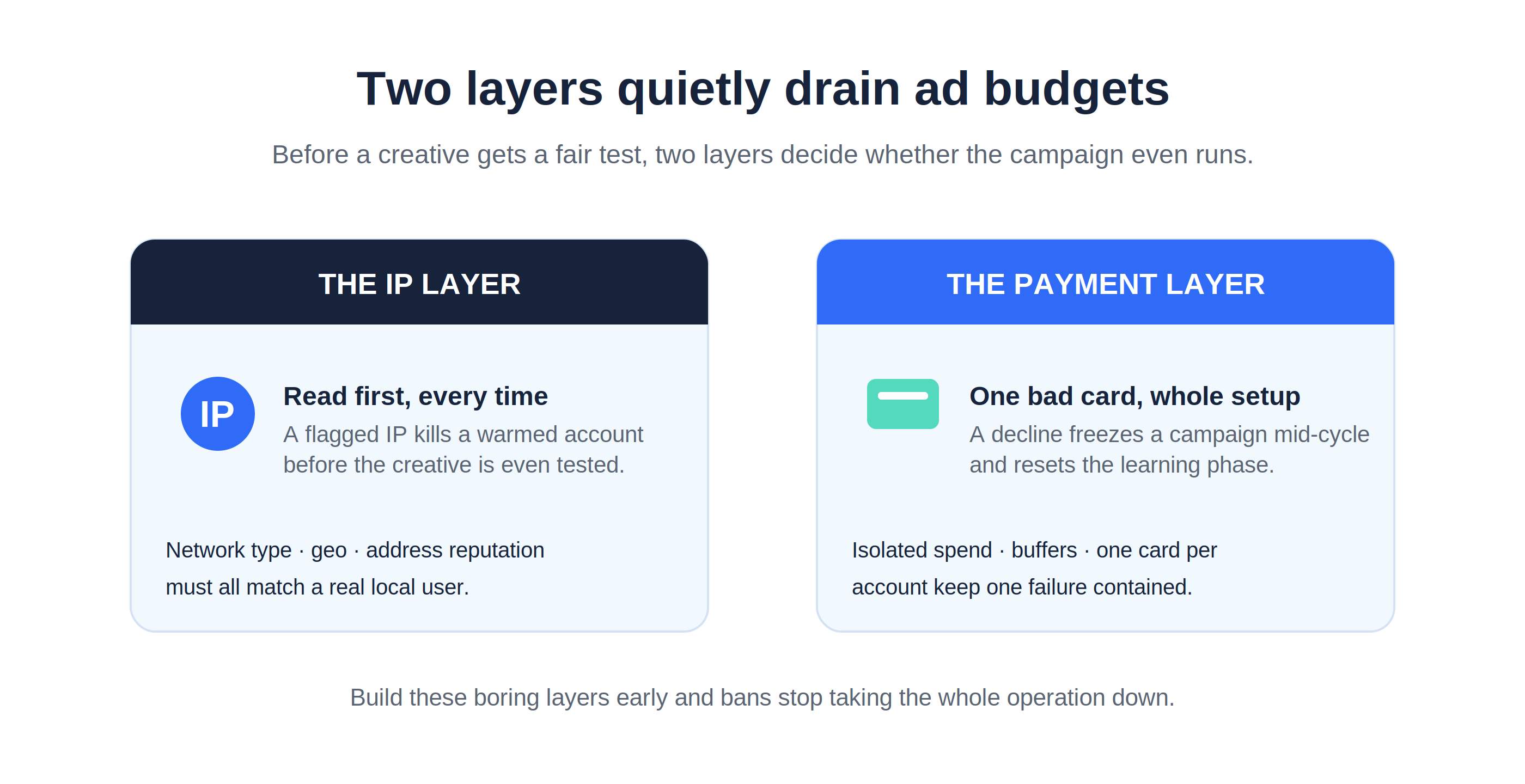
Most media buyers focus on creatives, targeting, and bids, but often underestimate the network environment and payments. IP issues can trigger additional checks, and a declined payment can stop an ad campaign.
In this article, we'll cover which proxies are suitable for media buying, the differences between residential, mobile, and datacenter proxies, how to configure rotation, and how to organize payments for stable ad account operation.
Why ad accounts may face checks before the creative launches
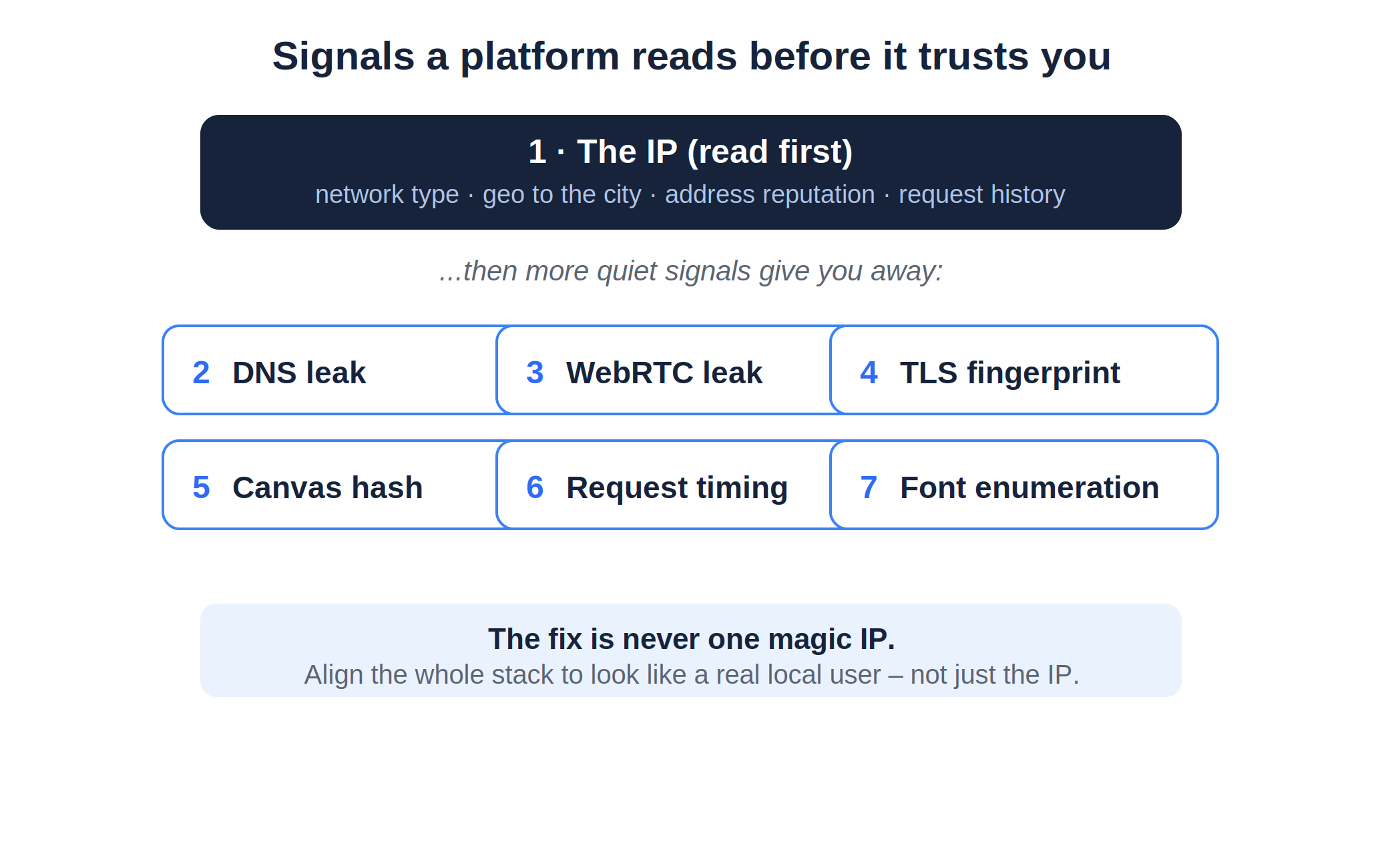
When a user logs into Facebook, Google, or TikTok, the IP address can be one of the signals the system uses to evaluate the session and network environment.
Depending on the platform and workflow scenario, the following may be considered:
- network type – home connection, mobile carrier, or data center;
- approximate IP geolocation;
- IP reputation;
- characteristics of the current session;
- consistency of different connection parameters.
If these parameters contradict each other, they can become an additional signal for review. However, IP is far from the only factor.
In the browser environment, the following may also matter:
- DNS and WebRTC, which in some configurations may reveal additional network information;
- TLS connection characteristics;
- browser fingerprint parameters, including canvas and other browser features;
- language and locale;
- timezone;
- device characteristics and user behavior.
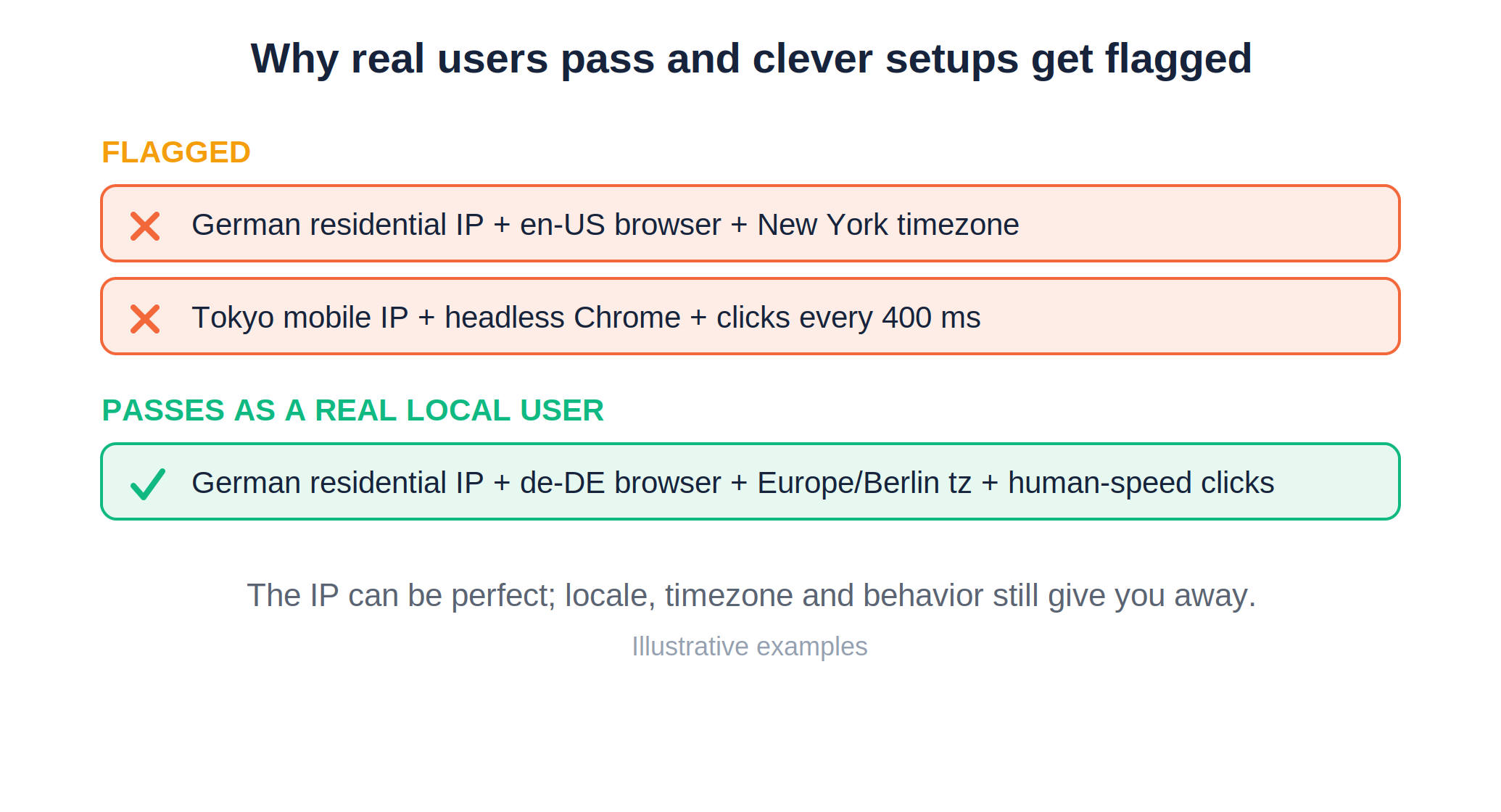
For example, a German residential IP combined with an American locale and New York timezone looks less consistent than an environment where these parameters match each other.
This does not mean an automatic ban. However, such mismatches can become an additional reason for review.
Therefore, the goal of proxies for media buying is not to find one "magic" IP, but to ensure consistency between the network and browser environment for a specific workflow scenario.
How to choose proxies for media buying
Choose the proxy type not by the principle of "which is the most reliable," but based on the specific task.
For media buying, ad verification, SEO, SERP analysis, and working with geo-dependent content, three main types are most commonly used:
- residential proxies;
- mobile proxies;
- datacenter proxies.
Dexodata provides all three proxy types and operates on a pay-as-you-go model. The service's current page lists IPs from 100+ countries, 99.9% uptime, and the ability to start with a top-up from $1. The service also states that IPs are obtained with user consent and the network operates with KYC/AML procedures.
| Proxy type | IP source | Suitable for which tasks |
|---|---|---|
| Residential | IPs from home internet connections | Ad verification, geolocation, localization, and websites |
| Mobile 4G/5G | Mobile carrier networks | Mobile ad verification, SEO, and tasks where mobile IP matters |
| Datacenter | Servers and data centers | Automation, infrastructure testing, and high-volume requests |
The main rule is simple: there is no single best proxy type for all tasks. Residential, mobile, and datacenter proxies solve different problems, so choose based on what exactly you're going to do.
Rotation also matters. For long sessions, too frequent IP changes can disrupt connection stability. For short requests and high volumes, more frequent rotation may be needed.
Five proxy mistakes that burn budget
1. Connecting proxies at the last moment
If the account and browser environment are already configured and then the IP or geolocation changes abruptly, additional inconsistencies appear.
It's better to choose the proxy type and GEO before starting work.
2. Choosing proxies based only on price per GB
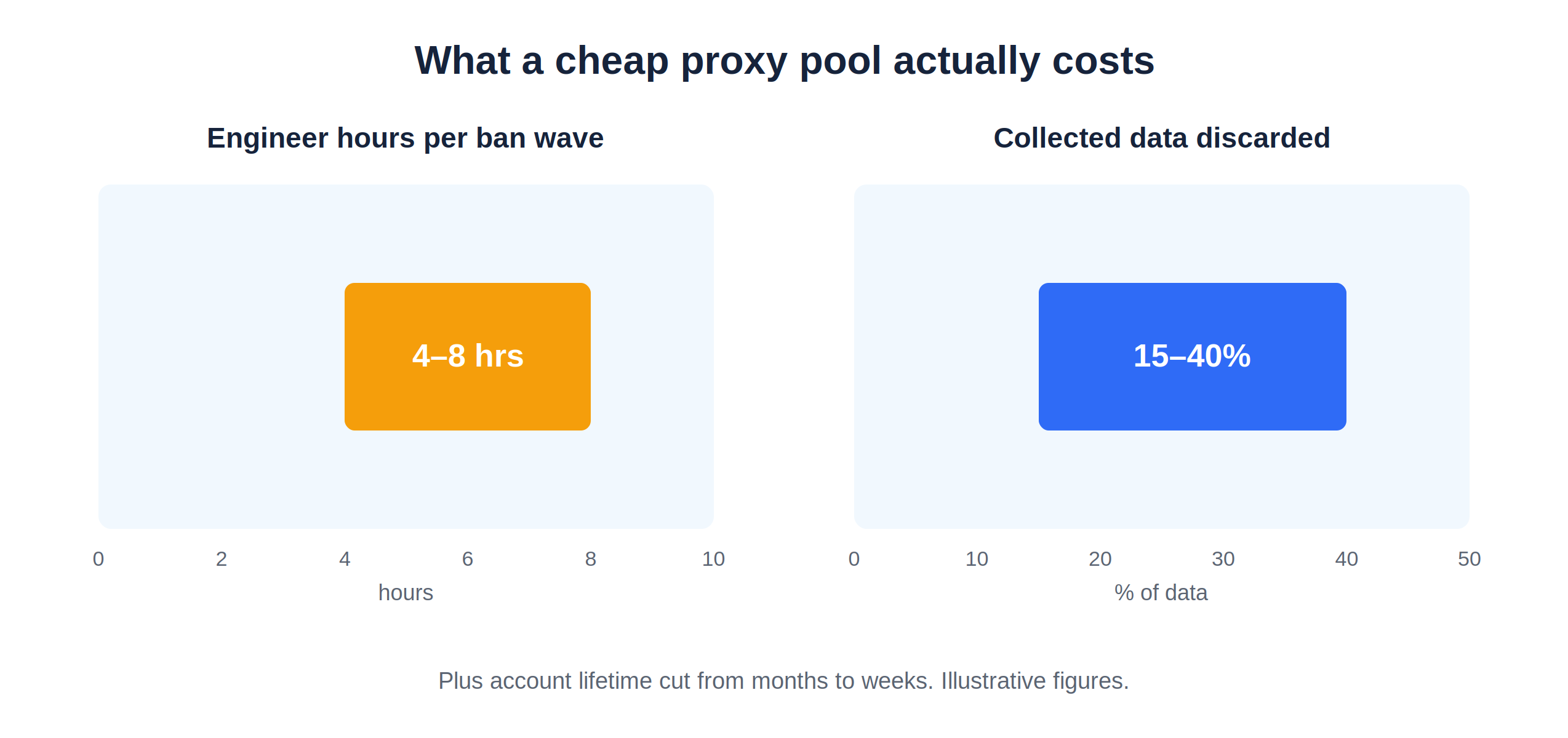
Low price alone doesn't mean the proxy is more cost-effective.
When choosing, look not only at traffic cost but also at:
- IP pool quality;
- available countries and cities;
- connection stability;
- rotation capabilities;
- limits;
- support for required protocols;
- terms of use.
Sometimes a more expensive but stable pool turns out to be more profitable than a cheap option that has to be changed constantly.
3. Using the wrong proxy type
Residential proxies, mobile proxies, and datacenter proxies differ not only in price.
If the task requires a home IP, using a datacenter network may give a completely different result. Conversely, overpaying for residential traffic for routine infrastructure testing doesn't always make sense.
4. Not planning rotation
Too frequent IP changes can interfere with long sessions. Too infrequent rotation puts too much load on a single IP address.
Therefore, rotation should be chosen for the specific task, not just by enabling the most frequent IP changes.
5. Considering IP as the only factor
Proxies are only part of the network environment.
Locale, language, timezone, browser parameters, and user behavior can also matter. Therefore, it's better to think not only about a "clean IP" but about a consistent working environment.
The payment layer: where billing quietly stops campaigns
Even a well-configured ad account can face problems if the payment fails.
A declined transaction can stop ad delivery, and several repeated failed attempts in a row create additional complications when searching for the cause.
Decline reasons can vary – insufficient funds, issuer restrictions, payment profile specifics, data errors, or requirements from the ad platform itself.
Therefore, the payment part should be considered a separate element of media buying infrastructure, not a detail that can be configured at the last moment.
How to separate payments when scaling
When multiple ad accounts are running simultaneously, it's more convenient to separate expenses to control budgets more easily and identify the source of payment issues.
You can use separate virtual cards for this. For example, Pay2.House allows you to issue cards for ad platforms and manage them from a single dashboard. A separate card can be assigned to a specific ad account or project to avoid mixing expenses.
This approach simplifies financial control and helps localize problems faster if they occur.
One stack – fewer unexpected problems
Successful media buying depends not only on creatives, bids, and targeting. The network environment and payments also need to be planned in advance.
The right proxy for media buying helps control the network side of work: GEO, IP type, and connection stability. Residential proxies are suitable for tasks where home geolocation matters, mobile proxies for scenarios with mobile networks, and datacenter proxies for automation and infrastructure tasks.
If you need to test different proxy types without a long-term subscription, Dexodata offers residential, mobile, and datacenter proxies on a pay-as-you-go model. The service supports 100+ countries and allows you to start with a small balance.
For the payment side, Pay2.House can be used to issue separate virtual cards to separate expenses between ad accounts.
The main idea is simple: proxies control the network environment, and a separate card controls the payment flow. The earlier these two levels are planned, the fewer unexpected problems during launch.
Frequently asked questions
Which proxy type is best for media buying and ad verification?
There is no single universal option.
Residential proxies are suitable for tasks where home connection IPs and geolocation matter. Mobile proxies 4G/5G use mobile carrier IPs and are suitable for mobile advertising, SEO, and other tasks where the mobile network environment is important. Datacenter proxies are more often used for automation, monitoring, and high-volume requests.
Therefore, choose not the "most reliable proxy" but the network type that matches the specific task.
Why can an ad account face checks even with a good IP?
Because IP is only one of the possible factors.
The platform may consider geolocation, session characteristics, language, locale, timezone, browser parameters, and other signals.
Therefore, a residential proxy with an IP from the right country doesn't guarantee the absence of checks. It's important that other working environment parameters don't create obvious contradictions.
How often should proxies be changed?
It depends on the task.
For long sessions, too frequent rotation can be inconvenient because the IP changes during a single work session. For short requests, automation, and high volumes, more frequent IP changes may be used.
Orient yourself by the scenario: session work – stable IP, large number of short requests – more frequent rotation.
Do cheap proxies really end up costing more?
Sometimes – yes.
Price per gigabyte matters, but it's not the only indicator. Also consider IP pool quality, stability, geography, rotation, and technical support.
If cheap IPs have to be changed frequently or work unstably with the required sites, the final cost of the solution may turn out to be higher.
How to choose between residential and mobile proxies?
Start with what network you want to simulate.
If a home internet connection IP and geolocation matter, choose residential proxies. If you need a mobile carrier IP and the scenario is related to mobile networks, look toward mobile proxies.
For automation, testing, and high-volume requests, datacenter proxies are more often suitable.
How do virtual cards help avoid stopping ad campaigns?
The main advantage is expense isolation.
If each ad account uses a separate card, it's easier to track payments and understand where the problem occurred. This doesn't guarantee the absence of declines, but it helps avoid mixing expenses from multiple projects.



 Telegram
 Email
Email









Be the first to share your opinion!
We value your feedback — share your thoughts.